With today’s reveal that Corvette Racing by Pratt Miller Motorsports is set to compete in IMSA’s GTD Pro class in 2024, it feels like the end of a 25-year chapter for Corvette in GT racing and the start of a brave new one.
The GT racing landscape has evolved constantly throughout the past two decades and one of the few constants has been Corvette Racing’s desire to compete as a factory in both the USA and at Le Mans. However, the end of GTE racing at the conclusion of this FIA WEC season and a seemingly global pivot by the major championships to focus more on GT3 customer racing, the decision to set up a customer racing in GT3 with the Z06 GT3.R has led to what will be a radical new look for Corvette in motorsport going forward.
The Z06 GT3.R programme, under the management of Christie Bagne, will see Corvettes racing around the world, in more places and with more customers than ever before. While not entirely off the table for the future, factory racing is no longer the main priority.
For this transition, Corvette Racing has shifted into an umbrella role, with oversight from Chevrolet Motorsports Engineering. Pratt Miller meanwhile, will continue to be a key part of the family, manufacturing the GT3 chassis and competing domestically.

While Pratt Miller has been integral to the car’s development, testing and construction, the engine is being produced in-house at GM.
The Z06 GT3.R is powered by a 5.5-litre V8 motor that is being developed at the GM Propulsion Performance and Racing Center in Pontiac, Michigan.
The LT6 engine for the Z06 GT3.R originates from the Performance Build Center in Bowling Green, the same line on which all production Corvette Z06 engines are built. At the Performance and Racing Center, they are fitted with race-specific components. An impressive 70 per cent of the race engine’s parts are shared with the production powerplant.
Going forward though, Pratt Miller, despite carrying the Corvette Racing name, will not compete as a full-fat factory team. Instead, it will have a level of independence, enabling it to explore its own commercial opportunities.
We have a phenomenal fanbase that supports us to the end and we want to make sure that going forward they get ‘the show’ they expect when they see Corvettes Racing
Some say that sections of Corvette Racing’s legion of fans may see this change as a reason to be downbeat about the future. But in the organisation, the excitement levels are growing rapidly ahead of the 2024 season. And there’s certainty within that the fanbase will follow.
“It’s super exciting!” GM sports car racing programme manager Laura Wontrop Klauser told DSC. “We have a phenomenal fanbase that supports us to the end and we want to make sure that going forward they get ‘the show’ they expect when they see Corvettes racing. The difference now is we will be offering them many more shows!”
The GT3 customer market is already huge around the world, some would say saturated, with 13 makes currently involved. GM knows that joining the party this late, with so many major OEMs running long-established programmes with loyal customers, will be a colossal task.
However, there is a clear drive to remain realistic, especially early on, and sell cars off the back of Corvette’s long-standing reputation for excellence on the race track.

In year one, eight Z06 GT3.Rs will be released for competition. Four will run in IMSA, two will race in the FIA WEC and a further pair will be seen in SRO America. Targeting three major series off the bat is part of a wider strategy, which will lead to a larger customer presence from 2025 onwards.
“Our rollout has been limited by the build schedule,” Wontrop Klauser explained to DSC, “which is limited by when the car is homologated. You don’t want to build too many before you’re set, on the off-chance you need to make a change. It’s a delicate balance.”
In recent months Corvette has been hard at work building up a customer support team and plan. It knows the key to building its customer base, especially when starting from zero, is its ability to provide world-class customer service.
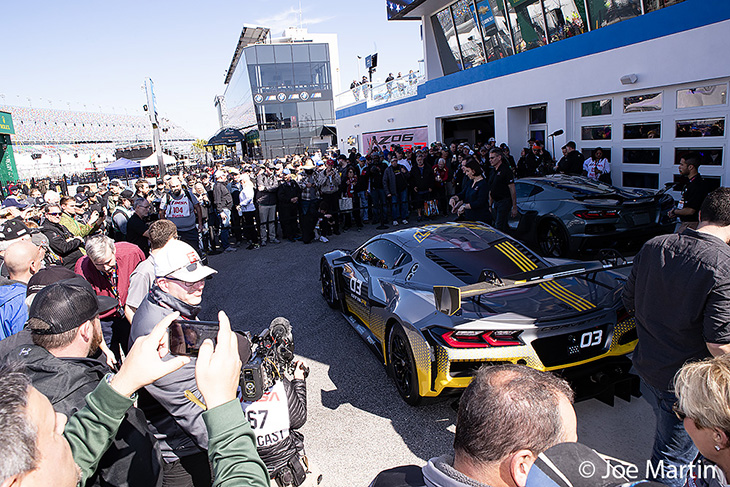
“We do not want a customer to take delivery of one of these cars and not feel like they have the backing to be successful,” Wontrop Klauser continued. “It’s easier to set up in North America, where we are based and where the cars are being built. It’s one landmass that we can quickly move around in.
“For the WEC we are going to have a bespoke level of parts distribution support for 2024 that we are working with our (unnamed) team on. To do a proper job in Europe we want to make sure we have a set-up that will likely include some type of headquarters that we can run parts in and out of.”
The location and size of the planned European headquarters have not yet been decided. It is a crucial part of this programme, though, as it will boost Corvette’s customer support capabilities outside of North America. It will be easier and more cost-efficient to supply parts to teams. Supporting its teams on-event in Europe will be easier from a logistical standpoint too.
This newfound commitment says a lot about Corvette’s long-term vision and goals in Europe, both in the racing sphere and production realm. While no announcements are expected in the short term, there is a desire to get the Z06 GT3.R to compete in as many major European championships and events as logically and logistically feasible.
To do a proper job in Europe we want to make sure we have a set-up that will likely include some type of headquarters that we can run parts in and out of.
Corvette has been doing its homework. It sent a delegation on a fact-finding mission to the Nürburgring 24 Hours back in May and will be present at the Spa 24 Hours next weekend too.
“It’s not that we’ve committed to any of those races yet, but we are learning about them,” Bagne told DSC. “We are learning about the specific regulations, how those teams operate and what type of customer support is needed to be successful.
“All of that will factor into the decisions we make regarding where we will expand beyond those first 8-12 deliveries for IMSA, WEC and SRO North America.”
So, how quickly will Corvette’s customer base grow? The expectation as it stands is “pretty fast”. The level of interest for the Z06 GT3.R has been described to DSC as “enormous” since the car launched back in January at the Rolex 24 Hours.
The list of teams hoping to run the car is so large in fact, that it prompted Bagne to create a scoring system to help select teams, a new criteria based on a detailed in-house analysis of each aspirant outfit.

“All our potential customer teams bring different strengths to the table,” said Bagne, “and different opportunities for the programme. I created a weighted scoring system that includes things like heritage, results, brand representation, and collaborative culture – which was a big one.
“We need teams that will work with us and collaborate with us as we launch the programme. Every team got a score in this system to try and make it objective.
“If I came to a point where a team scored lower and I thought they should be higher than another team, it meant I needed to understand what was broken in the system and what I was missing. That created a lot of thoughtful discussions that helped us decide who would get these race cars.”
Beyond the initial batch of eight cars and a small number of additional chassis that are being built up as test cars and spares for the big races, Wontrop Klauser told DSC that the number will grow to 20 “soon”.
“In the first two years, 20 need to be built, (by regulation),” Bagne added. “We will have no problem achieving that. We will do that between the end of 2023 and the beginning of 2025.”
What was stressed to DSC though, is that Corvette Racing wants to avoid growing too fast.“Culture and collaboration are huge,” Wontrop Klauser pointed out. “Everyone that works or races with us should feel that they can pick up the phone at any time for help or advice or support.
We’re not trying to build crazy high volumes of GT cars and say ‘Good luck, we will see you again when you want a new car!’
“We’re not trying to build crazy high volumes of GT cars and say ‘Good luck, we will see you again when you want a new car!’”
This is in part because resources, clearly, are finite. Along with the number of cars, the stock of spares and the factory driver roster will need to grow too.
“We don’t want to have a couple of ‘fender benders’ at the Rolex 24 and find out we don’t have enough parts to run,” Wontrop Klauser chuckled. “So we have to hold ourselves accountable for spares.”
When it comes to drivers, no number is being put on the size of Corvette’s factory pool in the coming years. Instead, Corvette feels it has “room to grow, along with the number of teams”.
The toughest part might be keeping it to a rational number, as there is no shortage of talent keen to get involved. A smorgasbord of drivers, fully aware of the loyalty that Corvette Racing has shown in the past, have been throwing their names in the hat on a weekly basis.

“It feels like I now have contact details for every driver on the face of the earth!” Wontrop Klauser quipped.
There is clearly so much more to come later down the line. The most important element at this stage is ensuring the development programme for the car has been successful ahead of the car’s global race debut.
Testing started last September. Utilising GM’s Milford Proving Ground track in Michigan, 20 minutes from Pratt Miller’s facility, made the rollout of chassis #1 a simple task ahead of the extensive test schedule for the car that included visits to Mid Ohio, Road Atlanta and Sebring in 2022, before runs in Daytona and Sebring earlier this year.

During its development running, which is coming to a close in Europe over the summer ahead of homologation, the Z06 GT3.R has completed nearly 9,000 kilometres. Tests with Goodyear and Pirelli tyres are also planned in the coming months, ahead of Corvette’s 2024 customer programmes in the FIA WEC and in SRO competition.
“We’re at the fine-tuning point,” Bagne said. “We have made it through the process of analysing different aero platforms using in-house 3D printing facilities. We were able to rapidly print out our aero parts with different concepts and make final evaluations. That’s what we did last year, along with damper evaluation.
“It’s been developed to work with a range of drivers in a range of operating windows in different environments. It’s all in place now, so when customer cars hit the track they will be in great shape.

“It’s always hard to close a chapter,” she continued. “What we have now is very special to us. But a lot of elements are carrying forward. It’s a lot of the same people who have learned so much and are carrying knowledge to the constructor programme.
“There’s a bit of sadness because the GTE car is awesome. It’s a proper driver’s car, a classic GT. But there are so many chances to take what we’ve learned, the culture we have developed and carry that forward into the GT3 programme.”
“It’s exciting to expand the reach of Corvette Racing and give people who could never race a Corvette the opportunity,” concluded Wontrop Klauser.