Held with the build-up to the 2023 Spa 24 Hours as its backdrop, the SRO’s Annual Press conference today proved to be a significant gathering for Stephane Ratel to give key industry stakeholders a window into his vision for the future of GT racing around the world.
The atmosphere trackside amongst the teams here at Spa has been peculiar. Look around, and there are GT3 teams and manufacturers throwing more resources into the platform than ever before. The paddock is packed tight, the structures behind the garages have never been so high and the competition on track has never been this intense.
Yet it feels like GT3 racing is reaching a critical point. With inflation impacting the cost of racing across the board, there is now genuine concern in paddocks around the world that the level of interest can be sustained in the coming years, let alone grow.

“It feels like this form of racing will be gone in five years right now,” a senior manufacturer representative said in a conversation with DSC before Qualifying here at Spa.
Look no further than the cost of the newest models, which are eye-opening and eye-watering, with the pricing understood to be set at 700 thousand Euros plus for more than one of the new breed of cars.
So what does the future hold? Naturally, the SRO, and particularly Stephane Ratel, is quietly planning for the future. And the solution may lie in the maturing GT2 ruleset, which has just been boosted by the public reveal of Maserati’s MC20 in Belgium and is set to be bolstered in the near future by another manufacturer that has not yet been named.
“We have many cars now, but we need many cars running, that’s the next step. The grid is slim but I have no doubt it will grow rapidly,” Ratel told DSC at the MC20 GT2 launch. “The car is eligible for every round of Intercontinental GT, European, America and Asia. We have a platform globally, already this year.
“I think the transition will come naturally, we will introduce GT2 at Spa (for the 24) when we have enough cars for a real class, about six to eight. People need to order them, manufacturers need to deliver them and people need to run them. I see more towards 2025 that we will see quite a significant number of them.
“The price is right. GT3 is getting very expensive. We need a class that is cost-effective, fast and impressive and this is the right category.
“I would be very worried if I didn’t have GT2. Now that I have GT2 I sleep very well,” he joked.
Now that I have GT2 I sleep very well
We have been here before, of course. GT3 racing has successfully navigated choppy waters where its future has been questioned amid financial, political and global health woes in years past.
The reality is that right now, with IMSA’s GTD grids as healthy as SRO’s existing platforms, DTM becoming an established home for the class and the wider introduction of LMGT3 to ACO’s sphere on the horizon, there are more places to race a GT3 car than ever before.
We are in a world where there are lengthy waiting lists at Ferrari for the 296 and at Ford for the upcoming Mustang GT3. There is real demand too, (exceeding the current plans for roll-out supply) for Corvette’s new Z06 GT3.R. Many manufacturers can’t build cars quickly enough.
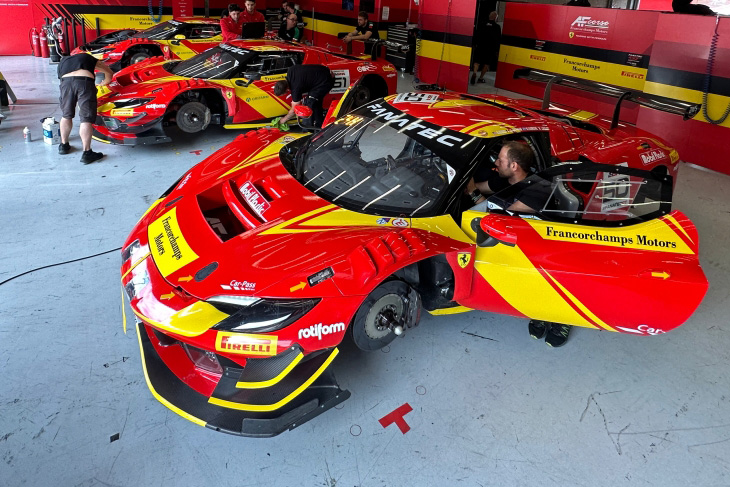
So for the time being at least, it would be foolish to come to the conclusion that it’s going anywhere. Instead, GT3 as a proposition for the future remains one to keep an eye on, as it edges closer and closer to becoming similar to the outgoing GTE category in terms of expense.
The ultimate question, which will be answered in time, is: how much higher will costs rise before a tipping point is reached and teams become unable to justify continuing en masse?
Looking further afield, the structure of SRO’s global platforms is evolving too.
The headline from the conference was clearly the addition of the Nürbugring 24 Hours to the new-look, four-round (for now) Intercontinental GT Challenge in 2024. It’s a natural fit, but hosting half of the globetrotting series in Europe is a diversion from the IGTC’s initial goals and evidence of how tough the task of creating marquee events in certain parts of the world has been.
Clearly, COVID has had a huge impact on ambition and Ratel admitted that it’s been tricky to create stability, growth and enthusiasm for the IGTC since 2020, when there were nine manufacturers signed up for a more diverse calendar. He even eluded to the fact that its very existence was up for debate internally when the pandemic had its stranglehold on international events and travel.

Going forward, a return to Suzuka Ratel says, “would be the dream”, and it’s a dream shared by at least one of the major manufacturers involved.
Kyalami too is a circuit which he still believes can be tapped into. Meanwhile, work needs to be done with the race at Indianapolis to create more of a buzz and a decision needs to be taken for the potential fifth round after further consultation with the paddock.
Where would that fifth race be? Ratel won’t be drawn into specifics at this stage, though he did confirm to the media pack that it would be held on a different continent.
“We will ask the manufacturers and find out who is interested. We will ask if they are happy with four events or if they want one more, and if so which would be their favourite,” he said.
“We need to know who is playing and how many cars.”
So what about the Nürburgring 24 Hours? This surprise addition to the calendar has come together quickly. Interestingly, the idea was originally proposed by Andreas Roos from BMW Motorsport.
“We were at Kyalami (this year) and both depressed. ‘If you want the IGTC’, he said, ‘talk to the Nürburgring’,” said Ratel.
“It’s a very German affair. Then,” he continued, “like a present from the sky, Ferrari wins it. Suddenly what was a German race, became like us (SRO), others could win it.

“That triggered it. I contacted them and came to an agreement.”
Some of the finer, but nevertheless important details are already ironed out. Essentially, the race will run as normal in 2024. It will be the multi-class GT and touring car spectacle with a field of over 100 cars that we are used to.
From a GT3 point of view, the IGTC’s presence is expected to boost numbers, (though there is no target from the event organiser’s side), it will be open tyre (not exclusive to Pirelli like the other IGTC races) and the BoP will be set and managed in its current manner.
There is one caveat though. Any team or driver wishing to compete in every race on the IGTC schedule will almost certainly need to factor in the need for a ‘Ring permit to race, meaning additional meetings at the ‘Ring will need to be added to the commitment for any event newcomers.
Manufacturers that don’t frequent the ‘Ring will likely need a wider commitment too. Currently, regulations state that in order to compete in SP9, OEMs need to commit cars to at least two NLS races plus the qualifying race in order to get entries for the N24.
This feels on the face of it to be the most positive and successful announcement from the morning, though it comes at a time when the future of the racing on the Nordschleife that surrounds the N24 has never been more unclear.
Next year the current organisers of the NLS have been granted no event slots on the circuit for 2023, amid a row between multiple factions that has resulted in the formation of a new Nürburgring Endurance Series that hasn’t yet got a defined shape or structure.
(This is a story that has been tracked in detail by Bianca Leppert of Auto Motor und Sport)
DSC spoke with a key team manager that takes part at the top end of the NLS prior to today’s SRO conference, who expressed, among other things, real concern over grid sizes going forward. “Nobody can plan, and the numbers have been decreasing in NLS anyway. They need 130 cars to break even and they are struggling to reach those numbers,” they said.

“There are big problems now because the owner of the Nürburgring isn’t working with the NLS,” explained Walter Hornung of ADAC Nordrhein to DSC moments after the reveal. “They want to make their own organisation with the AvD, but most of the teams and spectators don’t like it.
“It’s a political thing, but now it’s too early. Maybe the next months will bring results? There are a lot of meetings to find a good solution.”
However, in amongst the flurry of global calendars released today, perhaps the most controversial and intriguing move is the decision to place the final GT World Challenge Endurance Cup race on the streets of Jeddah in Saudi Arabia.
Looking beyond the obvious question mark that Saudi Arabia, last time DSC checked, isn’t in Europe, its inclusion raises a multitude of queries.
The task of making it both logistically and financially viable, it seems, is a problem already solved. A financial package has been delivered by the Kingdom that will ensure the teams will not need to spend big to take their cars, equipment and team members outside of Europe for the race.
“If it cost more money to the teams, it would have been a problem,” Ratel told the media after the conference, before confirming that it will, in fact, work out cheaper for the teams. “We will give them a lot of subsidies, the teams don’t know it yet but they will be happy.
We will give them a lot of subsidies, the teams don’t know it yet but they will be happy
“It’s a very good deal. And the fact we go there (with team trucks) on a boat, in and out, without needing to pack containers, that’s the beauty. It will be a full paddock like in Europe and we will have GT4 as well.”
There appears to be another benefit too. Two manufacturer representatives have told DSC that the logistics package seems to be flexible enough to allow manufacturer support and teams to remain in the Gulf region to also take in the Dubai 24 Hours and the Asian Le Mans Series weekends at Dubai and Yas Marina.
There is an elephant in the room though, and that is the location itself. Without delving too deep, sideline commentary about ‘sports washing’ is already appearing in the wake of the news, as there is when any major sporting events are planned, announced and held in that part of the world.
Closer to home, there is surely the potential for further pushback from teams and drivers uncomfortable with cultural differences in Saudi Arabia too, in addition to the debate on placing the season finale for a European series in the Middle East.
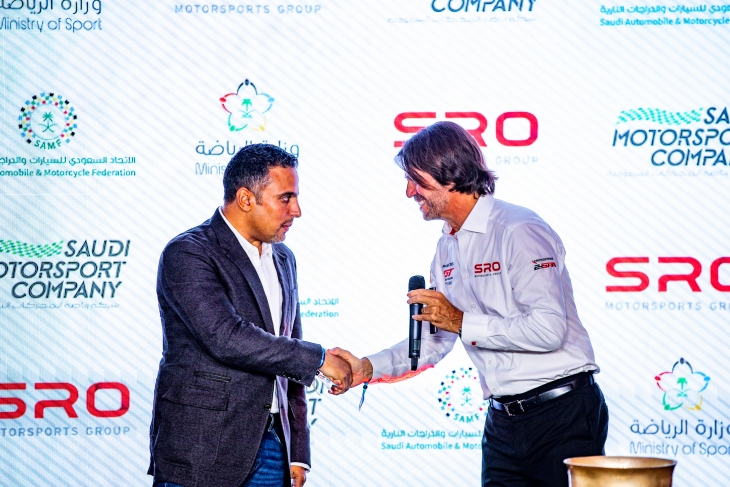
DSC raised this concern to Stephane Ratel. “Now all of motorsport is going to Saudi, and the country is going in the right direction,” he said in response. “We will see if there are reservations. But the decision has been taken to go, and we are going.”
HRH Prince Khalid Bin Sultan Al Faisal Al Saud also spoke of the ambition of this event and its future. He was bullish, to say the least.
“Saudi is a very welcoming country,” he said on stage. “Hopefully we can have teams from Saudi in the future. Bringing the best GT racing series to the Kingdom will inspire people.
“This is just the beginning of GT racing in Saudi.”
Image credits: SRO, Mercedes, Frozenspeed, Andrew Hall, Falken