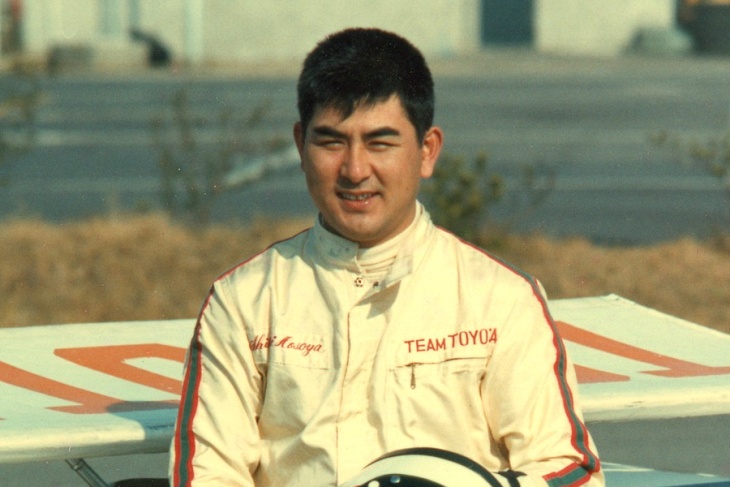
One of the most prolific and successful Japanese racing drivers of the 1960s, Shihomi Hosoya passed away on Monday, 22 January. He was 85 years old.
Hosoya was the Captain and lead driver of Team Toyota, the automaker’s first full-factory racing programme and the predecessor to Toyota Gazoo Racing as it is known today. He was one of the first great Japanese drivers of the 1960s and a man who shaped the automotive industry at large through his work developing the Toyota 2000GT.
Born 8 March 1938 in Onomichi, Hiroshima Prefecture, Hosoya’s father was a police officer who perished in the atomic bombing of Hiroshima in 1945. He, along with his mother and four siblings, lived outside the city but were spared in the blast. They would return to Onomichi soon after where the family ran a small inn.
He developed a love for cars as a child. While in high school, he got a part-time job maintaining cars for a local driving school. Eventually, he’d become one of its driving instructors.
Hosoya wanted to take part in the inaugural Japanese Grand Prix, which would be held at the brand-new Suzuka Circuit in 1963 – but couldn’t afford the costs to enter on his own. Setsuo Okamoto, a long-time friend of his from his youth, was scheduled to race but decided at the last minute to drop out of the event for his safety. Okamoto offered Hosoya his spot in the race – and he accepted his golden ticket into motorsport.
Driving a borrowed Toyota Publica 700 with whitewall tyres, and having only driven one lap around the circuit in the pre-race trials, Hosoya rapidly gained pace and confidence throughout practice and qualifying. In the C-II touring car race, he finished in third place.
Hosoya’s natural driving ability caught the attention of the Toyota Motor Company, and in 1964, he signed an exclusive contract to become one of the manufacturer’s first professional drivers, and joined the engineering department at Toyota.
In his Monday-to-Friday life at the Toyota offices, Hosoya studied and trained himself in the ways of in-depth automotive knowledge. His most famous contribution was his work developing the storied Toyota 2000GT.
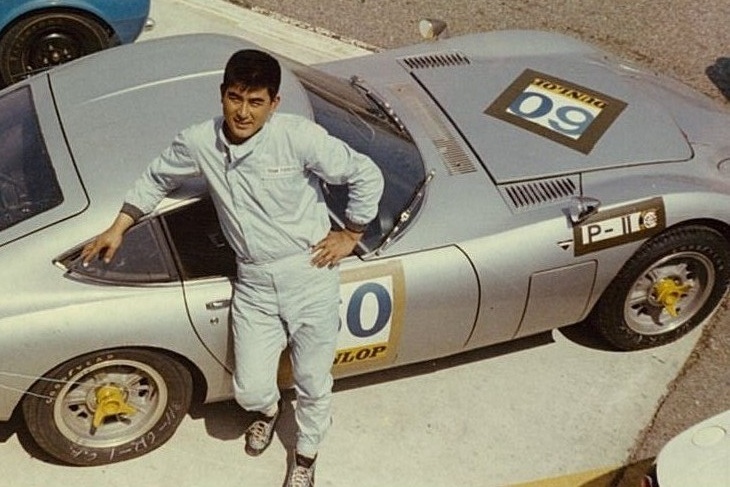
From the infancy of the project and the collaboration between Toyota and Yamaha, Hosoya was a key contributor, both as the 2000GT’s lead test driver and as a body line designer.
On the track, Hosoya applied those skills in setting up his cars for races, and combined with his driving skills, he built a sterling reputation. He’d finish second in the 1964 Japanese Grand Prix T-II touring car race driving another Publica, and in 1965, he’d get his first win at Suzuka in a Toyota Corona 1600. He then won the inaugural Suzuka 300km and 500km endurance races driving the nimble Toyota Sports 800.
It was only appropriate that when Team Toyota was formed in 1966, Hosoya was selected and named the Captain of Team Toyota, due to his supreme driving talent and engineering background.

His and the Toyota 2000GT’s legacies would be interwoven on the track. Hosoya drove the 2000GT’s racing prototype, known internally as the 311S, to a third-place finish in the 1966 Japanese Grand Prix at Fuji Speedway. After the 2000GT hit showrooms in 1967, Hosoya and his co-driver Yoshio Otsubo drove it to victories in the inaugural Fuji 24 Hour and Fuji 1000 Kilometre races that year.

In between, Hosoya anchored the lineup of five drivers – himself, Mitsuo Tamura, Tomohiko Tsutsumi, Sachio Fukuzawa, and Hiroshi Fushida – that broke 16 FIA speed and distance records during the 78-hour Toyota 2000GT Speed Trial at the Yatabe High-Speed Test Track in October 1966.
After the success of the 2000GT, Hosoya would be entrusted to drive and develop Toyota and Yamaha’s first line of pure-bred racing prototypes, collectively known as the Toyota 7. This project would spark Toyota’s ambitions to compete in international motorsport, namely the 24 Hours of Le Mans and Can-Am series.
The scope and scale of the Toyota 7 project evolved rapidly, yielding the three-litre 415S, the overhauled five-litre 474S, and the mighty turbocharged five-litre 578A, with Hosoya’s fingerprints on all of these iterations.
Hosoya won the ’68 Suzuka 12 Hour race in the 415S, and finished fifth in the ’69 Japanese Grand Prix aboard the 474S. In these cars he also raced against some of the finest talents from the Can-Am series in the 1968 and 1969 Fuji World Challenge Cup 200 Miles.

Sadly, as we now know, the 578A never raced following the death of Minoru Kawai in a testing accident at Suzuka in 1970. Team Toyota was disbanded, and TMSC-R (Toyota Motor Sports Club Racing) was established in its place, racing sports and touring cars on a smaller scale.
Hosoya took his final competitive victory in November 1971 at Fuji Speedway, driving a Toyota Celica 1600GT. He retired from racing in 1973, just before the onset of the oil shock, after an 11-year career.
While retired from racing, Hosoya remained with Toyota in several capacities: He was an advisor in the Product Planning office for new cars, he trained test drivers and driving instructors at Toyota and other affiliated companies; he also worked in driver education for employees and bus drivers, and was even sent by the Ministry of Foreign Affairs to give driving lessons in Cambodia, Nicaragua, Angola, Namibia, and Mozambique as part of peacekeeping operations.
He volunteered much of his time as a driving instructor and lecturer, whether it was back home in Onomichi, or near the Toyota HQ in Aichi.
In recent years, Hosoya had worked closely with Aichi-based company Rocky Auto, supervising the development and production of faithful replicas of the original 2000GT.
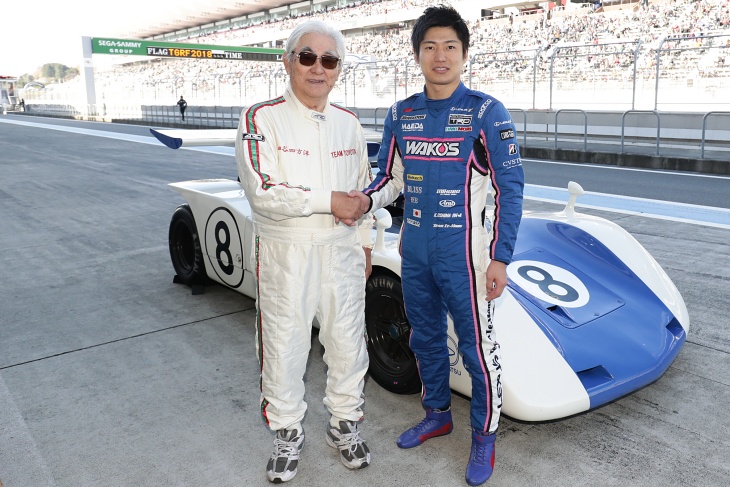
Hosoya also made many appearances at Toyota’s end-of-year motor racing festivals, linking the generation of Team Toyota to the current generations of Toyota Gazoo Racing drivers in Japan and all over the world. His last public appearance at a motor race came when he waved the ceremonial green flag for the 2019 Super Taikyu Fuji Super TEC 24 Hours.
It’s impossible to imagine that most if not any of Toyota’s success in international motor racing would have happened without the groundwork laid by Hosoya and Team Toyota in those formative years, and generations of Toyota racing supporters will be grateful for those contributions.
DSC would like to extend our condolences to Hosoya’s family, friends, and many colleagues who have worked with him over the years.