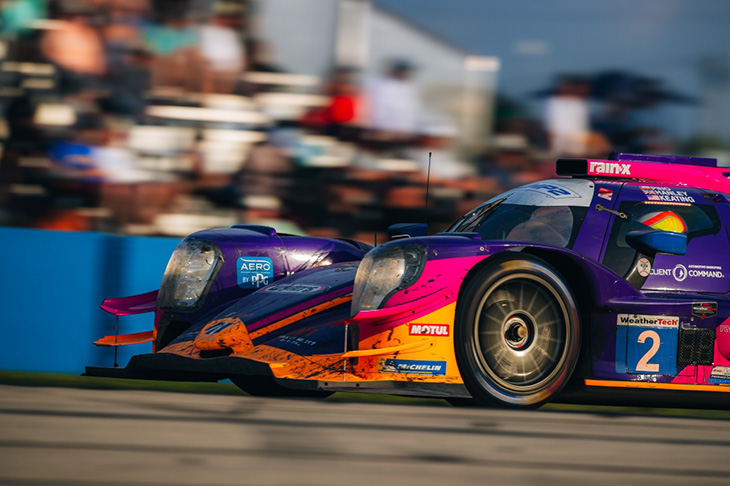
For many IMSA teams, the Rolex 24 Hours at Daytona represents the grand opening to the season, but Round 2 at Sebring is a race they want to win just as much. It’s a 12-hour battle on a notoriously bumpy, narrow, ancient airfield surface which runs into darkness and in the case of 2024, held in punishing heat too.
Enter United Autosports, a multiple title-winning LMP2 team in the FIA WEC and ELMS that has moved into IMSA full-time for 2024 with two ORECA 07s. This shift to North America is a huge undertaking and has included moving into a permanent base in Mooresville, North Carolina, signing up a new squad of drivers and reassigning its WEC LMP2 staff to a new championship.
For this year’s event, DSC spent the week embedded with the United team. This gave a feel for how it operates and just how high the level of competition is in IMSA’s boosted LMP2 field.
So just what is it like to fight for a win at Sebring?
DSC had open access to key staff and drivers, sat in on briefings and listened to the team radio during sessions. It also travelled to Mooresville after the race to see the cars return to the shop for a post-race rebuild. It gave first-hand insight into how to survive, and thrive, at Sebring.
Now, with time to reflect, here’s an account of the full experience.
****
The week, with its condensed schedule, began on Wednesday with a first glance at United’s set-up in the paddock. With no track action for the WeatherTech SportsCar Championship teams, all is calm and under control.
In the main paddock, United’s set-up is spacious, with plenty of elbow room around its two ORECA 07s, which sit in between its two race ‘haulers’ for the crew to work on. As with most historic US circuits, the main paddock – with its rows of race trucks that stretch almost the entire length of the back straight – is detached from the pitlane, though thankfully at Sebring, the paddock is only a short hop from the pit wall.
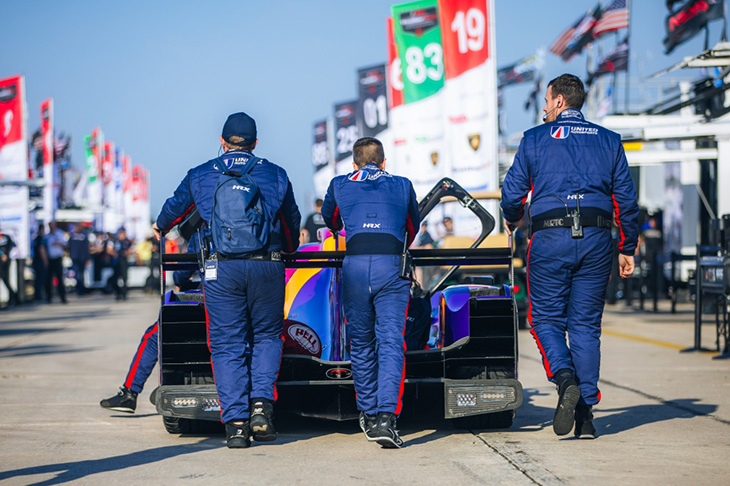
No wheels have turned yet there’s plenty of work to be done, including getting both cars through scrutineering and ensuring they are fully ready for what promises to be an intense Thursday of track action.
The timetable tomorrow features three practice sessions, including the only night session – which is vital for teams looking to work on car set-up in the cooler temperatures that are more representative of the end of the race, when the pressure is high.
In fact, the work on the cars started long before the cars arrived at Sebring, with lead engineer Gary Robertshaw tasked with heading from the UK to Mooresville to assist the United Autosports USA staff on-site in preparing for the 650-mile trip down the east coast to Florida.
The entry list for the 2024 Sebring 12 Hours is 58 cars strong and features 13 in LMP2. As I stroll up and down the paddock I take extra notice of the other teams in United’s category, to see how its work area compares. To my surprise, there are no enormous differences in terms of resources, everyone is doing this ‘properly’ – the days of racing as a private team in IMSA on a shoestring budget are long gone. This is a cut-throat championship these days, with every private team increasing its level of resources seemingly every year to keep up.
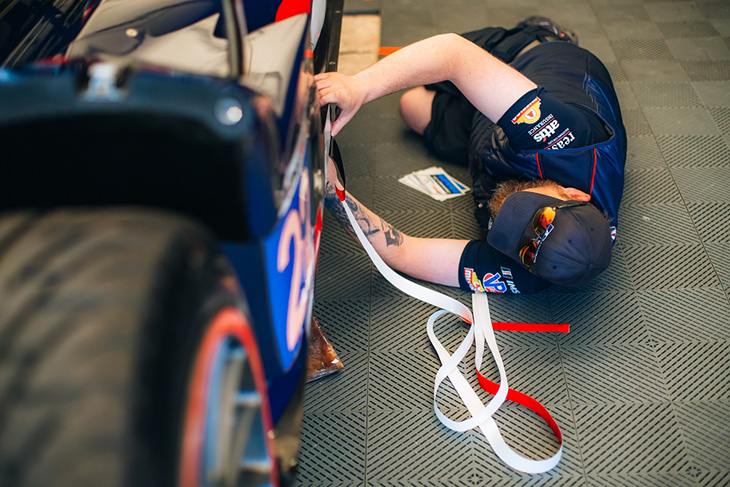
What is most interesting is that following the removal of LMP2 from the FIA WEC, IMSA’s class has grown and features an eye-catching selection of European teams. From Europe, United is joined by TDS Racing, AF Corse, Inter Europol (via PR1), High Class Racing (via MDK) and Algarve Pro Racing (under the Crowdstrike Racing banner). And on the other side of the Atlantic, Era Motorsport, DragonSpeed (which lest we forget has a rich history of racing in Europe) Sean Creech Motorsport, AO Racing, Riley and Tower Motorsports are flying the flag for North America.
Altogether, it’s a mouthwatering list of competitors in a championship that boasts world-class fields in all four of its current categories.
****
My first significant encounter with a member of United’s team during the week was with 2023 FIA WEC GTE Am champion and Le Mans class winner Ben Keating, who joined United for this new venture over the off-season, switching allegiance from PR1. For the season he is paired with experienced pro Ben Hanley, and here at Sebring the duo are joined by Chilean up-and-comer Nico Pino in the #2 ORECA. It’s a trio that stands out.
As we sit outside the front of United’s awning in the sunshine, the cult following the ultra-talented Bronze-rated Texan has built is on full display. He’s constantly being acknowledged by passing fans and crew members from other teams, though admirably, he manages to remain focused entirely on our conversation.
As an orator, Keating is one of the very best in the sport. When he speaks, you listen. When you ask a question, he will answer it with candour and detail.
As an orator, Keating is one of the very best in the sport. He’s been here at Sebring before many times, he’s won the race three times too. Yet he remains just as enthusiastic about the 12 Hours and competing in IMSA. When he speaks, you listen. When you ask a question, he will answer it with candour and detail.
To him, the only thing that has changed this year in IMSA has been the team environment he is working in. Switching from PR1, a team which he won IMSA titles and major races with over the past four years, to United, a team joining IMSA’s full-time ranks for the first time, was a gamble. But, he appears satisfied that he’s placed his bet in the right place now the season is underway.
Last year Keating told DSC that United co-owner Richard Dean was “the smartest of all the suiters”, offering him a golden ticket to the Le Mans 24 Hours – something few teams can do with any certainty. With no LMGT3 programme to replace his GTE Am effort last year (Keating isn’t a fan of ABS and GT3 BoP) finding an LMP2 team that could offer both an IMSA and Le Mans programme was the priority.

But that was then, this is now. How is Keating – arguably the most talented Bronze-rated driver on the planet – finding life at United Autosports I wonder, after finishing sixth at Daytona and preparing for another gruelling 12-hour race at Sebring?
“We had a freak mechanical issue at Daytona, but we had a great car there. We had a car to win that race, however we didn’t have the luck to be there at the end,” he explains.
“But in terms of how the team operates and how it developed the car we ran at Daytona, I was impressed. I’ve been with a few different teams and every one of them has a different approach. I like the way these guys go racing.
“I have to look at the world through the lens of my own experience, and based on my previous experiences, I don’t like being part of a two-car team, as I like all the attention of everyone to be on a single car. I don’t want a team to be running around with their hair on fire worrying about an issue on a car that isn’t mine.
“My experience in the past has not been a positive one,” he continues. “Until now.
“So far it’s been an advantage and theoretically, it should be. It has to do with United’s approach. They’ve got really good people, they’re well organised and because everyone knows their role we don’t have anyone with their hair on fire! United knows these cars better than anyone. I was concerned coming into this that it had been a while since they’d been on the Michelin tyre, or that they hadn’t been in IMSA for a while.
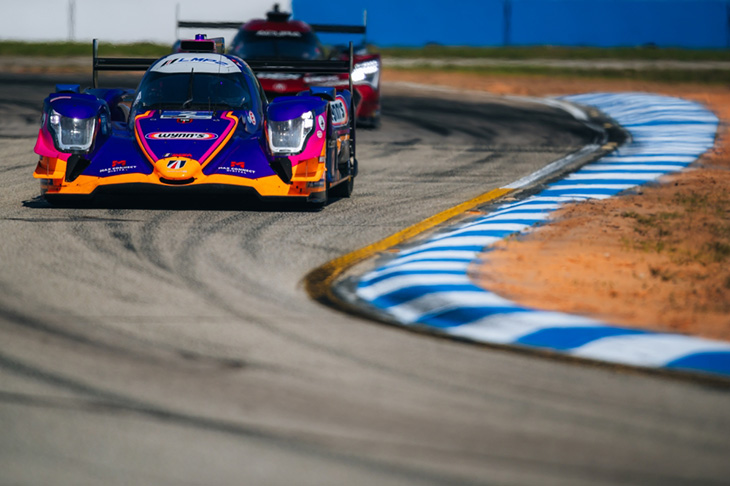
“But they know what tweaks to make to a car, and they also know what tweaks they are not going to make. They don’t allow anyone to go off on a tangent or a path they know doesn’t work.
“It’s been spot on, this has been a better experience than any team I’ve ever been with.”
High praise indeed.
IMSA’s LMP2 class, which mandates a Bronze driver for each line-up, requires discipline and organisation. If you can attract a talented Bronze driver who is fast and crucially, can bring a car home regularly without scratches, then the rest of the programme will fall into place.
With Keating, and Daniel Goldburg on the other side of the garage, that’s what United hopes it has found for the latest chapter of its flagship prototype offering.
*****
Next up on my list for a sit-down catch-up is team co-owner Richard Dean. To his credit, he looks remarkably fresh considering how intense Q1 of 2024 has been with the Rolex 24 Hours, the FIA WEC season opener in Qatar, the Sebring build-up and testing in between.
We take a seat on Friday morning, after the three practice sessions, but before Qualifying I am keen to get a read on the mood of the team now the IMSA season is underway.
Dean and I first spoke about his IMSA plans almost a year ago, sitting in the ELMS paddock in Barcelona. There he was facing a dilemma. With no LMP2 class in the WEC for 2024, his Hypercar plans were dashed and at the time, he had no LMGT3 effort to put his name to; so his focus shifted to IMSA.
IMSA’s SportsCar Championship, he said, was a place United wanted to be competing in any way. So this transitional phase for the team’s WEC effort was a perfect moment to leap. Running two ORECAs was key to keeping his WEC LMP2 staff active while United continued to look at opportunities in the new-look top class.

11 months later and we’re in the IMSA paddock, he’s pulled it off. He’s set up a base (and United Autosports USA) in North Carolina via a partnership with Jr III Racing, allowing the team to “do this properly”. Remarkably, with limited time to work with, United secured two spots on the FIA WEC grid in LMGT3 too. There has never been a busier time in the team’s 14-year history.
So, I ask, “What are your impressions of the championship now that you’re part of IMSA full-time?”
“Well, we’ve learned a lot,” he replies. “We learned a lot when we did our one-off IMSA races like Daytona with Lando (Norris) and Fernando (Alonso). And since then we’ve done sporadic one-offs. And all of that has gone into our approach this year, with two cars for a full season.
There has never been a busier time in the team’s 14-year history
“We wanted to come over here not as a fly-in, fly-out race team. The preparation started a long time ago.
“Our engineers started work back on the Michelin tyre to prepare so we could be on the pace. But IMSA is unique, there are a lot of intricacies. This is why we have an integration with an established team in Jr III and Billy Glavin (Jr III’s owner and the new head of United Autosports USA).
“A quarter of our staff are full-time in the US and the rest come in and out. We wanted to keep the core group that has won with us at Le Mans and in the FIA WEC, and we’ve done that.”
“And genuinely, John Doonan (IMSA’s President) and his team couldn’t make this process any easier,” he adds. “They are there for you. You just have to ask and they respond straight away. You know that when you’ve asked something they have looked at it seriously, and they try and accommodate us. They know our challenges as a European team and it makes a massive difference.
“What this means is everyone in the team, media, marketing, catering, mechanics, they all want to do IMSA. That is a credit to what John has built at these events.”
Our conversation takes many turns. We discuss the role of Bronze drivers, the condensed Sebring schedule, reflect on Rolex and compare notes about the atmosphere in the paddock.
“We look around,” says Dean. “There are people in our class like Bobby (Oergel) from PR1 who have had a huge amount of success. You’d be an idiot to believe you could just step in and beat these guys. It’s going to take a lot to win races. But as a whole, everyone in the paddock is pushing each other to raise the level. It keeps moving. We have had to raise our game.”
Getting up to speed is clearly the biggest challenge here. United is no stranger to IMSA, it has raced here before, but this new programme has a permanence to it. The team is in this for the long haul, as “LMP2 has a future here”, Dean tells me, so it has to nail the details.
Just what is the key to ensuring the team is ready for the notoriously brutal start to the year in IMSA, with 36 hours of racing, at two radically different circuits, in less than a month?
“We are very well structured. We do a lot of planning meetings and try to think about things,” Dean points out. “We were planning for Daytona week in November. You have to plan but you have to adapt. For instance, we destroyed a car at Daytona and needed to build a new car around a new monocoque so you have to be ready.
“But operationally, it’s all gone smoothly, despite it being intense.”
As soon as we’re done, Richard is called away. He answers his phone and strolls to the back of the awning. Somehow, we’re already over halfway through the event, yet it feels like it’s not even properly started.