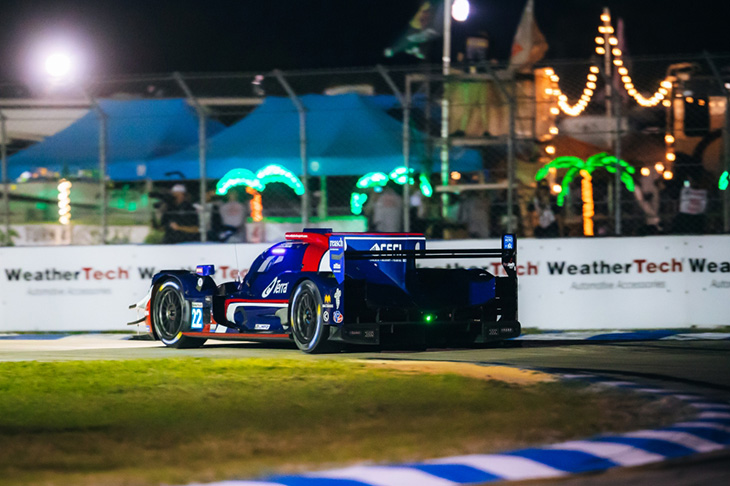
Part 2 of DSC’s bumper Sebring feature with United Autosports has arrived! Missed Part 1? Catch up HERE >>>
The three practice sessions on Thursday gave me a real sense of what it means to go racing ‘the United way’.
Over in Europe, where teams are tucked away in garages and small pit perches, you feel isolated when the sessions begin. I know this for a fact because last year at the Spa 24 Hours, when I spent time with Audi Sport Customer Racing, the scale of the event was lost on me – I had no concept of what was going on outside of Team Sainteloc’s little world in the lower pit lane.
The working environment couldn’t be any different here. With no pit garages to hide in, everyone is exposed, to the elements, the fans, the noise and the general hustle and bustle of a live pit lane.
On my notepad, I write that the space behind the pit wall – which is a row of pit stands housing desks and mechanics and a storage area for parts, clothing, food, drink and general equipment, separated by a fire lane – has the bizarre feeling of a lived-in trench from the Great War. Stay with me on this…
Every pit stand is different, though they all serve a similar purpose. Some are closed while others have open backs that allow mechanics to rush between the wall and the parts storage without any obstacles.

However, it doesn’t matter how big the team is, they’re all cramped, and filled with intensely focused bands of workers who treat the race as a military operation, battling fatigue and the task at hand. Some of United’s team are working on strategy, others have a more physical task of jumping over the pit wall and executing rapid-fire pit stops. Then there are the drivers, who congregate at the very back, waiting for their turn to jump in. It is a war of attrition.
Everything has a system, everything has a place and each team has its own way of working. All the while, the noise from the cars on track and coming in and out of the pit lane is deafening.
You can’t really see the track either, as the fire lane is an enclosed environment, and the structures on both sides are tall. All you get is the occasional glimpse of the cars passing the start-finish line and brief flashes from the cars passing through the pit lane.
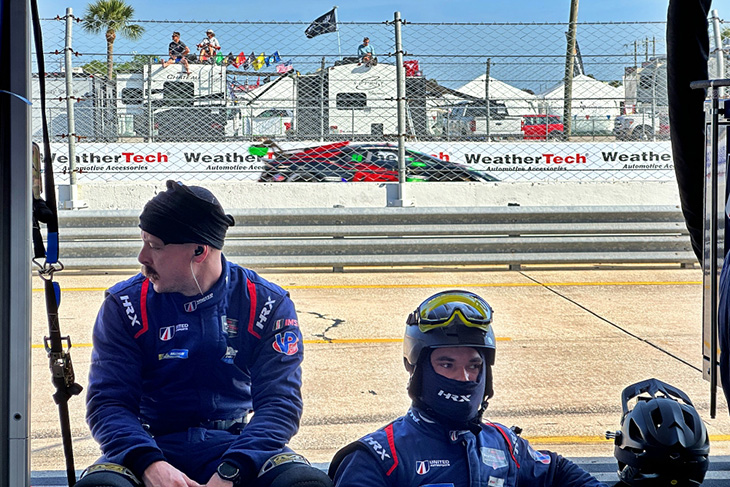
United’s stand really is mission control, I note, with 42 monitors being utilised by staff members, tracking data, following the track action and pushing through the run plan.
I put on one of United’s radio headsets to listen in on the action throughout the sessions. It blocks out the noise, which is a plus, but the radio traffic isn’t as busy as the traffic out on the track.
This is a team that has been there, done it and got the trophy almost everywhere it has competed around the world. As such, the communication between the strategy desk, the mechanics and the drivers is professional. The messages are all methodical, calm and short. IMSA radio communications are open too, so giving away details on strategy isn’t wise anyway – anyone could be listening in, including journalists like me.
What stands out is just how calm everything is
To me what stands out is just how calm everything is. Ben was right. Everyone is fully on task and at ease, verging on nonchalant.
****
Practice is the best time to work through car set-up. For this race, which will see the conditions evolve significantly throughout, finding a balance that allows the Bronze-rated drivers to feel comfortable in the heat of the day, and the pro drivers to extract high levels of performance when the temperature drops at night, is key.
IMSA rules allow teams to gain laps back via safety car wave-around procedures, so during a 12-hour race like this one, building a lead is almost impossible as the field will get bunched up periodically as incidents occur. Thus, the focus for the drivers tasked with steering the cars for the first half of the race is survival, before the pro drivers push at the end when the checkered flag is in sight.
“We engineer the car to work at night specifically,” engineer Gary Robertshaw tells me. “It’s amazing how much the balance changes between the morning, afternoon and evening. But we need the car to be at its best at the end. And typically what happens in the evening is you pick up more front-end grip, and drivers like that.”
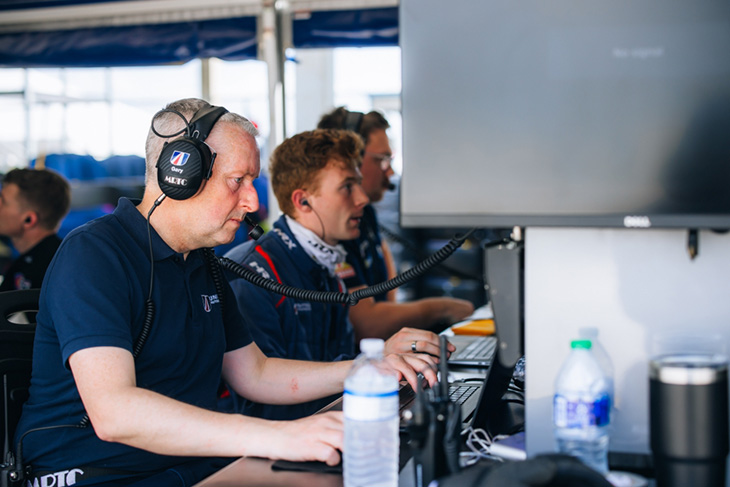
Practice, as a whole, goes well and United is pleased with the set-up. In fact, Robertshaw’s work prior to race week to find a base set-up via sim work and a recent test has worked a treat, as the cars require only fine-tuning in practice.
“Because of the experience we’ve had at Sebring, and the test day a few weeks ago, very little needed changing,” he explains. “We did some small tuning to ride height, but everyone accepts that in the middle of the day when the track is hottest, you have an understeer balance.
“But this is perfect because Ben and Dan as Bronze drivers need confidence in the rear end. Their lap time comes from knowing the rear will stick and not step out and surprise them. Entry stability is a huge factor. If we can give them a car with good entry stability they will like it, and that works because the bulk of the race is in heat and it works for them.”
Ben and Dan as Bronze drivers need confidence in the rear end. Their lap time comes from knowing the rear will stick and not step out and surprise them
Across the day, Paul Di Resta sets the best lap of the two cars, a 1:51.363, good enough for second in the combined times. The body language in the awning is positive, the team feels confident it has a solution that will see both cars at the sharp end of the field when the sun sets on Saturday.
Pace aside, practice is important for another reason, as Ben Hanley and Paul Di Resta have had plenty of time working with their lesser experienced teammates. A chat with Di Resta, who splits his season competing with Peugeot in WEC Hypercar and United in IMSA LMP2, is a good chance to get a read on the way that the team works behind the scenes to ensure everyone is ready for the race.
“I enjoy seeing the development of drivers like Dan and Bijoy (his teammates in the #22). They’re both ambitious. Watching Ben (Keating) and Dan (Goldburg) go up against each other is going to be interesting all year,” he tells me.
“When I coach drivers I want to come naturally to them, they have to explore this themselves and find out what works. If not they need coaching through every lap. I prefer to give a sense of direction and not go too in-depth. It makes their job a lot easier.
“I know a lot of guys do a lot of video analysis and data. But for me, I want to get one area sorted, and then get onto the next one. You don’t want to overload them. It may take longer to get there, but you want it to be natural. It’s a snowball effect and natural ability comes into it.
“For Dan, I don’t want him to rely only on me, he should be working with everyone in this team and building relationships.”

We also have a back-and-forth about the rules in IMSA. Di Resta has an interesting take.
“Here you have to be lucky to get a result, but I’d love to see in the future that Bronze drivers have to do the end of the race. They qualify, but why not have these guys in at the end of the race,” he suggests.
“This (ruleset) throws a lot of load and pressure on them at the start of the race. But with a small tweak, they could create a better spectacle for fans and for the drivers.”
****
Before the race gets under way the small matter of Qualifying takes place. And Dan Goldburg impresses, putting the #22 on the front row with a 1:52.313. Keating isn’t far behind though, putting the #2 third with a 1:52.673.
When I sit in the back of United’s truck with Goldburg, for our first proper discussion, he’s got a spring in his step. Sebring is his home race, and after a rather disappointing Daytona, in which the car retired after just 128 laps, the run in qualifying has served as a real confidence boost.
He’s generous with his time as we talk about his background and his journey to United. Prior to his break in prototype racing, Goldburg spent time club racing and eventually contacted United after a standout season in VP Racing SportsCar Challenge last year racing with JDC-Miller in which he won three races and finished second in the standings to his current teammate Bijoy Garg.
After that campaign, he said, he felt ready to step up to LMP2, as his time spent in LMP3 taught him valuable lessons in prototype racing. The biggest challenge, he says, is not driving the ORECA over the Ligier JS P320 he drove last year, it’s changing his approach and mindset to every race from running flat out in a sprint to conserving a car for hours at a time. His approach, he believes, is much better this time around after a tough Daytona.
“There is nothing better out there to prepare you for LMP2 than LMP3,” he explains. “It’s different driving the LMP2 car than the P3. I’ve never driven open-wheel stuff, so I don’t know how relatable those are. But P3 is.

“There are differences though, the LMP3 car requires an aggressive driving style, you’re hard on the brakes, turn in and get back on the gas hard. Whereas this car in its current form is much more gentle. What I am learning is that the aero is so important on this car that the driving style is managing the aero.”
So what made United stand out to Goldburg, who is sharing the #22 with his old VP Challenge sparring partner Bijoy Garg and Di Resta this year?
“I interviewed a lot of teams looking for the right fit, I’ve done this enough times to know that it all needs to feel right. High up on the list was a team that has been doing LMP2 for multiple years and performing well,” he replies.
“So I wanted an operation that I knew was going to be good. I spoke to teams already doing the series, many were one-car teams that would add a second car for me, others were LMP3 teams wanting to step up. But I wasn’t as interested in them.
I wanted a team that could put it all together for me, good drivers and engineers. And Richard got all those boxes ticked
“I saw that United posted they were bringing their WEC operation here, and I knew about them, had seen them race. I’d not met Richard (Dean) but I got in touch. We chatted on the phone and met up in Watkins Glen and I had a good feeling about it.
“The whole picture is important, I wanted a team that could put it all together for me, good drivers and engineers. And Richard got all those boxes ticked.
“Then United partnered with JR III, and that was gravy for me.”
****
Into Friday evening and with the Pilot Challenge support race over, it begins to sink in that the 12 Hours is almost here. It’s now time to join the drivers for the pre-race briefing before the early start in the morning.
So at this level, what is there to discuss at a driver’s briefing? After sitting in on the hour-long session, it came as somewhat of a surprise.
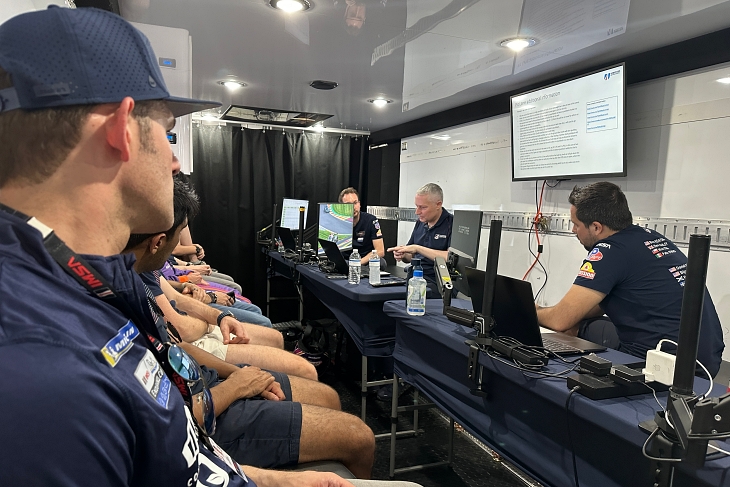
I assumed the race strategy would be the focus, instead, it was more of a refresher on the IMSA rules and United’s processes during a race. What do you do if the car’s electronics cut out? What is the definition of being ‘committed’ to the pit lane when it closes? How does the start procedure work? Which end of the car do you pass during a driver change?
All these topics, and many more, are covered before the engineers dedicated to each car run through the race plan – which isn’t too complicated.
The team has opted for a higher downforce set-up for the race, will double stint tyres early and rotate their Bronze drivers through double stints before the light fades.
It will be up to Hanley and Di Resta to finish it all off.
****
Saturday morning is an early start, as the race gets underway at 9:40 am. The sun is shining, the crowd is huge and the action on track is fierce in the opening hours of the race.
It’s all going to plan early, with Keating and Goldburg running 1-2 after the pole-sitting AO Racing ORECA suffers an issue on the pace lap and Keating steers the #2 to the front. If this continues, I wonder, will team orders come into play to prevent the two United cars coming together?
“They’re not going to do anything selfish, they’re in it for the long term,” Richard Dean tells me of his drivers. “We’re letting them race.”

But, as predicted, caution periods and varying strategies throughout make it near-impossible for United’s cars to run together, hold station and build a gap. Instead, it becomes somewhat of a lottery at each round of pit stops. By the fifth hour race, the P2 class has seen the three different leaders at the top of the hour.
This race though, is not about the first half, it’s about the back half. The #2 is lucky to be in the running after two errors by Keating, the first being a spin in traffic where he is inches from being collected, the second an off-track excursion that thankfully does no significant damage. The #2 is fifth, with the #22 down to eighth. But there is nothing in it and both cars are on the lead lap and within 30 seconds of the leader heading into the final third.
With the race beginning to wind down, the atmosphere in the United pit becomes more intense. I stand with 90 minutes to go behind Dan Goldburg, who has finished his drive time. He is fixated on a screen that features every track camera on a grid, and following the #22 through each section of the circuit intently.
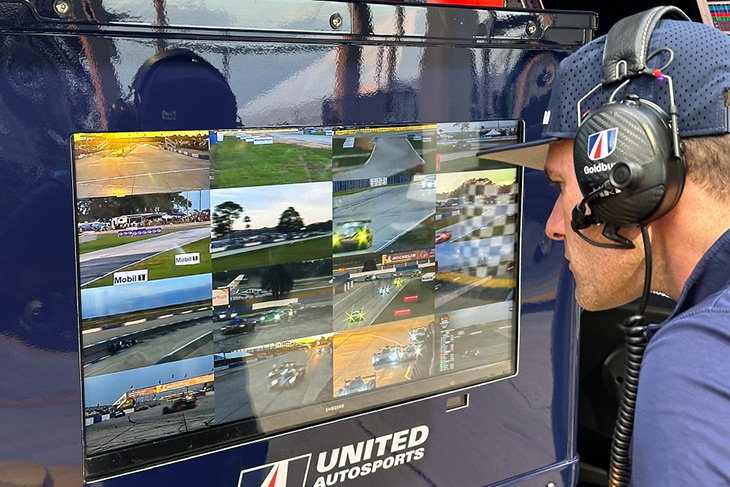
The top five are all within a handful of seconds and both United cars have emerged as contenders, with the #2 out front. There is a sense now that the race might run green to the flag after a sizeable chunk of uninterrupted racing. Up and down the order everyone begins to push.
But, it wasn’t to be. A flurry of late cautions in the race changes the dynamic. Suddenly the cars at the back of the field have more strategy options, they can pit early, take on more fuel and ensure their final stops will be quicker. It plays into Era Motorsport’s hands perfectly, as back-to-back yellows see the eventual winners at Era vault from ninth to first at the final round of stops.
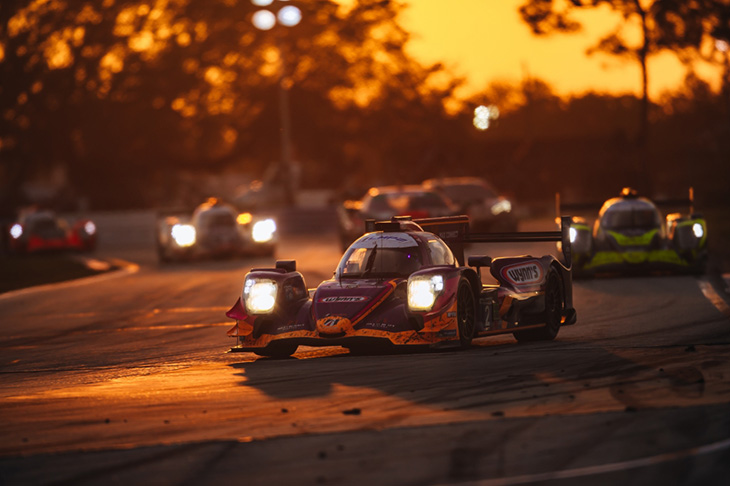
“At the second to last safety car Era was nowhere really, one of the slowest cars in the race by stint average, but when the FCY came out 10 laps after our cars made a stop, they decided to pit to fill their tank. Era and Riley pitted under that FCY which turned out to be a key decision,” Robertshaw explains after the race.
“At the time we had track position, so we decided not to pit cars and we knew if we did pit we’d still need one more stop. But they did because they had nothing to lose. We didn’t want to go to the back and nobody in front of us did either. What that meant was they did some fuel save, so when they made their final stop they didn’t need as much fuel. I think Era’s stop was 12 seconds faster than everyone else, they jumped everyone.
“And with the cars so close on performance you just can’t overtake.”

A puncture for the #2 also hampered United’s chances. “You can afford to have a puncture at any point in this race, except the end,” Dean admits.
“Tom Dillman had a go at Ben (Hanley) into Turn 7 and side-swiped him, which pushed him offline,” Robertshaw adds. “That put Ben on the debris and it cost us. We had to pit to change tyres and that was the end for the #2. You can’t come back from that less than an hour before the end.”
This is IMSA racing. It’s exciting, it’s unpredictable. You can strategise and stress over every second of an endurance race and execute perfectly, but luck more often than not comes into play. The #22 nabs a podium late on when Di Resta brings it home and the #2 drops down to 10th.
****
When I travel to Mooresville after the race to catch up with Richard Dean and Billy Glavin as the cars are unloaded from the trucks to the shop, I get a debrief. Clearly, this wasn’t the result the team wanted or expected, but it is proud to have made the podium and continues to feel more at home racing in the USA with each passing month.
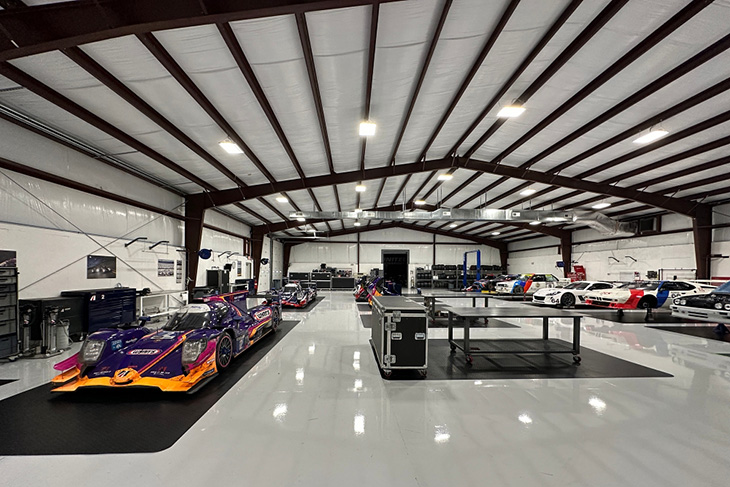
“It was a typical IMSA race, 12 hours and you had nine cars on the lead lap after the final safety car. We definitely had a fast car, as we did at Daytona. But these are hard races to win,” Dean says when asked to summarise the event.
As I step through the front door of United’s new Mooresville facility, I wonder just how the rest of the IMSA season will pan out for United. It is doing everything the right way. It has the resources, drivers and staff to succeed, it just needs a little more time and surely the hard work will pay off?
To United’s frustration, there’s a big gap in the calendar now. It can’t just put Sebring to one side and head to the next circuit. Instead, it will have to wait until summer, as there are no races for the LMP2 teams until after the Le Mans 24 Hours in June at Watkins Glen.
The wait for a first win continues, but I get the impression it won’t be much longer…
Images courtesy of United Autosports