For the 2024 racing season,Michelin is utilising its 2023 tyre range for the Hypercar teams in the FIA WEC and GTP teams in IMSA. But behind the scenes, it is not resting on its laurels. The French tyre manufacturer is currently developing a new range of top-class tyres for the WEC and IMSA, which will debut in 2025.
The new tyres are currently “in the third phase of development” and have already completed three track tests. The first was with a rain tyre late last year in Le Castellet, the second was a test in Bahrain. Then at the end of last month, it invited the Hypercar teams to take a car to Portimao for further slick testing.
Creating tyres that are suitable for the wide variety of LMH and LMDh cars competing in this new converged era has been a colossal task since the Hypercar formula made its debut in 2021, yet Michelin continues to push forward. For the next generation of tyres, its targets are ambitious and focus on two areas: tyre warm-up and sustainability.
Michelin, and every major manufacturer around the world, is pushing to reduce its carbon footprint as a matter of priority. And its goals in motorsport stretch beyond making changes to its development and production processes. In 2025 it aims to produce race tyres for the WEC and IMSA that feature a significant increase in sustainable materials.

“What we achieved for 2023 was developing a new wet tyre with 45 per cent sustainable materials, it was a big step for us to produce sustainable materials for worldwide championships,” Michelin’s sportscar operations manager Pierre Alves told DSC. “And in the slicks, we have more than 30 per cent.
“For next year the main target for our developers is to go higher, with no compromise in performance. We need to improve the percentage but not degrade the performance we have today.
“Next year we will bring tyres with more sustainable materials in wet and slicks and we are going to work on the warm-up for the tyres. We have targets to go over 50 per cent sustainable on the slick and higher on the wets. Though at this point we don’t know if we will be able to reach it, because we can’t compromise on performance.
“We are making efforts on the casing, with recycled metal parts, we are also using old rubber using companies that can extract carbon black and have new ideas with rice peel, and orange peel to make some resins and oils.
Next year we will bring tyres with more sustainable materials in wet and slicks
“We need to find a balance because if we can go over 50 per cent but the performance isn’t as good we will have to evaluate it.”
Ultimately Michelin’s goal is to produce tyres made entirely from sustainable materials, but this is a task that’s far from simple.
There are grey areas in defining what constitutes a sustainable material and developing new solutions to replace traditional rubber and traditional manufacturing techniques is both costly and complex.
“We could produce a tyre with 100 per cent sustainable materials, we know how to do it, and we know our competitors can too,” Alves explained.
“The big problem is producing these in industrial quantities. We can make one tyre fully sustainable, that’s easy, but we need to make six to seven thousand for the WEC.”
One area that Michelin says will not change going forward is in-race tyre strategy, even as its range of race tyres for the WEC and IMSA becomes more environmentally friendly.
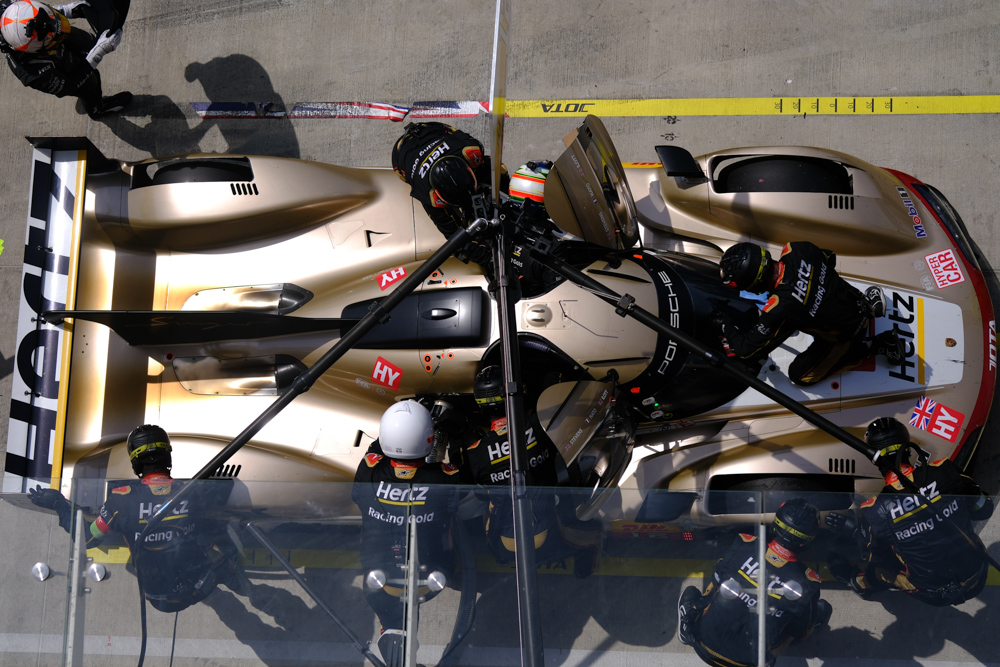
Currently, Michelin produces three slick compounds, a Soft, Medium and Hard – each with a specific temperature window – and nominates two for teams to use at each race bar the Le Mans 24 Hours, where all three are on offer.
This differs from Goodyear in the Pro/Am LMGT3 category, which produces two slick tyres and nominates one of them for each race as part of its drive to reduce waste and cost for teams.
In future seasons Michelin says it will not reduce its range and restrict teams to using a single tyre compound in races. This is because it believes that tyre strategy is an important element for prototype racing at the highest level.
“For us the strategy aspect is important,” Alves said. “We want to bring strategy in tyre choice. If you only have one choice you limit strategy.
We want to bring strategy in tyre choice
“The issues last year with teams struggling on our tyres (and the debate surrounding the tyre warmer ban ahead of Le Mans) was always a team not choosing the right tyre at the right moment.
“Take Spa for example, when we had big complaints about the lack of tyre warmers, the tyres being cold and it being dangerous. The week before in Spa we couldn’t choose the two compounds, we had no idea because it can be cold and hot and the track is high energy. We needed something strong so it was hard to choose.
“We saw that our tyres could suit all cars but there were pros and cons. Toyota started the race on Soft tyres and double-stinted for the whole race. They were not very fast for two stints, but they took no risks, the warm-up was very good and they managed degradation.
“Ferrari did the opposite, they thought the Hard had good potential but it needed three to five laps to bring them up to that potential. They chose the Hard compound because they saw a massive gain in the second stint. I remember them being so much faster than the Porsche, with (Fred) Makoweicki on the Medium and suffering from degradation. We like this in racing.”

Looking back at the journey since the Hypercar formula replaced LMP1 and GTP replaced DPi, Alves admits it has been challenging, but he feels extremely positive about the results.
Michelin has shown off its capabilities as part of this programme, and so far has managed to produce versatile tyres that have rarely come under any form of scrutiny.
This is despite the fact that for Year 1 it had to “start from scratch” and develop tyres for a brand new ruleset featuring radically different prototypes, then debut a new range in 2023 that could accommodate non-hybrid and hybrid LMH cars (Peugeot 9X8 than ran with different sizes), hybrid-powered LMDh cars and produce suitable levels of performance and consistency at every stop on the IMSA and WEC calendars.
“For the first year with a new type of car, with new weight, aero balance. No cars existed, and we had to create tyres, so it was a huge task,” Alves recounts.
“We were lucky because we had some knowledge in terms of simulation. So we worked closely with some of the manufacturers to give us all the references for the cars that they will build in the future. We put that into our simulator, and we started to create all our models to create the best tyre, with the best size, that would suit the race tracks.

“It was a new approach for us and we saw that when our developers created the first batch of tyres for the Toyota, we had no idea what the reaction would be. Before LMP1 had cars less than 900 kilos, with 1000 horsepower, these new cars have less power, less aero and were 200 kilos heavier. That’s why we needed a new philosophy for the tyres.
“We were relieved (after the first track test with Toyota) when Pascal Vasselon (the team’s technical director at the time) called us and gave good feedback. We were very anxious.
“Then of course with tyre warmers then being banned we needed another solution. We need strong tyres that can double and triple stint at Le Mans and start from cold. “We did a good job I think.”