We lost our friend and colleague Michael Cotton earlier this month, he’s remembered here in very personal style, by his friend Serge Vanbockryck.

Over a decade ago DSC commissioned a series of profile interviews of a number of motorsport figures: Drivers, team owners and team bosses, with Michael tackling the task woith aplomb, telling stories and revealing the human side of some famous names in the way that a truly great writer can. The features ran from 2012 – 2015 originally and was supposed to carry on with another set of ‘greats’ but sadly a period of ill-health from Michael intervened.
We still however have his earlier body of work and it deserves a second read for those who were readers back in 2012 and beyond, and a first airing for those that have joined us since. Enjoy!
And thank you Mike.
You can catch up with Part One Here and Part Two of this interview here
The curtain falls, in America
“We were talking about next season, towards the end of 1983. I went to Dominelli’s office, as usual at six o’clock in the morning. He wasn’t there, but his assistant Mark Yarry was putting stuff into a cardboard box. And on the desk was a pistol. I asked him what was going on. He explained that an Italian [named] had come from Phoenix demanding the return of his three million dollars, and if it wasn’t on the table in the morning he would come back and shoot everyone in the building!”
This was the worst news imaginable. “As soon as he said that I realised what was happening. I went cold: it was a complete shock, and I never saw it happening. It never crossed my mind that there was anything wrong with the money Dominelli had been putting into the team.”
Was he naïve? Well, maybe. Fitz knew that in the States there was a lot of drug money, or money gained by illegal means, the Pauls and the Whittingtons later convicted of drug related activities. But Dominelli had given every impression of being a successful businessman, with offices above the bank which held his accounts without question. He was a respectable man, when not hurling wrenches at rivals on the track.
It turned out that Dominelli was short of 250 million dollars, and there were a lot of very angry investors out there wanting their money back. Tim Schenken had sold his house in Maidenhead to act as JFR’s team manager, and he too had lost his investment.
John Fitzpatrick Racing got the full treatment from the IRS and from Rico, the anti-racketeering agency. They turned over every scrap of paper, every invoice, every bill, bank statements, the lot, to see if Dominelli had used the team for money laundering. He had not.
Awkwardly, though, Dominelli owned half the team, and the investors swung into action. “They sued his bank, they sued his lawyers and his accountants, it was serious stuff involving many millions of dollars.” And, they reckoned they owned half the team, valued at $5 million. Fortunately JFR was represented by “a brilliant lawyer” by the name of Brown Smith, a friend of Dick Barbour.
They didn’t want race cars, a workshop or any of the hard assets, just money, starting at 2.5 million and working down. Eventually, thanks to Brown Smith, Fitzpatrick settled for $500,000 to clear the matter and moved the cars, the transporter and all the equipment to Silverstone, where he rented a new workshop to carry on competing.
Dominelli was convicted on five counts of mail fraud, each carrying a five-year sentence and sentenced to 25 years in jail. He was released after 15, having suffered a major heart attack. Another, two years after his release, proved fatal. He was penniless. “They got everything off him, he wasn’t clever enough to hide any, he thought he could carry on for ever.”
The combined efforts of the lawyers resulted in the investors getting 90 per cent of their money back, mainly from insurance companies. It was not an ideal result for them, but better than they had feared, even if it did take two years for restitution.
In the four years he raced regularly in the States, Fitzpatrick had won no fewer than 16 IMSA Camel GT Championship races, including all the classics, and the IMSA title in his first full season.
David Prewitt, Fitzpatrick’s longtime friend and associate, would manage JFR’s European operation for the next three seasons, 1984 to 1986. Fitz was hands-off at this point, buying a very nice house in Sotogrande, on the famous golf course.
Ah yes, the golf! Throughout this 20-year-period Fitz had played golf as often as time allowed, and with some of the world’s best golfers. Tony Jacklin is his friend, neighbour and golfing partner, and Fitz has played pro-am tournaments with the likes of Seve Ballesteros and no fewer than 12 British Open champions including Tom Weiskopf, Gary Player, Sandy Lyle and Nick Faldo, whom he has known since Nick was an amateur. At the age of 72 Fitz’s handicap has increased a little, to nine.
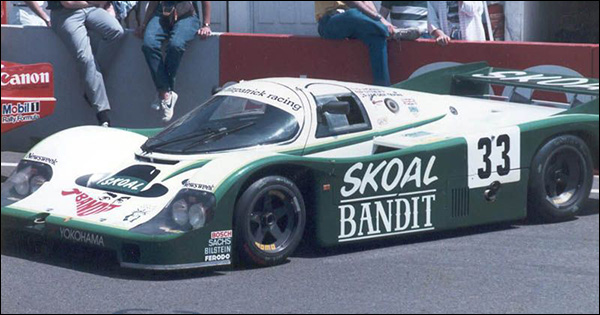
Skoal Bandit were the principal sponsors in 1984. It was to have been a three-year deal, but chewing tobacco was not to the taste of European customers, and the American company suffered a reverse of fortune when Esther Rantzen claimed in her television programme that chewing tobacco caused mouth cancer. Abruptly, they closed their factory in Scotland and cancelled the sponsorship.
“It was very difficult to get sponsorship for Group C. We had no television and Bernie was doing his best to squash it anyway. Skoal were also on John Macdonald’s Formula 1 car and the trouble was, the money we needed for Group C was enough to get them on the back of a Formula 1 car.”
Emilio de Villota brought sponsorship from Danone for one year, and a new Porsche 962 was added to the fleet. However the drivers didn’t like it (it had taken the factory’s drivers a while to get comfortable with the longer wheelbase model with 19-inch diameter wheels, and revised suspension).

Manuel Lopez, the Peruvian driver, leased a 956 with backing from Canal 9 Peru, but wrote off this car in an amateurish fashion, leaving the pits at Silverstone on cold tyres, slithering across the track and hitting the outside wall at Copse with a mighty thump.

With backing from American 100s cigarettes, another coup by Guy Edwards, two cars were entered for Le Mans, but one of them was wrecked in a crash in qualifying.
Two seasons ticked by without wins, but there was one more achievement for John Fitzpatrick Racing: in 1986, when they made a 956 available to Derek Bell for the World Championship qualifying race at the Norisring. His usual co-driver Hans Stuck was entered in the Blaupunkt-sponsored, Joest Racing Porsche 962 with PDK transmission, his usual mount in the Supercup series.
Bell described the 956 as “diabolical” and struggled round to finish in 11th position. Stuck, meanwhile, was in trouble with the PDK’s electronics, made a pit stop and finished 15th. So, neither of them scored any World Championship points, and at the end of the season they were level on points, as they had been when crowned WEC champions in ‘85.
Had they won the World Championship for Drivers, for the second year? Arguably yes, but in a moment of madness the FIA decided that Bell would be the singular champion, on the basis that he had finished ahead of Stuck at the Norisring. It was a disgraceful decision, the sort of thing that gave the FIA an aura of infamy with the sportscar championship teams, and of course Bell was incensed that Stuck would not share the title. But presumably, if JFR had not made the 956 available to Bell, then Stuck would have been the singular champion by virtue of finishing 15th!
“I was finding it impossible to get enough sponsorship to run the team properly” says Fitzpatrick with a tinge of sadness. “I saw my investment dwindle and dwindle, and at the end of 1986 I decided to stop. Jochen Dauer bought everything from me, the cars, the transporter, everything, and I was quite glad to be out of it.”
They say that the way to make a small fortune in motor racing is to start with a large one, and Fitz could see it going that way. He was fortunate indeed to find a very wealthy German to take the entire assets of the team, at a decent price.
Silverstone calls
That was not quite the end of the story. After four happy years on the best golf courses, Fitzpatrick was perhaps ready to answer another call to duty. His old nemesis, Tom Walkinshaw, was the catalyst, having sold his car dealerships to Silverstone while chairman of the BRDC. “There was a massive uprising in the club, and they asked me to become the club secretary, which I did for five or six years.” He moved back to England to be near Silverstone, while his two sons were boarders at the Radley College nearby.
When Silverstone was running smoothly again in the 1990s, and his sons through school, he and Sandra went back to Sotogrande. Today, he will say quietly, he doesn’t like the modern layout at Silverstone. “My 956 was so quick there, with tons of downforce in the fast corners like Club, Stowe and Woodcote, it made your neck ache. It was a good period, people could buy a car, a Porsche, and be competitive. Now, you can’t, you have no chance against the factories.”
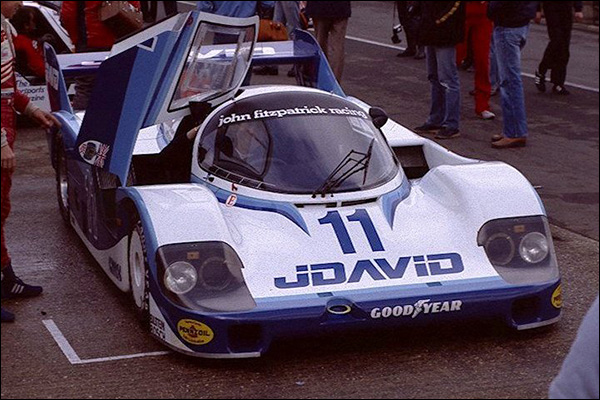
Today’s hybrid cars, he says, are something else again. “The last time I drove my 956 at Le Mans there were no chicanes and my top speed was 375 km/h. Now, with two chicanes, they’re quicker than that, and they’re 15 seconds a lap faster. The progress is incredible.”
In the space of two decades John Fitzpatrick won no fewer than 45 races in the British and European Saloon Car Championships, the European GT Championship, the DRM, the IMSA Camel GT Championship and the World and European Endurance Championships. He never raced a single-seater but was always at the forefront in touring and GT cars, a true champion in every sense of the word.
Michael Cotton