Saturday saw something quite incredible at Spa Francorchamps. It was not the race (though it was very, very good), or the size of the crowd, (though it was a record for a non-Le Mans WEC race at 88,180 over the race weekend), but rather the decision taken after the long red flag to reset the race clock to an hour and 44 minutes, effectively negating the delay to the on-track action.
It was widely welcomed, by the viewing public (watching trackside and at home), but was criticised by Ferrari, which saw the specific circumstances as unfair when taking into account its competitive position when the Red Flag came out.
We’ll get to all of that in due course but first, let’s look at the official reason as to why was the race extended.
This from the FIA post-race:
“The race session was not extended in duration but resumed for the 1 hour 44 minutes needed to make the necessary repairs and ensure the track was safe to race. That corresponds to the length of the race remaining when the red flag is brought out minus 3 minutes (time from the red flag to the cars stopping on the grid).
“This solution ensures sporting fairness for the competitors, who set their strategies for a six-hour race. Cutting the race session short would mean that some competitors would gain, and others would lose as a result.”
The length of that delay came after a huge accident for Earl Bamber which also involved Sean Gelael and Neel Jani. The most damage came because of the hit from Bamber’s #2 Cadillac on the rear of Jani’s #99 Porsche and Gelael’s #31 BMW.
(DRIVERS OK) Here is the accident that caused the red flag.#WEC #6HSpa pic.twitter.com/O9dY98Harr
— FIA World Endurance Championship (@FIAWEC) May 11, 2024
That left substantial damage to the armco barriers and debris fencing on the Kemmel straight with several sections of the barriers needing to be replaced to ensure the track was safe to race. 10 poles and 80 meters of barriers as well as eight meters of fencing required replacing.
First things first.
The work needed was extensive and was needed immediately and the race had a significant chunk of time remaining.
Before we get to the sporting side of things let’s look at the overall event and its context.
This is an important race for the WEC. It’s a warm-up for Le Mans at a long-established and popular venue. Spa-Francorchamps has invested very heavily in its spectator infrastructure and now boasts some of the best viewing spots in world motorsport and, for once, the weather was perfect! There was a huge and enthusiastic crowd attracted by all of the above and the excellent 2024 FIA WEC grid.
Then take into account three other fan-facing factors: The frankly disgraceful way in which the fans were treated back in 2021 at Spa during the F1 Grand Prix. There, weather was a major factor but the event’s liability for ticket refunds was callously ‘managed’ by running the bare minimum under Safety Car to ensure that revenue was retained. The current roadworks in Francorchamps need a mention too. They proved to be a major headache throughout race week, and the (at least in part) knock-on effects on traffic flow into the circuit on Saturday left many fans queueing for hours to get to the race. Many missed the fan-facing activities during the morning including the autograph session.
This was therefore an important moment. With the WEC growing in stature and fan visibility, which way would the organisers and rule makers move? In the grandstands and on the spectator banks there was no real hint of anything other than the clock running down until just 11 minutes before the initially planned end of race time.
The announcement of the extension brought applause and cheers in equal measure, and whilst some left, presumably with time-critical travel plans and/ or family commitments, the vast majority stayed. It was a HUGE win for the WEC in the eyes of the fans and one that was widely welcomed by the media, including this writer. Finally, it seemed, the fans had been put first!
Except that’s not the way that Ferrari fans and Ferrari itself saw it!
Ferrari, make no mistake, was very, VERY annoyed by the decision. Its two factory 499Ps had made their way to the front of the order before the red flag and looked set to stay there. They would have taken the win had the decision been made to run the clock down.

Worse still they were trapped on the wrong side of a pit stop cycle when the race restarted under the Safety Car, forced to take emergency fuel and thereafter doomed to make a full pit stop under green flags.
A likely win became a fruitless chase of the two leading cars that had been fortunate enough to pit just before the race was paused.
Its view, and it is difficult to argue against it, is that the decision directly affected the outcome of the race. It meant a hugely strong and valuable World Championship win and points haul was snatched from it through absolutely no fault of its own.
Ferrari sources told DSC afterwards that whilst they understood the reasoning, the team could not agree with the way in which the sporting decision was delivered. In the end its cars had no answer to the minute-long advantage that the #12 Hertz Team Jota and #6 Porsche Penske Motorsport cars had been ‘gifted’.
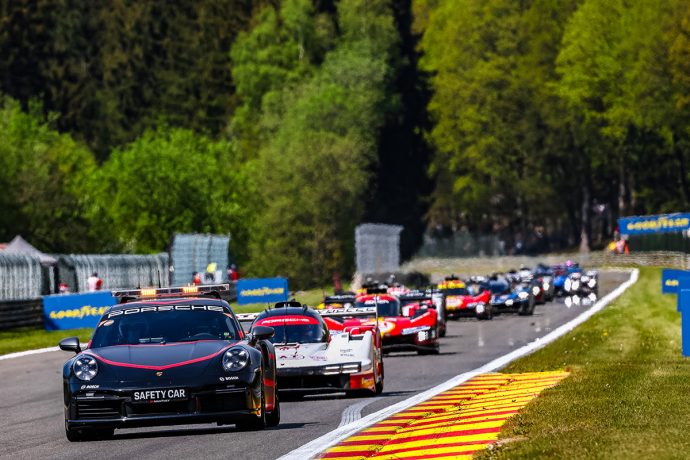
The cars had been allowed to take tyres under the red flag. This was a measure designed to offset any risk with several of the field having run through the extensive debris field of the accident. Whilst this writer is not a fan of the F1 method of managing Red Flags, in this instance it might well have been fairer to allow a full-field opportunity to pit for fuel under the Safety Car too. That would have seen the gap at best as the length of the queue.
It’s similar to the decision that was taken to amend the Safety Car rules in the wake of a massive advantage handed to the two factory Porsches in GTE Pro at Le Mans in 2018. During that race the timing and spread of the Safety Cars gifted the 911s an uncatchable margin. That was deemed later as a rule getting in the way of fair competition.
If that’s what happened on Saturday to Ferrari and others, then that rule too needs a review. There was a better way to ensure sporting fairness, and if the rulebook stood in the way of that decision it needs to change.
Across the whole picture though the decision was a good one. It was a great race meeting, which produced happy punters, a historic first privateer Hypercar victory for Hertz Team Jota and a third different team winning in the first three races.
Roll on Le Mans!