Here we are at the start of race week for the centenary running of the Spa 24 Hours, in the aftermath of a dramatic red-flagged IMSA Endurance Cup race at Watkins Glen over the weekend.
It’s hard to believe the Le Mans 24 Hours finished nine days ago. Where has the time gone? With the sheer amount of significant endurance races packed into May and June these days, it already feels like the dust has truly settled on the 2024 running of Grand Prix d’Endurance.
However, here at DSC HQ we still feel there are some loose ends to tie up after another staggering edition of the ‘World’s Greatest Motor Race’ at the Circuit de la Sarthe.
It was, as ever, an enormously busy 12-day stretch. It was packed with track action, press conferences, car launches and stories to chase down, and that’s before the race itself began on the Saturday.
So before we move on to the pre-race festivities at Spa-Francorchamps ahead of what promises to be another spectacular GT3 race in the Ardennes, here’s a rundown of some of the talking points we’ve been batting back and forth at the proverbial water cooler at the DSC office since the team returned home last week.
Nicklas Nielsen, take a bow…
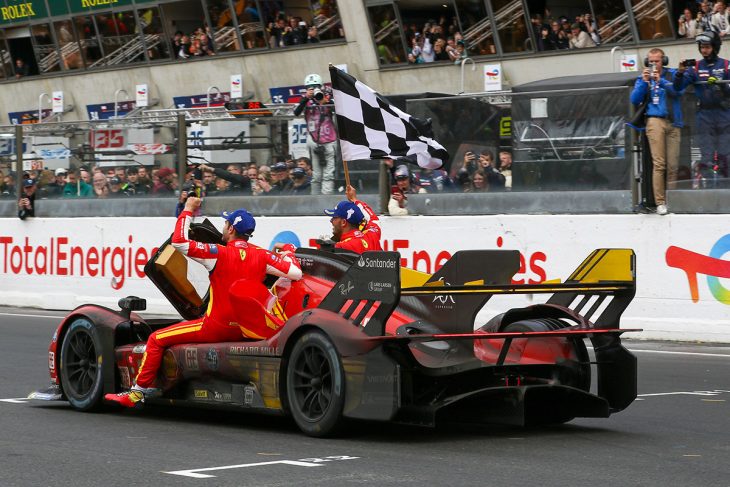
In a race as hotly-contested as this year’s Le Mans 24 Hours, there were always going to be multiple standout performances to reflect on (Alex Palou for Cadillac, Oliver Jarvis for United and Morris Schuring for Manthey EMA immediately spring to mind). But for us at DSC, Nicklas Nielsen’s effort at the end of the race to secure the victory for Ferrari stole the show and stood alone.

His composure when faced with the task of fixing a door that wouldn’t shut in the closing stages, and his determination to keep the #7 Toyota at bay in the final hour while managing his car’s rapidly depleting virtual energy tank was a sight to behold.
The stat of the race was that for the first time at Le Mans, more than two cars finished on the lead lap. And it wasn’t just two, or three, or even four, this race featured nine cars still in the fight in the treacherous, punishing conditions with time expiring.
Staying mistake-free, managing a lead, keeping out of trouble and staying focused after being called in for a quick door fix, under those circumstances, deserves the highest levels of recognition. It’s a stint that will surely go down in history as one of the all-time greats.
Nicklas Nielsen is a special talent, and now he and his teammates in the #50 finally have a WEC win under their belts, it feels like the sky is the limit.
New cars prompt mixed reviews
The 23-car Hypercar class thundering down the Mulsanne Straight in the opening laps of the race was truly a sight to behold. It was a field so deep, so varied and packed with world-class driving talent.

You could argue when looking around at other forms of motorsport right now, that those of us who have long been passionate about sportscar racing are being spoilt.
The new ruleset has delivered on its key promises, generating close racing between multiple hungry blue-chip manufacturers with great-looking and sounding cars. Back in the LMP1 era, did you ever think you’d see a Lamborghini prototype going head-to-head with a Cadillac in the top class at Le Mans? We didn’t either!
But with so many teams on the entry, the days when you could limp home after multiple problems and still finish in the top five (or in the case of 2017 – win outright) are over. Thus, there were plenty of manufacturers that left Le Mans with no trophies, and in many cases, no points to show for their efforts.
Unsurprisingly, this camp was filled primarily by teams bringing cars to the race for the first time.
For starters, it was undoubtedly a tough weekend for Alpine and BMW. The Alpine A424s both suffered mechanical dramas and retired early on, while both BMWs were taken out of contention with crash damage – the #15 in particularly dramatic fashion, the car an on-the-spot retirement after one of the race’s more controversial moments.
It would be too easy to pile on here. So instead, it’s worth pointing out that neither manufacturer endured a totally disastrous week. Sure, there is still work that needs to be done for them to become players at the head of the field, however, it shouldn’t go amiss that both made it into Hyperpole and shouldn’t require any wholesale changes to take the next step. Alpine may want to take a long hard look at its engine choice though…
Elsewhere, Peugeot and Lamborghini failed to feature at the sharp end too with their new challengers. The difference is that both 9X8 2024s and SC63s quietly made the finish.
Peugeot is an enigma, its new car promised so much but in performance terms was unable to make the same splash at Le Mans that the previous 9X8 did last year when it led the race in changeable conditions at nightfall. Did it simply get dealt a bad hand on BoP? Does the car need more tweaking? Did the team take too cautious an approach? It will all come out in the wash eventually.
There are rumblings that the 2024-spec 9X8’s key weakness has already been identified internally, which is believed to be a relatively simple fix via a further update. We shall see… At the very least the French marque has found the reliability it has been searching for since its Hypercar debut in 2022.
As for Lamborghini, getting two cars home relatively unscathed was a victory in itself. This is a programme that is still playing catch up in terms of testing and development time and until Le Mans has been navigating each race weekend in the WEC and IMSA with a single car. If more speed and consistency is found, then the SC63 could well prove to be a surprise package in the not so distant future!
We shouldn’t ignore either the Le Mans finish on its Le Mans debut for Isotta Fraschini.
Yes, the Tipo 6 Competizione needs to find speed, but it made the finish. That’s a mighty step in the right direction for what is undoubtedly the factory Hypercar programme with the tightest budget of them all. With the 2025 two-car mandate now in play that could just prove to have been an even more significant result…
Yes, LMP2 still deserves its place on the grid
Let’s be honest. This year’s LMP2 race at Le Mans was far from a classic. It didn’t get much air time, when it did it was generally for incidents and as a whole, the weather changes made for a race that was extremely challenging to follow.

However, LMP2 remains a key, foundational category in sportscar racing and it deserves to form a part of the entry for the discipline’s most important race indefinitely.
On the Friday before the race, when the Hypercar ruleset extension was announced, along with the WEC calendar, many may have missed that the current LMP2 ruleset was extended too. Not only that, but after some digging DSC discovered that the entire ruleset previously proposed for 2026 had also been scrapped – meaning a new set of regs will now be drafted more or less from scratch for 2028.
Right now, LMP2 is in rude health, with big grids in the ELMS, IMSA and Asian Le Mans Series, packed with high-quality teams and a suite of talented drivers looking to break into Hypercar and GTP.
However, behind the scenes, the formula remains fragile due to rising costs and uncertainty surrounding its future. It therefore deserves attention and must be protected going forward. And the best way to ensure the privateers keep coming back is to offer them a shot at glory at Le Mans.
Since the end of the 24 Hours, there has been plenty of discourse surrounding LMP2’s place in the sport and at La Sarthe. And on that front DSC would argue that it’s never been more important to save spaces on the Le Mans grid for these cars.
When the Hypercar ruleset reaches its natural end (be it in 2029 or beyond if it’s extended again) history tells us that privateers will be in high demand – especially if the Hydrogen ruleset fails to attract such a vast number of OEMs.
These eras with multiple manufacturers spending vast amounts of money to race in the top class never last. So, it’s crucial that the FIA, ACO and IMSA support and invest in LMP2 now and over the next few years, so that if and when the time comes, there is still a band of loyal private teams competing with prototypes to keep the grid healthy.
It wasn’t that long ago that 20-plus LMP2s were being called upon each year at Le Mans to ensure the race ran with a capacity grid. Don’t forget that.
A good week for Balance of Performance
After a Le Mans 24 Hours in 2023 that saw a huge amount of commentary and criticism over the Balance of Performance in Hypercar – and politicking in its wake. It is therefore a delight to say that the result of the 2024 race, and the way in which it emerged, silenced almost all of those critics.

The reality of the 2024 race was that we had four different manufacturers, and five different teams, in contention for a race win or a podium finish right into the final hours. It finished with a record-breaking nine cars on the lead lap too.
Yes, there were some concerns quietly voiced on the detail, but the major moans and groans disappeared, with Toyota, some of the loudest critics of late, able to race right to the finish in real contention.
Even one of the loudest critics of the process told DSC privately post-race that the basics had proven to be robust, despite the challenges imposed by mixed weather.
Some points of detail remain – including a close look at how the two-stage process introduced for Le Mans to manage top speed, and therefore lap time, works in practice. But the general consensus was that the cars, in more depth than ever before in the modern era, could race, race hard and race well.
Lessons have been learned on communication of the methodology, and on dealing with those who, whatever successes the process produces, will never be convinced. Good luck to them.
Has the WEC turned a corner in the debate around BoP? Let’s hope so!
Race Management in the spotlight
As always there was plenty of online comment about decisions made in dealing with incidents, and in punishing misdemeanours. And right now race management is a hot topic after a fog-shortened Nurburgring 24 Hours, rain-shortened Watkins Glen 6 Hours and a Le Mans 24 Hours with more than its fair share of safety car interventions.
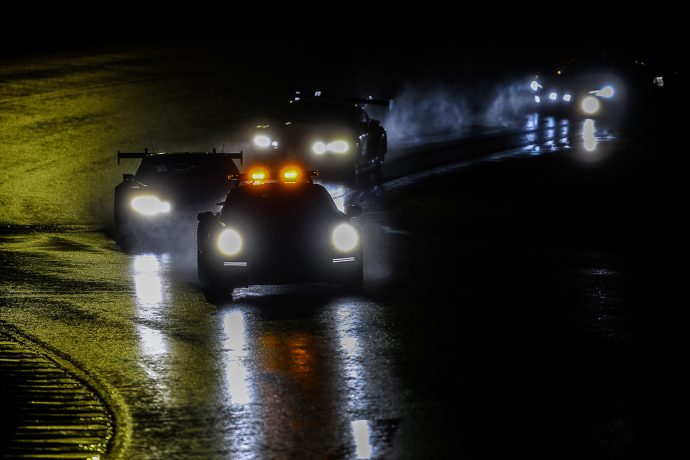
At Le Mans, two key matters arose from the race: The long overnight Safety Car period and the clash between Robert Kubica and Dries Vanthoor that saw the #15 BMW eliminated.
First things first, opinions from the public domain will always have less validity than those made by anyone personally responsible for the consequences of their actions and decisions.
Those decisions are always made with the benefit of examination of the regulations that directly apply to whatever circumstance or incident. They also benefit from the input of experts in Race Control, trackside and in the Steward’s room.
Safety Car procedures changed again in 2024. The new-for-2023 ‘drop-back’ to achieve class separation behind the Safety Car was jettisoned for in the interests of shortening the process. Despite that, many of the same voices were again heard, principally around the length of the process needing to be shorter still.
What is all-too-often missing from such inputs is an eye towards the role in the process to remain as fair as possible, not just to the Hypercar class, but for LMP2 and LMGT3 too. If that requires an additional lap behind the Safety Car then so be it – it is, after all, a 24-hour race, not a 60-minute sprint!
On the Kubica-Vanthoor incident, there is an established principle that in any incident the act is considered (and if necessary punished), not the ultimate effect. That is always difficult when the consequences are so drastic, and in the case of Vanthoor’s shunt, so final.
In this instance too the compounding, broadcasted, element of a radio message from Kubica added to the public perception of complicity, and a subsequent tribal battle of words.
Post-race Dries Vanthoor has said that he would like to meet with the race Director and Stewards to discuss the incident and their decisions. That’s the correct response. He has also said that he is disappointed that there was no apparent attempt from Robert Kubica to reach out to check in on his fellow driver.
It’s this writer’s opinion that the latter point is the more valid of the two – and more worthy of comment from anyone not directly involved in the incident.
Mistakes are made all the time – but some of them can be fixed.
Still early days for LMGT3
The ACO’s new brand of GT racing reached a Le Mans debut with a 23-car, nine-brand field.
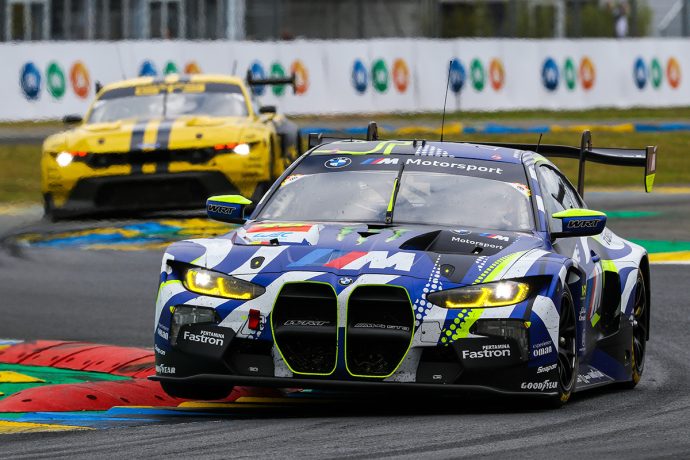
It’s still very early days with teams still pushing hard to find performance, full team performance, and sustained pace from their chosen packages. But the signs are that the second half of the WEC season will tell a different story to the first.
Whilst the previously established front-running order continued to stand out at Le Mans, they are, gradually, being joined by others. Porsche and BMW have been the race-winning brands in the FIA WEC so far, but McLaren, Lexus and Ford are now showing better speed and form.
There’s little doubt that the fans love the different lines and sounds of LMGT3. There are plenty of engaging storylines too, from the Iron Dames Lamborghini, the ‘sound of freedom’ Mustangs, the new-look to Corvette’s Le Mans presence and, lest we forget, Valentino Rossi.
LMGT3 may not, quite yet, be handing out the level of on-track entertainment that GTE, and in particular, GTE Pro traditionally did, but there are very encouraging signs. There is much, MUCH more to come, and the formula is set to attract more interest from the most important audience of them all – those with the resources to join the on-track fight!