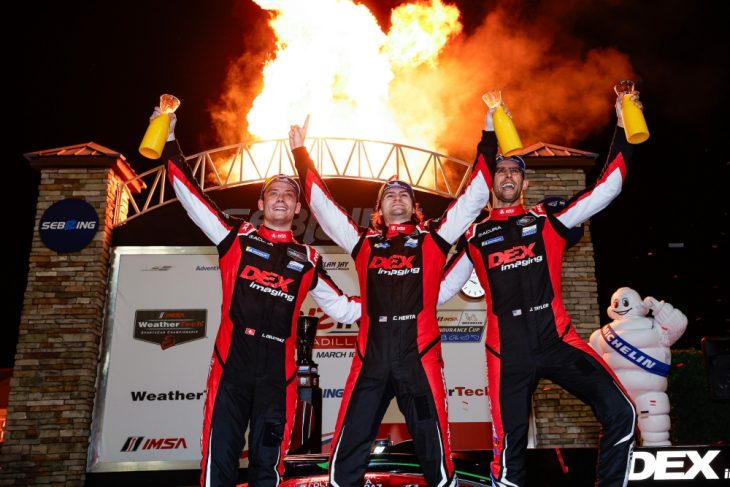
“I had a moment recently while working at home in Chicago,” John Doonan, the president of IMSA, recalls.
“When I was a little boy we had this tiny library at my school. It was like a closet. My dad was racing, so all I cared about were the books on the shelf about cars or racing. And there was this series of books called “Greatest Moments In…” for baseball, football, soccer and low and behold, auto racing.
“I checked that book out every week for my entire time in kindergarten through eighth grade, it had Richard Petty on the cover and I can probably recite it from memory. Fast forward to now, I found that book and now have it on my shelf at home. Back then I was reading about AJ Foyt, Parnelli Jones, Richard Petty and Jim Clark.

“So the other week I pulled it off and it gave me chills. Because who would have imagined that 50 years ago I was reading this book about the greatest moments in auto racing, and now what we are doing in sportscar racing and IMSA, is creating the greatest moments now, for the next generation?”
And he’s right. This astonishing era of convergence in sportscar racing is peaking, and fast. Crowds are attending races in record numbers on almost a weekly basis and broadcast viewing figures are on an upward curve globally. This area of the sport has always been cyclical, with manufacturers coming and going as the rulesets have evolved, and right now we are in the midst of an era that will be looked back on for decades to come.
For everyone at the top of the tree at IMSA and the ACO – who have worked tirelessly to get us to this point – making the most of the here and now and securing the sport’s future in the long term is the task at hand. And it’s fair to say that IMSA has exceeded its wildest expectations in growing its international audience since it soft-launched streaming WeatherTech races for free on YouTube back in March at Sebring.
That week, IMSA didn’t promote this addition to its broadcast offering, instead, it wanted to see what would happen if just put it up. DSC asked specifically if it should write about the YouTube option and share links to it throughout the weekend, but the answer was: “We’d rather you didn’t.” The powers that be wanted to see what would happen if it placed the broadcast on a platform in which it has a following of more than 350,000 people and the potential for colossal growth via ‘the algorithm’, with no PR punch.

The proof, as they say, is in the pudding. That live broadcast sits on the IMSA Channel now with 542 thousand views and led to the decision to add that option for fans permanently, alongside its IMSA.TV desktop platform and app.
With moves like this, IMSA is seizing the moment. It sees the huge, world-class Hypercar field in the WEC, and the capacity grids in SRO-run GT racing globally, and raises what it has in WeatherTech: A GTP field in rude health, GTD Pro class with factory resources being poured in and two high-quality pro/am categories packed with privateers.
The result of its push? A North American-based championship with an international flair, that now has a significant global fanbase to cater to.
It’s a special opportunity for us and we’re really happy
“With convergence, sportscar racing is in the spotlight more than at any point we’ve seen in our careers,” John Doonan tells DSC. “And when we moved to YouTube at Sebring, for the oldest endurance race in America, we had about 500,000 viewers live at the peak during that broadcast. We had high hopes, but that was beyond what we thought was possible.
“The North American market is incredibly important to our OEMs, our drivers, and our partners. IMSA is the largest ‘International’ racing series in North America. Those two points, coupled with the fact that we have 18 manufacturers choosing to compete with us, and dozens of drivers from all around the world on our grid, means that getting our IMSA product and broadcasts in front of a growing international audience is incredibly important.”
The figures post-Sebring offer further encouraging signs. The audience didn’t just tune in for the race with the highest profile and bolt. Instead, Doonan says, people have stuck around, making for a remarkable statistical jump year on year.
“We had 4.3 million hours watched on YouTube in 2023, and through the year to date so far we’ve had 15 million hours watched,” he adds. “It’s a special opportunity for us and we’re really happy.
“And this is making our manufacturers and partners happy too. The North American market has been named by almost every single manufacturer as the most important market for them when it comes to growing a brand.
“But with 18 manufacturers, their global headquarters may not be in the USA, they may be elsewhere. So, giving their executive teams – and people in the boardroom that agree racing is a proper marketing tool and an R&D tool – an easy way to view the races and see their return on investment is critical.

“Alpine (a target for IMSA in GTP going forward) is a tremendous example. They want to come to the US and sell road cars. If you bring the racing programme as part of the brand launch, it’s an authentic way to launch a brand. To do that you need lots of elements, retail locations and a distribution network, but you need awareness more than anything else. What better way to get that than via showing the public what you can do on track?”
Private teams around the world are noticing this upward trend too. IMSA’s paddock is becoming more populated with teams and drivers from outside of North America. Look at LMP2, which features top notch European teams like United Autosports, Inter Europol and Algarve Pro Racing.
By actively pushing for growth internationally, it’s opening doors for teams that have always wanted to race in IMSA, but were previously unsure how viable it would be commercially for backers and customers that don’t do business in the USA.
“We’re going to need 20 more pit boxes at Daytona in 2025 based on demand, to fit the interest we’re seeing,” Doonan points out.
The demographic these broadcasts are reaching is interesting too. YouTube is as accessible as it gets these days, with apps on phones, tablets and TVs, making it simple for younger race fans to find and consume content without the need for cable boxes or streaming subscriptions.
More than 70 per cent of IMSA’s YouTube audience is aged under 44, and they come from every corner of the globe. The top 10 countries for the race streams by audience size include the UK, Germany, Canada, Italy, Australia, France, Indonesia, Brazil, the Netherlands and Japan.
Beyond streaming full races live on YouTube, IMSA has taken strides through other types of content on its channel too. Doonan feels these accompany the race broadcasts and highlights packages nicely.
Its fly-on-the-wall behind-the-
“What Win The Weekend has done is send a whole new audience to the IMSA brand and show. It’s targeted motorsport fans who haven’t ever really focused on sportscar racing,” Doonan explains.
“Go back two years, our channel had 10 million views in 2022 and thanks to Win The Weekend, 80 per cent of the audience who watch had never been to the IMSA channel before.
“Then you look at the views in 2024 vs last year, in this calendar year, we already have 25 million views on IMSA YouTube. Last year for the year we were at 17 million.”
Another series that’s growing fast is the shorter-form supplementary features hosted by Marshall Pruett. His tech tours, paddock walks and explainers have achieved their target of retaining the new audience and giving them reasons to come back regularly during and after key weekends.
“They all feed the bigger picture,” Doonan adds. “This sport isn’t the easiest for new fans to grasp, so if you have all these extra pieces like Win The Weekend, short videos explaining how things like hybrid systems on GTP cars work, then it makes it so much easier for people to understand what they’re watching and appreciate it.”
What does all this mean for the future?
With heads now turned in the paddock and teams, manufacturers and partners alike getting a flavour for the reach they can tap into via the international broadcast, will we see changes and innovations to the broadcast experience? Will IMSA try to monetise this with a paywall?
We have to be careful. This is not a money grab. These initiatives are more about getting people invested and seeing value.
“For me, we want to add value for fans. We want to educate the fans,” Doonan concludes. “You want to make sure the broadcast comes across in a quality manner and thanks to our NASCAR Productions and broadcast team, it is, but it has to be the highest quality going forward too. That’s number one.
“Number two is you want to make sure that you have a critical mass of people that are tuning in regularly. That allows you to dictate those features and make sure that the quality of the production and technology comes through quickly to get across the racing and tell stories.
“But, we have to be careful. This is not a money grab. These initiatives are more about getting people invested and seeing value. Fans around the world are now tuning in at a consistently growing rate and we will continue to do our best to deliver exciting racing to them through the rest of the season and into 2025.
“For me, once someone watches IMSA for the first time, I want them to be so captivated that they come back again.”
Images courtesy of LAT/IMSA & Jack Webster