Three years ago, GT World Challenge Asia was practically written off as a casualty of the ‘Corona Shock’.
SRO’s Asia-Pacific championship was forced to cancel the entire 2020 season due to the onset of COVID-19 and travel restrictions that made entering and leaving many Asian nations prohibitively difficult, if not impossible. By 2021, most of those restrictions were still in place, and another year was stricken off the record books.
And now, that period feels like a distant memory.
One week after I had taken in the emotional rollercoaster that was this year’s 24 Hours of Le Mans, I was at Fuji Speedway for GT World Challenge Asia’s first Japanese round of the season – and what was said to be the largest gathering of GT racing cars ever assembled for a race meeting in Asia.

Big car counts aren’t the only ingredient to high-quality racing, but a group photo featuring 46 out of the 49 cars in attendance symbolised more than just a cool photo opportunity – it was a symbol of the resurrection and continued resurgence of a series that was once left for dead, yet has made a remarkable comeback – arguably better than it was before.
When talking about sports car racing’s comeback stories of the 2020s, the resurrection of top-flight prototype competition in the Hypercar/GTP era certainly is at the top. Aston Martin reviving its Hypercar programme from the scrapheap is up there. And how can you not love the human triumph of Robert Wickens, a champion endurance racer more than half a decade since his life-changing IndyCar crash?
But to know more about what I consider to be one of the other great comeback stories of the “post-COVID era” (COVID hasn’t actually gone away, of course) that was continuing under the shadow of Mount Fuji, I wanted to have a chat with Mr. Benjamin Franassovici from SRO Motorsports Group. “Benja-san” is the straight-shooting, energetic Championship Manager who not only oversees GT World Challenge Asia but also the new-for-2024 Japan Cup series.
Nothing was easy for anyone during the onset of the pandemic, in those years without safety nets in place. But you’ll likely agree that Franassovici had a much tougher task than most people trying to coordinate and execute a professional racing series during Those Uncertain Times®.
“We were the first ones to say, ‘Right – let’s go racing!’ when no one in Asia was ready for that,” recalls Franassovici – known to his Japanese colleagues as “Benja-san” – of the period when SRO Asia was ready to resume on-track action after two years away. “But it was a bit too early. It was difficult to get visas, people needed vaccination, et cetera.
“Not many were that courageous to make the jump because it was still COVID days, and people were still cautious.”
In over 25 years of working at SRO alongside the company’s founder, Stephane Ratel, Franassovici has worked as a Team Coordinator and a Championship Manufacturer for multiple SRO-sanctioned championships and major events.

And he’s seen no less than two seismic shifts in the highest standard of GT racing worldwide, along with an aggressive outward expansion of SRO from its traditional European strongholds into America, Asia, and Oceania during that time.
But – and this might be a “hot take” – a once-in-a-generation pandemic that brought normal day-to-day life to a standstill was a far more troublesome challenge than, say, the rapid boom-bust cycle of late ’90s GT1 racing.
East and Southeast Asia, the home base for the series’ venues and most of their competitors, were tightly locked down – creating a 21st-century Sakoku era. Not only was GT World Challenge Asia parked for two years, but the historic Suzuka 10 Hours dropped off the Intercontinental GT Challenge calendar, and the Macau GT Cup reverted from an FIA World Cup race to a strictly local event.
“People didn’t know if they could fly from Australia to Malaysia, and when we launched, you couldn’t. So we took a risk that no one else was ready to do.
“And it was a gamble! It was a total gamble – but a calculated one,” he said.
So after two years of silence, GT World Challenge Asia returned in 2022 – with a new wrinkle. The Japan Cup – a “championship within a championship” exclusively for Japanese teams – was created, with eligible teams scoring points in a separate set of tables during the four Japanese mid-summer rounds.
GT World Challenge Asia had raced in Japan before of course. But as Franassovici explains, it was now a crucial component of the series attempt to come back from the dead.

“I needed to go somewhere where you have racing teams and tracks. And Japan is the main one in Asia. They have history in racing, drivers, cars, and tracks – so you had the recipe to make it happen in one place without travelling. So we went ahead and we mixed Fanatec (GT World Challenge) Asia and Japan Cup – and the Japanese said, ‘I’m gonna have a bit of this!'”
But to make it to the launch of the Japan Cup, where nearly two dozen teams had committed to running most or all of those four races – the series first had to make it to its first event in almost three whole years – the May season opener at Sepang Circuit.
“We are definitely guilty of being ambitious!” exclaimed Franassovici. “And I knew that it was feasible.
“I knew that Sepang was going to be a bit early for some to commit. But I knew that in Japan I was going to have 20 plus.
“At that time I was talking to teams in Japan who’ve never raced with us on the phone. I had to convince people we’re going racing – and it was difficult to convince them.”
While it is worth restating my earlier point that car count alone doesn’t make for memorable racing, the turnout for Sepang was bleak, with only eight cars and only one big-name driver with a stature outside of Asia (shoutout to Earl Bamber). To the punters, GT World Challenge Asia looked like it was going to go down as a short-lived SRO endeavour that had potential, but ultimately failed.
Even Franassovici was beginning to second-guess himself in the build-up to that return race.
“At the beginning, I had around ten or 12 cars. I was calling Stephane – at that time I was in quarantine in a hotel. I knew that numbers were going down slowly.
“And then you have to convince someone, ‘oh, I’ve got 12, I’ve got 14-‘ but then I was going below ten, and I said, s–t!
“At one point I said, ‘We’re gonna have to can this – it’s not viable.’ But I knew also, that we had cars in containers. We had teams that committed. So why would I shut down after the first event, disappoint them – and then all the other people who were negative would have won?
“I told Stephane, ‘We’re not cancelling this.’ I’ve got customers with trust in us, and are coming, and with cars on the boat – so we’re doing it! And it wasn’t such a drama. It wasn’t that bad…it obviously wasn’t great.

“But then, in round one, people were actually saying, ‘Hey, well done! You guys did it. No one else was going racing, and you did it.’ And then we went to Japan, and we had 25 cars.
“We showed everyone the way,” he said with a smile. “I have to admit, it was ballsy. It was risky. But it paid off!”
The Japan Cup kept GT World Challenge Asia above water in 2022, and it laid the foundation for an all-around stronger championship in 2023. The series returned to Chang International Circuit in Thailand, while the number of full-season entries present from Buriram to Sepang tripled from 2022 – and not just from Japanese teams, but from GT World Challenge Asia’s core markets in China, Hong Kong, and Taiwan. GT3 factory drivers from Europe also began returning to the series to restore even more legitimacy in the eyes of Western audiences.
That’s not to say the Japan Cup in its second year didn’t have appeal. A good mix of full-time and part-time entries continued to add variety to the grid at venues like Fuji, Suzuka, Motegi, and Okayama from interested privateer teams who needed a place to race in a professional setting – particularly with the SUPER GT Series’ GT300 class grid already at its maximum capacity, unable to take on teams like Porsche Center Okazaki or Team 5Zigen.
It culminated in a 40-car grid for the 2023 round at Fuji Speedway – a keystone moment in the series’ revival, but also, in Franassovici’s eyes, a moment that sparked a big change this season. “Well, a year ago, we were racing here,” Franassovici said, “and we had 40 cars – we had a lot of Japanese cars and a lot of Asian cars.
“And it was a bit too many cars – 40 cars for 60-minute races. The drivers were a bit too excited. They all touched a bit too much.”
In particular, a carnage-strewn second race of the weekend with multiple heavy crashes – that ended with 27 cars receiving post-race time penalties for not following race control’s instructions – was what drove Franassovici to turn Japan Cup into a standalone series in 2024, to at least make things a bit more manageable.
“This race was a bit difficult, so I decided at the end of last year to say, ‘Okay, there’s interest from Japanese teams, and Fanatec is still very strong with more interest. It’s time to split it.’
“It was a bit early to do so, but I was very keen. Japan wants us to do something more, and I didn’t want to turn away those 15 cars which wanted to do Fanatec.”

Now, GT World Challenge Asia is a strictly GT3-based series just like the other World Challenge series, and averages over 30 cars per weekend with no shortage of high-quality efforts backed by major manufacturers who see the value of competing in the region.
Alex Gibot, Managing Director of Porsche Motorsport Asia Pacific, was proud to have a fleet of 11 customer 911 GT3 Rs in the World Challenge grid plus additional 718 Cayman GT4s and 911 GT3 Cup cars in Japan Cup – the fruits of a powerful investment from the brand in the Asia-Pacific region that began seven years ago. “We feel it’s a privilege to have such representation in a major GT championship in the region with GT World Challenge Asia. The championship had a super-rapid growth after the pandemic because the region was quite affected,” remarked Gibot.
“We have customers coming from mainland China, we have customers from Japan, and we have customers from Korea. So it’s a very good representation. It’s great to show that the Porsche path to international sports car racing is not just true for the drivers, but it’s also true for the teams.
“Also it’s not just a big number of cars, but it’s also a very competitive customer lineup – with some strong drivers, we have some drivers coming from the factory. So the level in general for GT World Challenge Asia is super, super strong. It’s quite competitive. And it’s great to have this competition with so many brands on the grid.”
Christoph Sagemüller, Head of Mercedes-AMG Motorsport, is another architect who values his company’s efforts in the Asian championship – with a total of eight cars present across both categories – and especially enjoys the interaction that his factory drivers get to have with the hardcore Japanese racing fans.
“Of course, Japan is, for us, a very important market – but also Asia in general,” explains Sagemüller. “And this is why we also focus on those markets and try to be very active in our customer racing programme. Because for our brand it’s a very important tool – and also the manufacturers are very interested in activating and racing even more here in the Asian market.”
“It’s very much about the fans and the dedication here – this feels really different. Especially when you look at the German drivers that are very, I would say, famous here in Japan. It’s so nice seeing the fans out there with the model cars and wanting to get everything signed!”

Sure, there are even more world-renowned aces coming over to take part in events: Names like Gounon, Engel, Stolz, Winkelhock, Picariello, Pilet, and Mapelli could headline almost any GT World Challenge race on their own, especially at that weekend in Fuji.
But even more importantly, the teams and drivers from East Asia – especially from the China region – are stronger than ever before. On the teams’ side, emerging powerhouses such as Origine Motorsport, Phantom Global Racing, and Climax Racing have quickly risen to the level of ‘older giants’ like Absolute Racing and Craft-Bamboo Racing.
On the driver side, whether it’s Bronzes like 2023 series champion Anthony Liu Xu or his main title rivals Lu Wei and Bo Yuan – or Silvers like Leo Ye Hongli, James Yu Kuai and Franky Cheng Congfu – they’re not just there to make up the numbers, they’re here to win and beat the best from the East and the West.
“It’s the fault of COVID – people couldn’t go racing, so the envy was multiplied,” Franassovici remarks of this surge in strength.
“China was big with us before COVID – and now it’s bigger. And the level of the teams and the drivers…they know they can show their muscle against our more established European hot guns. So it’s a great way for them to show and be compared.
“The Bronze Chinese drivers we have are very strong – and they’re very hungry, oh my god. Some of them are super-quick, but they are true amateurs. But I saw that coming last year. It’s really growing,” he says enthusiastically.

Japan Cup continues to offer GT3 and GT4 multi-class racing as a standalone series – and is now open to GTC one-make specials and prospective GT2 entries. Japan Cup has averaged about 15 entries per weekend so far. Franassovici hopes to have 20 for the series finale at Okayama this month.
The new series also exploits a rare gap in the Japanese sports car racing market, which already has two long-running championships: SUPER GT and Super Taikyu.
SUPER GT is firmly established as Japan’s most popular domestic motorsport league in terms of prestige, participation, and viewership. It is functionally an all-pro racing series in both the GT500 and GT300 classes. And while what we’d consider to be ‘Bronze’ drivers do still participate in GT300, their prospects of contributing to meaningful results are exceedingly rare or non-existent against nearly two dozen teams that have pro drivers in every seat.
Super Taikyu requires amateur participation in its GT3 and GT4 categories, operating as Japan’s equivalent to the Nürburgring Langstrecken-Serie. However, as an endurance championship, Super Taikyu demands quite a bit more resources to run every weekend than the sprint-based Japan Cup.
These are the competitors that Franassovici wants to bring in: The Bronze drivers and the smaller-budget teams that GT300 effectively left behind, and the GT4 teams that want to go racing at a high level but aren’t yet ready to commit to racing for three, five, or even 24 hours at a time as they’d have to be in Super Taikyu. But if a team that’s already in one of those other series wants to expand its reach, hey, they’re more than welcome to jump in too – five current GT300 teams have a presence in SRO’s Asian series!
Franassovici acknowledges that reluctantly or otherwise, SRO is the ‘disruptor’ in Japanese sports car racing. “But a gentle disruptor!” he clarifies. He does not want his series to be an antagonist and drive discontent between SRO, the GT Association (SUPER GT’s promoter), or the Super Taikyu Mirai Organisation.
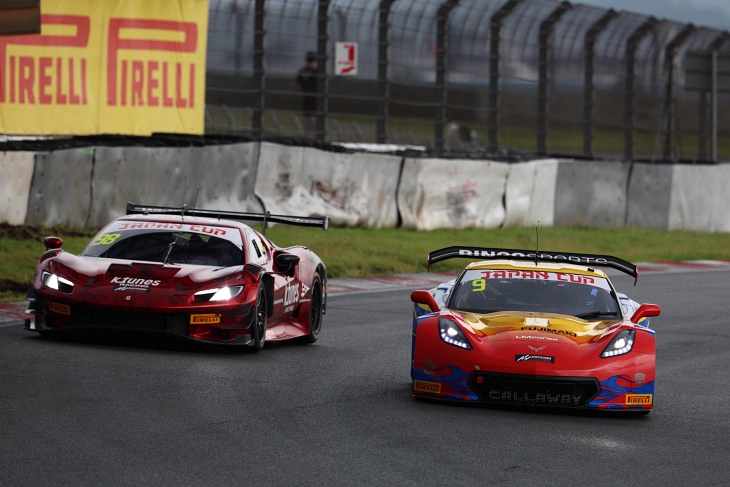
“We’re here because, for me, there was this big gap in the market with a well-organised sprint format that doesn’t exist here,” he says.
“You have Super Taikyu and SUPER GT – we fit in the middle. We don’t want to disrupt Super Taikyu, we don’t claim to – and we don’t clash, because it would be silly to clash. And SUPER GT, it’s in a league of its own with professional factories – and we don’t do that.
“For me, there was a gap in the market. There was an interest. And you can see it on our grid.”
And while GT World Challenge Asia and Japan Cup – just like any other Pro-Am sports car racing series – are focused more on racing customers than spectators, it was hard for me not to notice that Fuji Speedway was buzzing with the energy of avid racing and automotive enthusiasts once the gates to Fuji Speedway opened for racing on Saturday.
The crowds for the pit walk and autograph sessions certainly weren’t as big as the 400,000 strong that attended this year’s 24 Hours of Le Mans, or over 75,000 that turned up over the two days of the SUPER GT Golden Week race at Fuji. Even if it was just a few thousand, though, you could feel their love and enthusiasm throughout the weekend (even if I still couldn’t talk with them in the native language, no matter how hard I studied…).
Whether they came because they go to every race at Fuji, or whether they just wanted to see a slice of European-style GT racing in their backyard that they don’t see very often, they were treated to good competition in both sunny and rainy weather – two good Japan Cup races, two great World Challenge races, sprinkled with Formula Beat and Super FJ single-seaters and the absurd Superkarts.
It makes all the work to revive and restructure these series worth it.
“We didn’t have to do this,” says Benja-san. “It would have been very easy for me not to do it, to have maybe 35, 36 cars in Fanatec and make my life simple. No, no! I had to get another grid, buy more track time, buy more TV, and get a bigger team!

“It’s quite an investment from our end. But the result is we have a very humble grid for a new championship.”
At the end of my conversation with Franassovici, the topic of endurance racing came up, naturally with the 24 Hours of Spa-Francorchamps around the corner – talking about the prospect of many of these newer teams and drivers making the jump to race in marquee events like Spa, Nürburgring, Bathurst, Macau…and then inevitably, I had to ask about Suzuka.
What he could tell me at the time was that the Suzuka 10 Hours – which had been dormant since 2019 – might return under a different format. Days later in Belgium, Stephane Ratel announced to the world that the Suzuka 1000km would be resurrected in 2025, in its original format.
When it returns in September, the revival of Japan’s great endurance race will likely put the teams in the rejuvenated GT World Challenge Asia front and centre, likely to share the spotlight with top international teams that will elect to make the trip to Japan – and surely, other GT3 competitors from SUPER GT and Super Taikyu cannot be overlooked.
That’ll be the crown jewel of a season of SRO Asia events that also includes the debut of Mandalika Bay in Indonesia – three years after it was initially set to join the calendar – along with now-familiar stops across Japan, Malaysia, Thailand, and China.
The comeback story of the Suzuka 1000km will have to wait for another day.
Photos © SRO Motorsports Group, RJ O’Connell