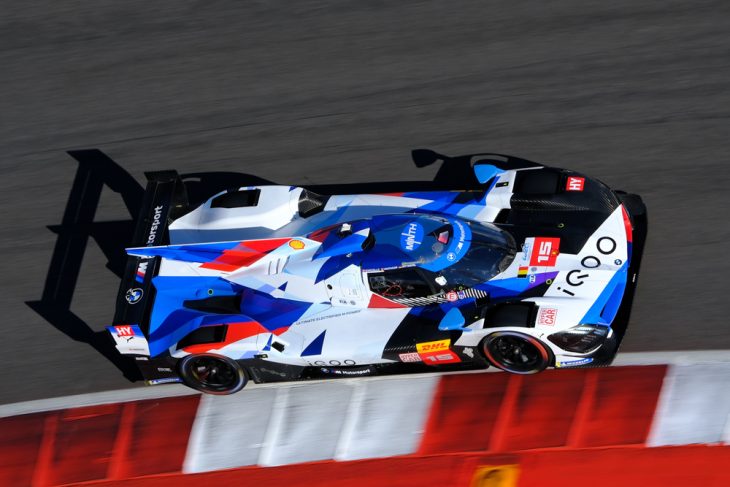

With a second-place finish in the WEC race at Fuji and a 1-2 in the IMSA Endurance Cup round at Indianapolis, things are suddenly looking up for BMW’s M Hybrid V8 programme on both sides of the Atlantic.
So is it time to reset our expectations, with Petit Le Mans and the 8 Hours of Bahrain right around the corner and the 2025 season openers approaching?
The road to BMW’s standout September in IMSA and the WEC has been a long and arduous one. This season RLL has been fighting through a second-year slump, with zero trips to the podium through the first seven IMSA races, while WRT has spent much of its maiden Hypercar campaign playing catch up with its new package. It’s only now, with the third season for the M Hybrid V8 on the horizon, that BMW is beginning to see results that match its work behind the scenes.
In the current era – with manufacturers desperate to keep budgets under control – once a car is homologated, your options to take strides in performance and reliability terms are limited. All updates must be approved by the rule-makers, and changes to improve a car’s raw speed are unlikely to be granted unless your situation is dire, as Balance of Performance is – in theory – now on hand to play backstop.
Therefore, targeting marginal gains to refine your car, to ensure it can reach the limits of its defined performance window over multiple stints is the key to success.
And that’s exactly what BMW has done with WRT and RLL over the past two years. Like the other LMDh manufacturers, when it comes to bringing evo ‘Jokers’, it has been apprehensive. But that doesn’t mean it has been twiddling its thumbs.
Andreas Roos, the head of BMW M Motorsport, told DSC that no major updates are in the pipeline back at CoTA. Instead, it has an off-season test plan mapped out and will stick with what it has for 2025.

“We are not where we want to be but there is room left in our package,” he explained. “So we are trying to optimise this and go further into detail to optimise the performance of our car.
“The performance has spiked, like at Le Mans. So we know the potential is there, we just have to be more consistent and quick under all circumstances. But it’s clear with all these manufacturers that it’s not that easy to make steps.”
Where exactly are the gains being made then?
According to Valentino Conti, BMW’s head of track engineering, much work has gone into fixing vibration issues that impacted a number of areas through the first season of the M Hybrid V8’s life.
He revealed that a change in engine concept from the current P66/3 eight-cylinder turbo (based on the DTM unit used in 2017 and 2018) was even considered at one stage. But like Porsche, BMW has decided to stick rather than twist, holding off on a major change.
It’s also notable that developments from Bosch – the hybrid unit supplier for all LMDh cars – are understood to have made a big difference in this area and played a part in both BMW and Porsche’s decisions.
“We have had vibration issues not only affecting the hybrid system, but various other parts on the car,” he continued. “We did a thorough analysis and we were thinking of a change (like Porsche) on the engine concept, but we identified all the areas and found solutions, which means we can stick to the concept.

“We never had many issues with the MGU, it was other parts to the car where we had issues that we had to fix. One part was the steering wheel. We were doing analysis on vibrations in the whole car, and one part was the steering wheel.
“It’s interesting, we underestimated it.”
Software is another area in which BMW has made progress with the M Hybrid V8. The complex systems behind the current set of LMH and LMDh cars can be tweaked and refined. And as he explained, there’s far more to it than just updating the car’s traction control.
“TC is one part for sure; you can always work on that and improve, and that’s critical for us,” he said. “But there are other functions on the car that you want to develop. You can influence the balance and also its performance under braking because it’s hydraulic, it’s in combination with the hybrid system and the re-gen. You want to play with these areas.
“You also have a power curve which you have to follow and with vibrations and oscillations, and it’s very hard to match the power. Sometimes, you overshoot, you undershoot, and you have to work out the margins and reduce them. Software never ends.
“And on this car, opposite to Formula E, it’s very aero-driven, and this is where we have to learn. The aero is frozen but you have to find the optimal window to run the car on the track and the differences here are the three types of tyres and sometimes it’s not clear.”

As BMW and its teams have learned more about the M Hybrid V8, they have found ways to improve tyre warm-up too.
With no tyre warmers in either IMSA or the WEC, every manufacturer has had to find ways to get their cars up to speed as quickly as possible after each pit stop, to avoid haemorrhaging time on out laps. There is still room for improvement in this area though.
“Tyre warm-up is a big thing,” Conti stresses. “With LMH and LMDh, there are differences because they have the MGU at the front and when they get away they can spin the front wheels as well, so for us bringing the front wheels up to temperature is still a struggle. And that’s not the only advantage.”
So while no ‘Jokers’ are expected any time soon, in part because the M Hybrid V8’s reliability is “knock on wood, ok” and in a “stable window” according to Conti, there’s cause for optimism. There is the belief that this uptick in form from BMW can and will carry over to the 2025 season, where expectations will be even higher.
Will we see BMW challenge for titles and major race wins at Daytona, Sebring and Le Mans?
Taking that step, according to Roos, is going to take “something from everyone to give the drivers what they need to be consistently fast.”