When the FIA WEC’s Prologue test gets underway in Qatar later this month, most eyes will be fixed on the pair of Aston Martin Valkyrie AMR-LMHs, the newest additions to the astonishing 18-car Hypercar field.
It is one of the most highly anticipated programme debuts of recent times for a number of reasons, but principally because the wait has been so long.
The original Valkyrie programme was set to debut back in 2020 after Aston Martin became the second manufacturer (after Toyota) to commit to the ruleset back in 2019. But it was shelved before it reached its testing phase as the brand shifted its focus to Formula 1. Now, though, after Gabe Newell’s Heart of Racing organisation resurrected the effort, we will finally see the Valkyrie in competition.
The test programme, which got underway in the UK last July at Silverstone and Donington Park, has been hailed a “success” by the manufacturer.
More than 15,000 kilometres have been covered at circuits in Europe, the Middle East and the USA by the two test chassis produced. The car has been put through its paces at Vallelunga, Jerez, Bahrain, Qatar, Road Atlanta, Sebring and Daytona in preparation for its global race debut.
This will take place in the Middle East rather than North America. Heart of Racing and Aston Martin decided that sitting out the Rolex 24 at Daytona last month was the best course of action, giving all involved more time.

The Valkyrie stands out from the pack in the Hypercar and GTP ranks and not just because of its dashing good looks. You could say it’s the purest horse in the race. It’s a non-hybrid LMH-spec prototype based on a road car which has been in customer hands since 2021. Philosophically, it ticks just about every box that the Hypercar regulations originally set out to achieve.
But that doesn’t mean that putting this racer together has been a simple task – far from it. Ensuring the Valkyrie fits within the regulatory boundaries that the FIA and ACO have put in place has been a complex exercise in engineering.
The car’s Cosworth-built 6.5-litre naturally aspirated V12 engine – which in roadgoing form reaches 11,000 rpm and develops over 1000 bhp – has been modified for competition to get it in the performance window and withstand the punishment it will take during some of the longer, more taxing races.
On reliability and durability, the hypercar regulations – which enforce a power limit of 500kW (680bhp) – offer advantages for a V12 that was already built to withstand extremes.

“Running lean to reduce the amount of fuel you are carrying to deliver the required stint energy is important,” Aston Martin’s endurance racing boss Adam Carter (above) says. “We operate the engine slower than it’s capable of because we require less power. The lower power limit within the regulations creates an opportunity for us to revisit the torque curve and reduce frictional losses by reducing engine speed to increase fuel efficiency.
“In order to take a 6.5-litre V12 in that package and meet the regulatory requirements within WEC and Hypercar it’s not possible to create that (a hybrid component),” Carter added, in conversation with reporters earlier this week. “Also, Aston Martin V12 engines feature throughout the product range, so running a sustainable fuel, lean-burn engine is synergy with that strategy.
“Everything is based on closed-loop torque controls at the rear wheels, and it’s about how good a job you do at achieving that control. We’re confident that we have a very capable package.”
As an aside, there’s been plenty of discussion regarding the decibel levels the car will produce in competition courtesy of its wailing V12. During the IMSA Sanctioned Test at Daytona at the end of last year, it ran quieter than expected. This, according to Carter, was the result of a cautious approach to silencing the car.

“When it first started running we were over-suppressed in terms of noise, we took a safe position in terms of silencing. The worst-case scenario is to get stopped in testing due to breaching noise limits,” he explained.
“We over-compensated, so as part of the development programme, which has been driven purely by performance, has been to reduce the silencer size. It reduces the weight, the inertial loading on the exhaust, the underbody blockage and helps with cooling.
“In turn, this has unleashed more of that beautiful soundtrack. I’m really looking forward to hearing it in Qatar out on track.”
Aerodynamically, the Valkyrie has had to evolve, too, to meet the FIA’s performance window criteria. The active aero devices found on the road-going model, for instance, are gone, replaced by a “passive” solution that Aston Martin hopes will see it capable of fighting at the sharp end.
“We’ve had to redefine the aerodynamics of the car. If you look at the car, actually we went out with great intention of leaving as much of the outward-facing surfaces as per the Valkyrie surfaces. It’s important that it’s the full representation of the Valkyrie where possible,” Carter continued.

“So, in terms of the re-positioning in the performance window, a lot of that is in the underfloor, the underfloor front wing area and you will also see, as per other LMH and LMDh cars, there’s an amount of work put in place around the aerodynamic stability criteria. So, apertures in fenders, rear-wing end plates etc.”
The racing suspension configuration has also been finalised. It features double wishbones front and rear, with pushrod actuated torsion bar springs with adjustable side and central dampers.
And digging deeper still, significant tweaks have been implemented to ensure it is race-ready. Unlike the production model, the LMH boasts quick-change front and rear bodywork, a single-point rapid refuelling coupling, a high-speed pneumatic jack system incorporated into the chassis, and a driver cockpit optimised for safety and quick access.
With the pre-homologation development phase complete, it’s over to Heart of Racing, which is responsible for the sporting element of this venture. The AMR-LMHs that will be campaigned across IMSA and the FIA WEC will be operated by two dedicated groups of HoR staff, though they will collaborate throughout the year.
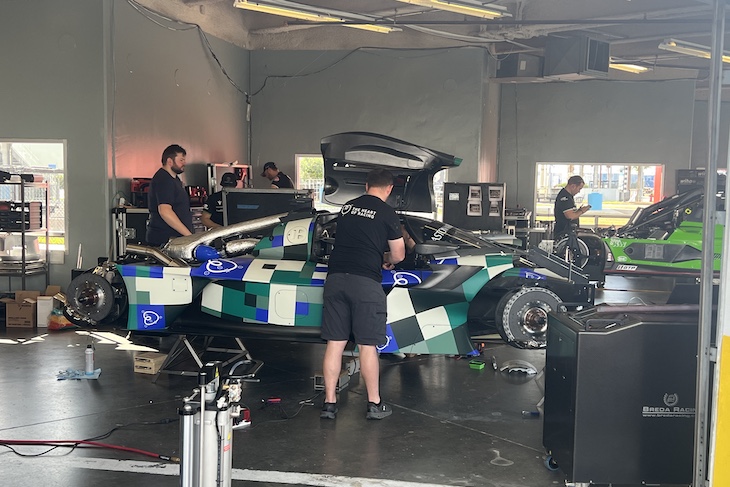
“Between IMSA and WEC they will largely be separate programmes though you will see some crossover, especially at the first races because of the learning opportunity,” Carter pointed out when asked about the staffing strategy.
“Strategically though, both will operate separately, with communication between both parties between races and you will see the odd person like myself (from Aston Martin) on event as required.”
Achieving breakthrough results in the first season will be tricky. The level is already so high and the Hypercar and GTP fields are big.
Look no further than BMW, Lamborghini and Alpine’s programmes, which endured challenging debut campaigns in the WEC with their prototypes last year. Racing in a field packed with teams that had joined the party in 2023 or – in the case of Toyota and Peugeot – even earlier than that, made breakthrough results tough to achieve.
“We fully respect the calibre of the competition and that’s part of why Aston Martin Racing wants to compete in both WEC and IMSA,” Carter said when asked about expectations for the season ahead.
“There’s only really a point in going if the competition is strong. If we can complete this year having shown competitively, then I will take that as a good position.”
Image credits: IMSA & Aston Martin