Joshua Rowledge returns to British GT in 2026, determined to convert a year of hard-earned learnings in Porsche Carrera Cup Asia into a defining GT3 campaign.
The 20-year-old will rejoin the GT3 Silver-Am ranks with Mahiki Racing, partnering team owner Steven Lake in one of the squad’s two new McLaren GT3 Evos. The move marks a fresh chapter following a sabbatical season spent refining his craft in one-make competition.
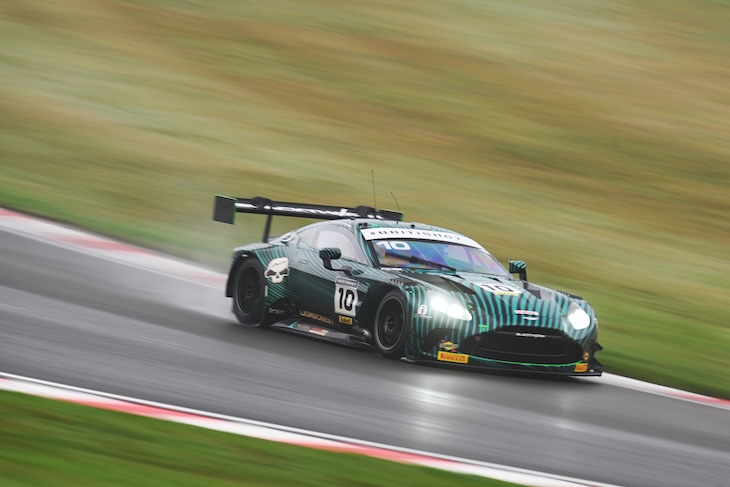
Rowledge previously competed in the 2023 GT4 category in a McLaren Artura before stepping up to GT3 Silver-Am in 2024 in a Blackthorn-run Aston Martin. He now returns, aiming to re-establish himself on a grid rich with factory talent.
“It’s one of the best [environments] to showcase your skills, because you’ve got those factory drivers in there,” he tells DSC. “I’m Silver-graded. I’m quite young, and that (factory driver status) is what I strive to get to. So to be on the same platform as them with a competitive car, there’s no better opportunity.
“I want to prove to the manufacturers, especially McLaren, because I would love to be a McLaren Junior driver one day within the next couple of years, if I can do the job that’s needed.”
Silver-Am has the potential to become one of the championship’s fiercest battlegrounds, following last year’s duel between Bridger Motorsport and Beechdean AMR.
The McLaren GT3 Evo has proven to be a front-running package in recent seasons, most notably in the hands of Optimum Motorsport, which mounted a GT3 Pro-Am title challenge last year.
For Rowledge, racing Mahiki’s McLaren represents a strategic move in his ambition to attract manufacturer backing — ideally from McLaren itself.

His CV already includes the 2022 Ginetta Junior title and a race victory in the 2023 McLaren Trophy Europe, but his 2024 British GT campaign proved more challenging. Seeking a reset, he opted for a full-season programme in Asia in 2025.
“In 2024, I had a little bit more of a difficult season in my first year of British GT3,” he explains. “I wanted to go over to Asia, where it’s one-make, all the cars are even, there’s no BOP, so I can try to showcase my skills there.
“And it was more of the fact that ‘Let’s send me halfway around the world, be very independent, and learn a lot myself’ to then bring the skills ultimately back to the UK.”
Driving the rear-engined Porsche 992 Cup car required a significant shift in technique after experience in mid-engined McLaren GT4 and front-engined Aston Martin GT3 cars.
A Cup car’s lack of anti-lock brakes and traction control demanded greater precision.
“So you’re battling a lot of understeer a lot of the time,” he says. “In a GT3, I would say it’s easier to be closer to the pace, but the final two-tenths is very difficult to find.
“Whereas a Cup car, it could be a second to 1.5 off the pace, if you’re not driving it right. I think stepping away for that year, I’ve learned a new way to drive cars.”
The effort yielded two podium finishes at Shanghai and Singapore, where the series supported Formula One.

The Asia campaign broadened his experience ahead of a return to the GT3 category, and whilst Mahiki’s GT3 programme may be new, his ties with Lake bring familiarity.
Lake previously ran a successful karting team in which Rowledge competed a decade ago before stepping up to car racing.
“I’m very confident in Mahiki and Steve as well. Not only has he run successful karting teams, race teams and car teams, but he’s also raced for a long time,” he says.
“He’s got a smart head on his shoulders, and I’m excited to work together to try to get the most out of both of us. In British GT, a car has two people, not one. So you need your Am driver to be on it and feeling confident in the car itself as well.”
This campaign is pivotal for both Rowledge and Mahiki, which is making its full-season GT3 racing debut. But for Rowledge specificially, it’s an opportunity to show his factory potential alongside talented professionals and some of the strongest Amateur-graded drivers in Europe.
Qualifying remains a particular area of focus. Combined times determine grid position in British GT endurance rounds, meaning both drivers carry equal weight in their performances on Saturday, not just during their stints on race day.
“If I were going to say one thing [to improve this season], it’s being able to do it on that one lap and qualify,” he continues. “When everything falls into place, you feel one with the car; you hit all your points. But my number one goal of the season is to really show my ultimate pace on that one lap, and then you know, build for consistency over the stint.”
The 34th British GT season begins with the Silverstone 500 on 25-26 April, the traditional blue-riband event and the longest race on the calendar.
“You sort of sit and twiddle your thumbs, and you’re thinking, ‘how are we going to be out of the box?'” he says in anticipation. “But I know we’re methodical, and if we follow our plan, when we rock up for that three-hour race, we’re going to be ready, and we’re going to show everyone what we’ve got.
“That’s the art of GT racing. There’s lots of sandbagging. Who’s quick? Who’s not? It’s all that excitement. That’s what makes British GT, or GT racing, what it is.”
Rowledge expects to familiarise himself with the McLaren during a series of test outings, including the Media Day at Silverstone on 31 March, which acts as an official pre-season test for the 2026 British GT Championship. Then, when the lights go out at the season-opener, the next stage of his career as a GT driver begins in earnest.