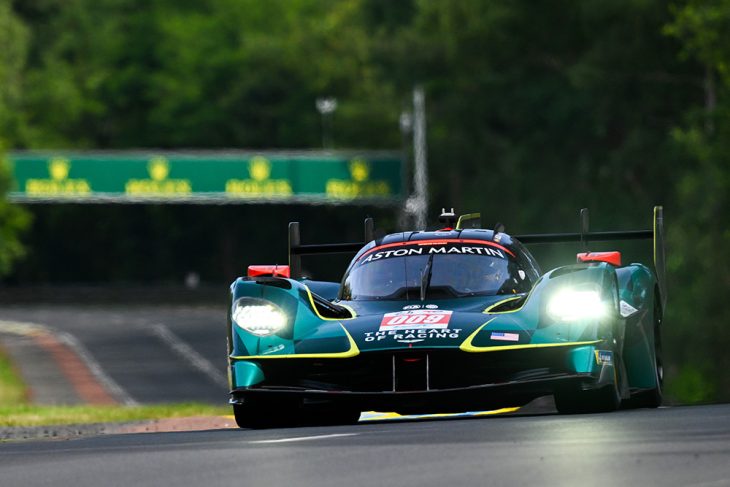
As it approaches its second appearance in the 24 Hours of Le Mans’ Hypercar category, Aston Martin THOR Team knows that it is in for a very different experience this time around.
12 months ago, the target, and public expectation, was very much on ensuring that its pair of V12-powered Valkyries reached the chequered flag.
This was comfortably exceeded, with Marco Sørensen proving to be the star of Wednesday’s qualifying session, placing the #009 Valkyrie into Hyperpole. Both cars then had clean runs through the race, finishing 12th and 14th respectively, only four and six laps down on the winning Ferrari 499P.
But with another 15 races under its belt across the FIA World Endurance Championship and IMSA SportsCar Championship, simply completing Le Mans will not suffice for the Aston Martin Valkyrie this year. Racing for a result is now the objective.
After a slow start to life, the car began to come on strong in the latter half of 2025, with headline results including qualifying third for the 6 Hours of Fuji, and finishing on the podium at Petit Le Mans.
This momentum faltered at the start of this year, as the Valkyrie tackled a succession of circuits it doesn’t suit, but the most recent FIA WEC round at Spa proved that the pace is still there at venues it likes, with both cars running in the top-10 throughout the six-hour affair.
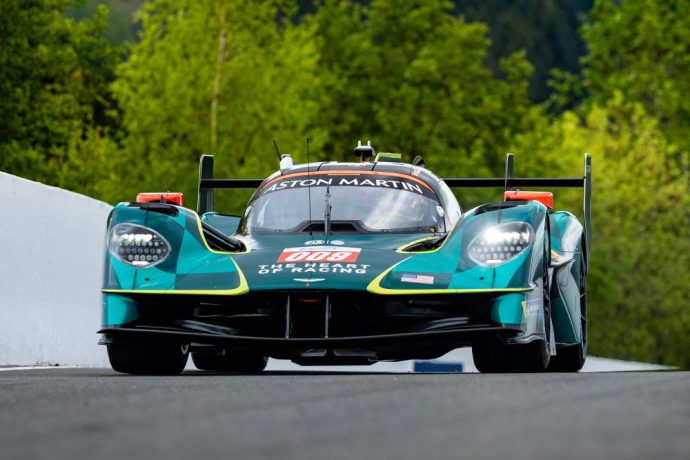
The #009 was eliminated after contact at high speed whilst in contention for a podium, whilst the #007 of Tom Gamble and Harry Tincknell came through to claim a fourth-place finish, the car’s best result in the FIA WEC to date, giving the team plenty of reason to be optimistic heading to Le Mans.
“We wanted to have a positive result to go into Le Mans with,” Gamble tells DSC. “We got a little bit of luck at the end, but both cars were quick enough to be where they were, and actually we had a bit of a tricky race with strategy and stuff before we got to that point, so I think if you would have put us in the lead at the end of the race, we would have been able to finish in the lead.
“Last year at Spa, every time we saw the leader, it was lapping you, and then this year to actually be seeing the leader just ahead as you cross the finish line was quite remarkable really.
“I’m unsure how we’re going to go [at Le Mans], as everyone brings their A-game, but I’m pretty optimistic that we’re going to have a stronger package than last year, and it would be nice to be up there in the top 10 and show everyone what the Valkyrie is capable of.”
Whilst the majority of its Hypercar opposition has elected to utilise an ‘Evo’ joker for 2026, Aston Martin has instead chosen to hold off a year and focus on maximising its current package in 2026. It’s a logical call given Jokers are a finite resource, and the Valkyrie ended last season with plenty of scope to improve without one.
“Even by the time we were in Bahrain, we were still missing stuff,” says Sørensen.
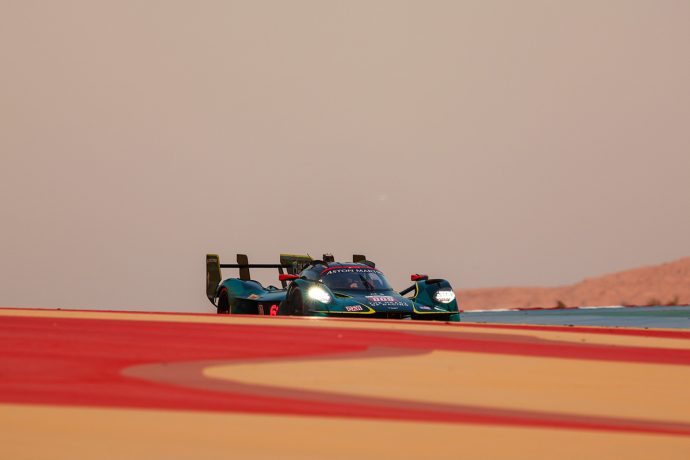
“We did a lot of testing in the winter to improve the TC, to get everything aligned more. We’ve made good progress. It’s good when you get to the track, and you need to push, because you see it.”
This progress, naturally, has focused on the car’s software, with this acting as Hypercar’s major battleground in a formula otherwise controlled by a strict homologation and Balance of Performance.
“We have six or seven software-based engineers, and the performance engineers get involved too,” team principal Ian James explains.
“They’ve given us probably the biggest step forward in performance the cars have had. The drivers also need to be on board to understand the systems and maximise them. The driver-in-the-loop process, the validation, is challenging. But up and down the pit lane, most of the performance comes from software; you’re locked in on hardware via homologation, so manipulating the car around the lap from an electronics point of view is the only scope you have to improve these cars.”
Further off-season gains have been found with Michelin’s 2026-spec tyre, with the characteristics of the latest-generation of Pilot Sport Endurance playing into Aston Martin’s hands.
“These new tyres suit our car more because they have more bite on the front, and our car is always a bit light on rotation,” Tincknell says.
“Our car doesn’t warm the tyre up great, but then the tyre lasts a lot longer. As it’s slightly more to the front, then everyone else gets more oversteer as the track rubbers up and time goes on, but we keep our rear tyres better.”
Although the Circuit de la Sarthe isn’t the hardest on tyres, the effect of the new rubber might still play a role for Aston Martin, as the high temperatures forecast for the race weekend could help relieve the Valkyrie’s difficulty in tyre warm-up.
One factor which sets Aston Martin THOR Team apart from its Hypercar rivals is that it opts to run with a two-driver line-up in the shorter FIA WEC events, as opposed to the more traditional three-driver approach, something which enables its regular FIA WEC drivers to have more track time.

It does, however, mean that Gamble and Tincknell haven’t raced alongside co-driver Ross Gunn since last year’s 8 Hours of Bahrain, but Gamble doesn’t feel as if this places the trio at a disadvantage for Le Mans.
“He’s [Gunn] obviously been busy in IMSA, so it’s not like he’s out of the car,” the 24-year-old explains. “It helps to have the driver here and gel a little bit with them, but I get on with Ross really well, and the whole team keeps in touch, so he’s very much in the loop of what’s happening.
Always useful in a racing team, the bond between its sextet of pilots is a clear strength of the Aston Martin THOR programme, especially given the challenges involved in building up a brand-new operation.
“The environment that Ian has created is unbelievable, the best of my career,” states Tincknell. “We all have similar personalities, get on well and work as a cohesive unit. We’re all genuinely friends who speak every day in a WhatsApp group.
“It’s great because last year wasn’t easy; we were turning up to races knowing we didn’t have a realistic shot of winning, and that camaraderie makes you stronger together. It’s a huge positive, and I understand the difference it makes.”
This chemistry no doubt played a role in Aston Martin electing to keep an unchanged driver line-up for 2026, giving them all the opportunity to reap the benefits of the programme they’ve helped to develop.
“I’ve always been an advocate of consistency and letting people find their feet“ James says. “I think it works for us in this situation. Obviously there’s more pressure in year two now for the drivers to perform, and I believe we’ve got the right six drivers that could do a really good job.”
This ability for Gunn, and Roman De Angelis, to slot into the FIA WEC line-up for three events a year whilst remaining fresh is enabled by Aston Martin THOR Team’s presence in both Hypercar and the IMSA SportsCar Championship’s GTP class.
Although a huge initial undertaking, especially with the FIA WEC introducing a two-car mandate for factory teams ahead of the 2025 season, it has no doubt already proven to be worth the effort, with the additional track time assisting the Valkyrie’s development pace.
This is only successful, however, by maintaining a seamless flow of information from one championship to the other, with Aston Martin THOR Team very much functioning as one squad in two different series, as opposed to a pair of programmes under the same umbrella.
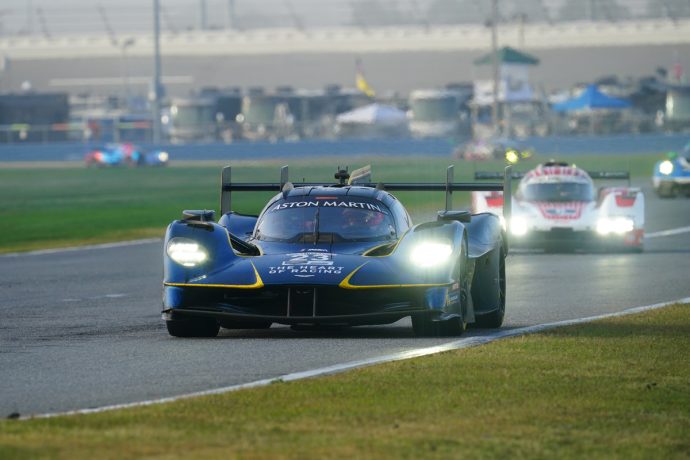
“It wasn’t easy to set up,” James states. “But in hindsight, having two cars in WEC instead of one and running both championships has definitely helped us develop faster. It’s not a small undertaking running three cars, plus two test cars. It’s a lot of parts and personnel, a lot of data and information shared between them all, and it takes a while to get that structure up and running and be efficient.
“We’re a tight-knit team, and there’s a lot of knowledge on both sides of the Atlantic. I don’t think we’d be where we are now with either programme if it weren’t for our decision to run both.”
With the arrival of the Genesis GMR-001, and the Valkyrie now validated over 24 hours, Aston Martin THOR Team no longer has to deal with the added attention of being a newcomer.
But with the car’s fan-favourite status, Gamble still feels the pressure to perform at what he describes as “the Super Bowl of our year”.
“I think the Valkyrie is definitely a car that all the fans want to see do well, so there’s a little bit of weight on your shoulders to deliver for them,” he says.
“We’ve got some incredible fans, and it’d be really nice to deliver a result to them. We had a few critics at the start of last year when we didn’t really have the pace, and then now some of them are going a bit quiet as the results are starting to show, so it’d be nice to get on the podium to show people what this car is capable of, and also as a bit of a thank you to the team, who have obviously been working tirelessly since the programme started.”
The early signs for Aston Martin are promising, with Gamble topping the pre-event Test Day aboard the #007 Valkyrie. But with all eight Hypercar manufacturers being covered by less than one second, this year more than any caution should be placed on drawing too many conclusions from the six hours of running.
Images courtesy of Peter ‘Pedro’ May, Andrew Lofthouse, David Lord and Jack Webster