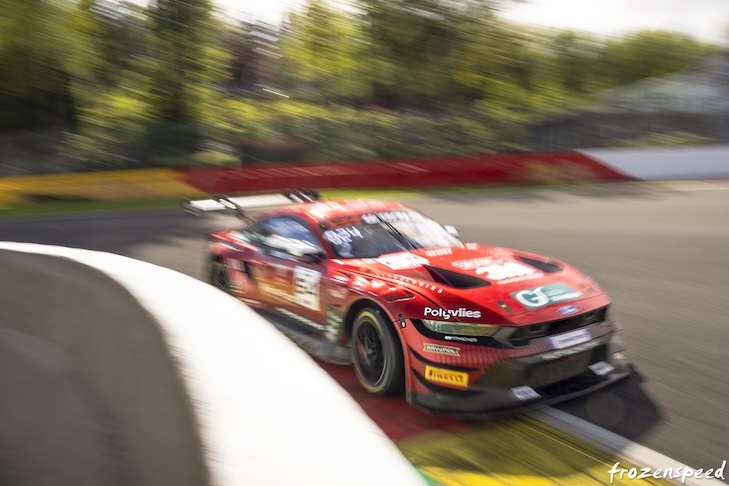

If any team on the grid at this year’s 24 Hours of Spa has earned the right to feel as if its owed some good fortune, it’s probably HRT Ford Racing.
The second year of the collaboration between the American marque and Nürburgring-based GT squad has featured several highs, such as securing the Mustang’s first DTM pole position and podium at the Lausitzring last week, but has also seen multiple opportunities for big results slip through the wayside through no fault of their own.
Famously, the Mustang’s first crack at the Bathurst 12 Hour back in February ended inside the opening hour after Christopher Mies struck a kangaroo, whilst oil on the circuit eliminated one of its Pro cars under four hours into the Nürburgring 24 Hours.
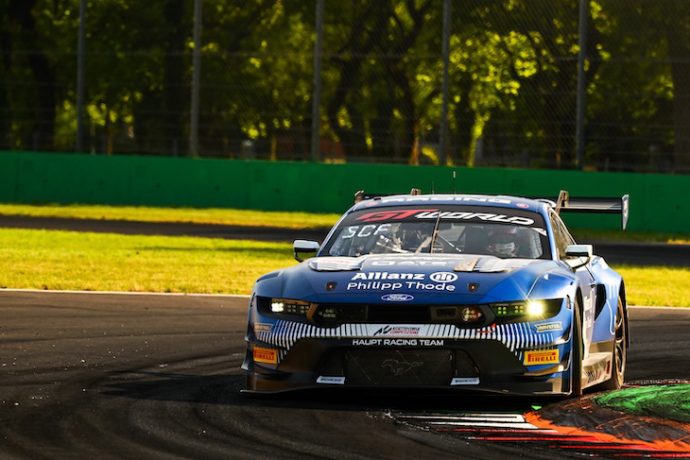
In GT World Challenge Europe competition, a 1-3 in qualifying at the most recent round at Monza delivered the Mustang’s first outright pole in SRO competition, with the clear potential for a first overall win to follow, only for both cars to be eliminated in an opening corner shunt.
On the performance front, the HRT Ford Racing effort has clearly taken major steps forward in 2026, meaning that its first major overall victory feels like a matter of when, rather than if, with this weekend’s 24 Hours of Spa, the biggest race left on the team’s 2026 calendar, its next opportunity.
Ford’s strategy with the Mustang GT3 in Europe has been to focus exclusively around HRT, rather than relying on multiple customer teams to help develop the programme.

With a presence in GT World Challenge Europe, the Nürburgring Langstrecken-Serie, Intercontinental GT Challenge, GT Winter/Summer Series, DTM and ADAC GT Masters, HRT Ford Racing has had no shortage of track time to work from, with its drivers, engineers and other staff all working across its various efforts. Arjun Maini, for instance, has raced for the team in everything but the ADAC GT Masters, which is impractical due to it sharing a bill with the DTM, this year.
Not only did this quantity-heavy approach assist the team during its first year with the Mustang GT3 in 2025, but it has also helped accelerate its understanding of its new-for-2026 Evo package, which naturally has reset some of the learnings from its first season with the car.
“We are still new to the programme, but in the end we have nearly 50 different races now with the Mustang, so you learn from and you progress from event to event, and that is definitely helping a lot, because you get more confident,” says Haupt Racing Team managing director, and co-owner, Ulrich Fritz.
“The Evo package for the car helps for sure, but I think also on the setup side we’ve found a few tweaks and tricks, and it’s easier to come to a track that we already know, which now mainly is the case, because last year everything was new to us.”
In the case of Spa, not only is the team going back to a circuit where it has a year’s experience, but also one it has already performed strongly at.
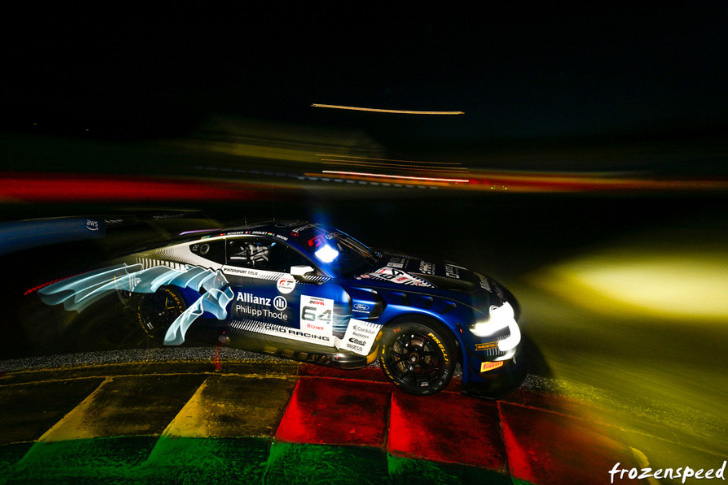
At last year’s 24 Hours, its Pro #64 Mustang GT3 was on the lead lap before contact on Sunday morning ended its chances, whilst the #65 Ford was fighting for a Silver Cup podium into the final hour when damage from gravel forced it into a heartbreaking late retirement.
In 2026, the team will again split its efforts between the Pro and Silver classes, in a clear example of its focus on developing young talent, as well as contending for immediate outright honours.

The Pro car will be driven by Maini, Thomas Drouet and Fabio Scherer, whilst Finn Wiebelhaus, Max Reis, Maxime Oosten and Edoardo Coseteng will share its Silver Cup entry.
“We should definitely be strong there,” Fritz states.
“We ran within the top five before we were taken out of the race last year. Finn and the [Silver] guys were on the drive to the podium, I think they would have finished P2 if the stone wouldn’t have happened.
“But you only get a result once you finish, and that’s the crucial topic. I believe once we will be able to finish the race and have no technical issues, no accidents, and whatever, then I think we should look for good results.”
This challenge of a clean run is a personal difficulty for Fritz, with the long race duration, plus the nature of the capacity GT3-only field, meaning that plenty of factors which will play a role in the battle for victory are out of his control.
“GT World Challenge in general, but especially 24-hour races are something very special,” he explains.
“In the end, you need the portion of luck to succeed. What happened in Monza was not very nice, but a clear statement of how humble you always have to be. You can start every race from P1 to P3, and not make it to the first corner without any fault of yourself. And this comes even more the more hours you run, and in a 24 in Spa with so many cars, there will happen a few things that are just out of our control.
“We just hope that with Nürburgring 24 hour with Arjun’s oil spill, what happened to us in Monza, and what happened in Bathurst with the kangaroo, we have eaten up all the bad luck now, and hopefully we can go into a solid 24 at Spa.
“To be honest. I don’t embrace 24-hour races a lot because they are so out of our control. It’s a big challenge, and as a team principal, you always like to control everything, and the moment you can’t do it, you’re just a passenger. You can only be as prepared as possible, and take it from there, and that’s what we are trying to do.”
HRT Ford Racing’s large programme isn’t without its disadvantages, especially when setbacks strike such as Monza, which has left the team having to completely rebuild both of its GT World Challenge Europe chassis under four weeks out from their biggest race of the season, whilst juggling DTM and ADAC GT Masters outings.

Fritz, however, believes that its 24 Hours of Spa preparation has not been significantly hampered, with HRT Ford Racing having developed the capacity to cope with such challenges, even when they strike at possibly the most inconvenient time of the season.
“I think you grow with your tasks and with what you’re planning for the season, so normally we are well prepared for this challenge,” he says.
“We have the structure to make this happen, but of course things happen like in Monza that put us on the back foot, because you [have to] build two new cars, and that is something that maybe three weeks later it wouldn’t have been an issue, but in a time like now where you have a lot of parallel events, it can really catch you on the cold feet, so it’s about this resilience you have to show.
“All of this, it needs planning for parts, for mechanics, for all the setup, and it’s a challenge, but we embrace it. I think we are well structured. We have a great home base at the Nürburgring, and we have everything it takes to have a quick turnaround, so we will also master this challenge.”
On the upside, the size of the programme means that HRT Ford Racing can afford to place less value on each individual piece of track time it has, because it has other opportunities to make up for any learning missed out on.
This is especially handy in cases such as this year’s two-day 24 Hours of Spa Prologue test, which was held in May, and saw wet conditions and incidents lead to disrupted running.
“It’s good to have test days, but in the end you learn from a race weekend even more because nobody is playing the BoP game,” Fritz says.
“Also the test for GT World Challenge was quite a bit weird, because of so many red flags and bad weather, so the learning we could get from that was limited, but it was a good test. We learned a lot, we showed some good results and some good performance, which we were able to translate into the Monza race.
“I would say testing is nice, and it’s nicer and more helpful than sitting at home, but I think with the race programme we are doing now, testing itself is is not as important as if you would just do one programme.”
Looking to the future, and Fritz is open to expanding HRT Ford Racing’s programme even further, as its still-new relationship with Ford Racing matures.
Amongst the potential avenues it might head in, the team notably appeared on an early version of the entry list for this year’s Dubai 24 Hours, whilst a step into ACO-rules racing is naturally of interest.
“It’s early times, also in our relationship with Ford,” Fritz says.
“But being able to do IGTC in Bathurst with the backing of Ford is something that we would like to continue, and there is also still other series out there that are interesting.
“[In] the whole ACO ecosystem, we have not done anything so far with the Ford brand, so that is definitely something which will be interesting for us in the future. In the end, growth is somewhat limited because you can only do so much, but it’s also about, every year, trying to evaluate what’s best for the team, for Ford, and for our relationship, and then taking it from there.”
More immediately, the goal is to keep making history for Ford Racing. And following on from Aston Martin’s first win since 1948, and Lamborghini’s first-ever triumph at the event, the 24 Hours of Spa is on a run of historical victories. A first Ford win at the Ardennes classic for 37 years would certainly maintain that pattern.
“We just want to be competitive, and we want to win races,” Fritz concludes.
“Every piece of performance you can show makes you proud, and especially now it’s always a first in the history of the Ford Mustang GT3. Getting the pole position in Monza was, for sure, one of these magic moments where we can look back and say, ‘hey, we have achieved another milestone’.
“Winning the [SP 9 Pro/Am] class in Nürburgring 24 last year was something like that, and also, of course, the first championship title for the Ford Mustang, which was achieved by Finn [Wiebelhaus] and Salman [Owega] in GT Masters. These are things you know you can look back on and you are proud of, and the possibility to make this happen gives you the motivation to even push further.”
Images courtesy of Frozenspeed and SRO/JEP