Porsche’s discontinuation of its Cayman GT4 pocket rockets signalled the end of an era on the race track as well as the road.
More than 1,500 718 Cayman GT4 Clubsport and GT4 RS Clubsports have been sold over the last decade, claiming 11 championships and 80 class wins in series around the world – massively contributing to a category which has proved a successful pathway to GT3 competition.
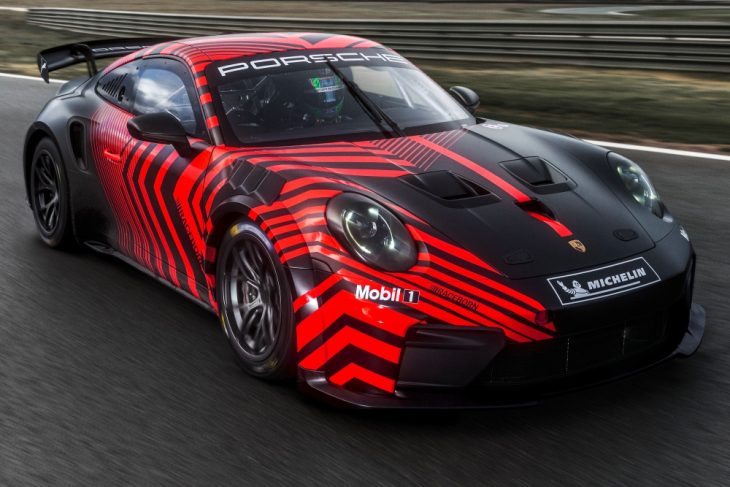
Now its racing successor is here, and it looks a little different: the 911 GT4.
Based on the 992.2-generation 911 GT3 Supercup platform, this new GT4 is a true departure from what’s come before for Porsche in that class.

After its unveiling at the 2026 Spa 24 Hours, DailySportcar was lucky enough to be given a one-on-one tour of the new GT4 by project leader Jan Feldman, who describes the new car as “quite special” – it’s a machine which took two years and over 120 people to design and develop.
Looking sleek and purporesful, this new GT4 has a naturally aspirated 4.0-litre flat-six boxer engine, which can run up to 520bhp depending on the Balance of Performance regulations, 20bhp than the Cayman.
Featuring a wider track, revised suspension and what Feldman terms as “full-blown racing electronics”, it represents a significant upgrade on its predecessor.
In its adaptation from the Supercup car, the GT4 has one-inch narrower wheels, and five-nut hubs instead of a central-locking system and a much simpler, 11-position rear wing. Further set-up options are added by dual-adjustable dampers and three selectable spring rates.
“We had to take the decision if, like the old car, we started from a street car – or if we base the car on the current 911 cup car,” he explains.
“The Cayman was hugely successful, we’re looking with a little tear in our eye on saying goodbye to this project, but for us [moving to 911] was the natural next step.
“It’s quite a special project, because it’s a big step for that class.”
The Porsche Supercup racing car has proved massively popular both with drivers and fans, not least for racing provided by its impressive performance – Feldman says reigning in the beast was one of the main challenges for the GT4 iteration.
“We had to bring down performance quite a bit from regulation point of view,” he says. “We have different aerodynamics, so a way smaller rear wing, very similar to what you see on the old car.
“The engine is the same as in the Cup car, but we delivered it with an air restrictor.
“We added quite some weight to the car, which will be homologated.
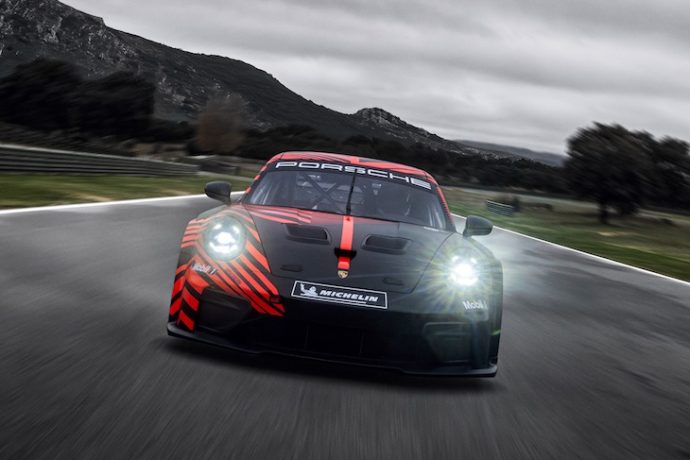
“We had to find the sweet spot in between weight and engine performance, and also the aero balance of the car. I am always very happy when we have somebody like Laurin Heinrich or Michael Safely, guys who run a lot on a lot of cars, and they jump out and say: ‘You’ve done good!’
“You can’t remove the weight during racing when new, but at a later stage, when perhaps the GT4 life is over and you want to use the car in some other races, you will be able to remove it to increase the performance on the car back again. This adds a lot to resale value, and helps the teams with a lower budget to run such a car.”
This leads to an interesting point for the GT4 car: the price tag. The new Stuttgart machine will be on sale for €265,000, a €60k increase on its Cayman forbearer.
“We know that this was a big number but, when you do all the real calculations, running costs will be very close (with the old car), with crash replacement costs going down,” says Feldman.
“Production cost, development costs, at the end of the day has to go on the price of the car – that’s [a reason] why it’s 90% based on the Cup car [to keep cost under control].
“We had a lot of hard discussions with suppliers to get good prices, [but] it’s simply more expensive now to build a car like that.”
As well as being hugely successful, the Cayman is one of the most recognisable cars on the grid.

The new 911 GT4 marks a big departure in looks but, as Feldman emphasises, the differences are more than just skin-deep.
Various components, such as the rear wing, doors, engine cover, elements of the cockpit are now made from natural fibres (such as hemp and flax) rather than carbon fibre, sharing this composition with the Supercup car.
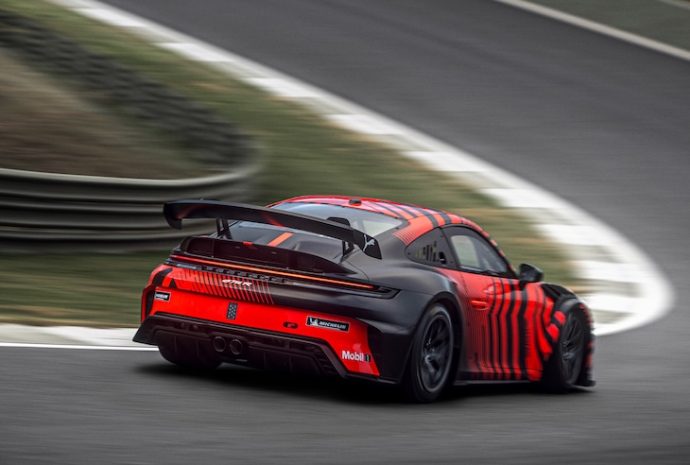
“This is a new version of it – you can see it’s grey in colour rather than brown on the Caymans – it’s also a bit of a ‘beta’ development for further usage in road cars,” says Feldman.
“We are able here to go into a lot of injection molded parts, which greatly reduces the price, sharing so many components with the Cup car.”
The software tech has also had a reboot, optimised for use on the race track.
“What’s definitely a big change is the full-blown racing electronics,” he says.
“There are two routes that you can go currently: either do a racing-specific electronic system, or you can take a road-legal system and adapt this racing.
“With the step to the Cup car, we could go into the racing-specific side, which improves the software quite a bit – it makes it much easier to update.
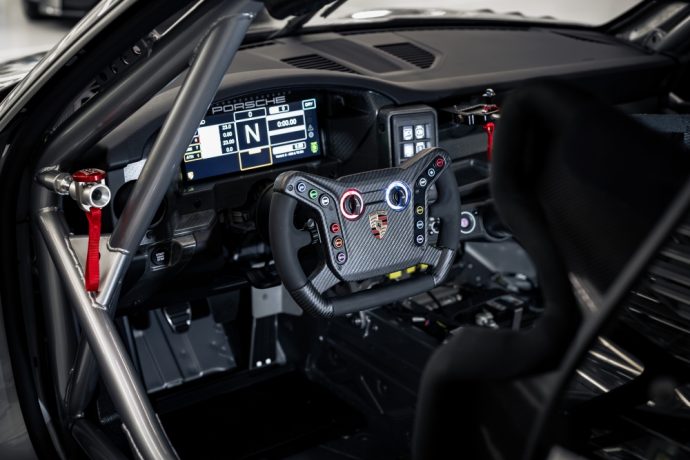
“We also have a new ‘eight-button’ panel. It looks like a touch display, but has real buttons [behind it], and you can cycle through the pages and functions behind them when the car is stationary.
“We can go into all the details the mechanics and engineers need with the car: steering, the steering angle, changing the pit speed, the maximum pit speed, engine mapping, fuel mapping, the different exhaust systems.
“Before, you had to plug in with your computer, now it’s all inside the car.
“We have functions like ‘warm-up’: push the button, start the car, as soon as it hits 95 degrees in oil and water, then the car will automatically shut off.
“We have a steering mode, which is quite nice for our mechanics. Even if it’s not driving you can move the steering column. We’re still talking about a DRS-type function in the future, so this is already integrated [as a button] in the steering wheel.
“These are just some ease of use things to make it more accessible, and also to just reduce the personnel you need.
“When I come to the racetrack, I love to see a sprinter with a trailer on the back with the car – the engineer is the mechanic, and the driver also has to put on the wheels himself, and they go! Two people go to the track and just race cars.”
The final part of the car Dailysportscar is shown is under the bonnet, for all important cooling arrangement.
“It’s a typical three-cooler layout, as we have in all the GT cars – left, right, and centre, but what we did here [in contrast to the Cayman] is we moved the centre cooler inside – the same as the Cup car.
“Before we had the air flow going out of the front ‘trunk’, now we have a way more streamlined shape, where less surface area gets the same cooling.
“So, we could split the bottom intake in half – under the bottom there, are four channels, to the left, right, then they go to the caliper, and the brake disc for increased cooling.
“Very, very efficient way to get air to the brakes – also we have a lot of increased stability here in the front, which will reduce the typical Porsche car vulnerability, where it’s driving off your cooler!”
While the car will ultimately be available in “all markets” after making its debut next year, Feldman says there will be customer support for the Cayman for years to come.
While he didn’t specify which championships Porsche is aiming at with the GT4, he did talk about the wide variety of customers Stuttgart hopes to attract with the new car.
“There are added challenges for us as we want to keep it accessible, not to go up with the price more and more. We have a lot of discussions about pricing, but I think we’ve always had this with customers.
“I think what’s a little shift is more and more work on the electronic systems coming into racing – more younger guys are naturally able to do the engineering stuff, software analysis of data.
“It’s still a very good car for entry-level racing, but the more you go to the top of its performance, the harder it gets to get the last tenths out of the car, which then brings in the professionals.”
As a successor to the Cayman, the 911 GT4 looks a car likely to make its mark one way or another – as long as the price tag doesn’t put too many off.
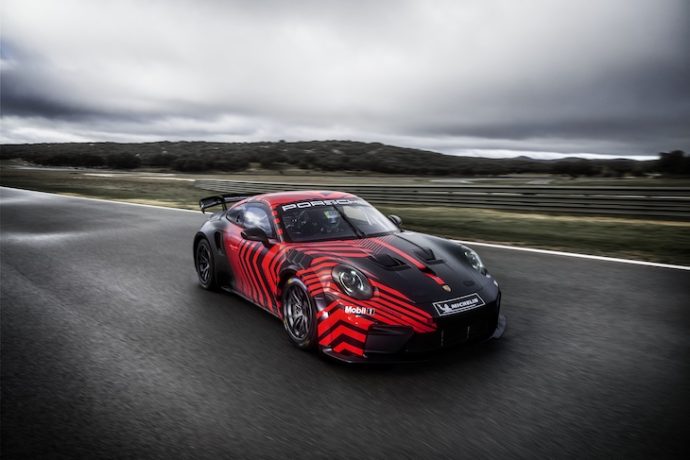
However, the fact Porsche is bringing its most recognisable shape to GT4 racing shows the growth in stature of this category, something not lost on SRO boss Stephane Ratel.
“It’s thanks to Porsche that we were able to build up the success of the GT4 category: it took eight years to get GT4 to the place where it is now, and in fact it was the arrival of the Cayman that really made it,” he said in its announcement.
“So to have a new GT4 car from Porsche, based on the emblematic 911, is simply perfect.”