2026 has seen the revitalisation of the GT2 European Series, as a flux of changes made entering this season have rapidly improved the fortune of SRO’s previously struggling series.
The introduction of a Silver Cup class, the SRO GT Academy competition and a reduced, five-round calendar have all gone down as a success, with the numbers to back it up.
The grid has over doubled in size, with an average of 20.7 cars across the opening three events, including a series record 22 for the season opener at Monza. This compares favourably to the average of 9.5 achieved last season, when entries dropped to as low as eight cars at times.
The variety has also picked up, with eight manufacturers on the grid, double the four full-season marques of 12 months ago.
Part of this growth has come in the form of smaller manufacturers, with Ginetta joining KTM and Maserati as GT2 competitors without a GT3 project. Ligier, meanwhile, has also developed a GT2-spec car.
Amongst the benefits of smaller marques, alongside the additional shapes and sounds they can add to the field, is that they typically sell their vehicles at a lower price, helping to make GT2 more accessible.
“For the moment, to restart it, I think with the likes of smaller constructors is probably the way to reach the price point and to see it grow,” SRO founder and CEO Stéphane Ratel told DSC pre-season.
“And Maserati still wants to sell cars, Mercedes-AMG still wants to sell cars, and you have cars on the market because they were the perfect track day car. They’re easier, less downforce. They start off like a road car.”
This focus on cost-cutting has come in the wake of a re-focusing of the GT2 formula, returning the class to its initial sprint focus, after the cars were briefly considered as 24-hour competitors.
“That was my mistake,” Ratel confessed.
“The manufacturers did a bit of a mistake, that they missed the price point, and I did a mistake. [Maserati] came and said they would like to do endurance racing with these cars, [they] would like to do Spa.
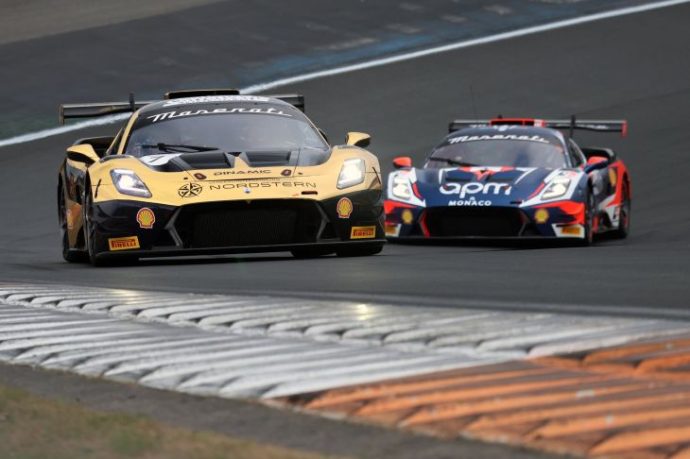
“And then, a bit foolishly I have to say, at the press conference at Spa I said we’re going to keep six to eight spots to introduce GT2 at the 24 Hours of Spa. In the meantime, Mercedes-AMG had worked on the car which was the supposed to be the GT2 which was, I have to say, more reasonably priced and everything.
“And then, when they heard that, suddenly they say what? This car has not been designed to race endurance. We need to go back to the drawing board. So the car they had initially designed became the track series, and they designed another car, did a lot of development, ran two of them at the Nürburgring 24 Hours as part of a development test to have them bulletproof, and the price went up.
“And then the Maserati also went up, because they were designed to do 24 hours. Unfortunately, at the same time, I think the finance of Maserati didn’t go particularly well, and instead of seeing a kind of factory-supported team coming to Spa, there was never the cars, so we never did it.”
Although not in SRO competition, GT2 cars are still making the occasional endurance race outing.
After the Mercedes-AMGs raced at the Nürburgring, Dinamic Motorsport have become a regular 24H Series competitor with their Maserati, and the KTM is a fan-favourite entry at the Bathurst 12 Hour. Ginetta also entered this year’s Dubai 24 Hours with their G56 GT2 as part of its development programme.
The future, however, appears to be built around the sprint race formula with which GT2 Europe has found so much success this season, as with the rise in quantity has also come a boost in the competitiveness of the field.
Only four different full-time crews won a race outright in 2025, a number matched in the opening four races of this season, as a quartet of different manufacturers won across the opening two rounds.
In the six races to-date, only SR Motorsport by Schnitzelalm’s Jay Mo Härtling has become a repeat pole sitter, no one has registered more than a 50% class win rate, and a remarkable 21 different cars have made at least one podium appearance across the three classes.
And with this growth, it didn’t come as a surprise to see the GT2 news at SRO’s annual press conference, held at the 24 Hours of Spa in June, limited to a 2027 calendar, with next year set to be one where the platform can hopefully stabilise and potentially even push on further.
2027 will again see the series contest five double-header meetings, although a major shake-up on the venue front means that only Misano remains from 2026.
Circuit Paul Ricard and Imola return to the schedule for the first time since 2024 and 2022 respectively, whilst the Nürburgring and Hungaroring will both make their series debut in the latter part of the campaign.
Provisional 2027 GT2 European Series calendar:
- Round 1: Circuit Paul Ricard, France (17/18 April)
- Round 2: Autodromo Enzo e Dino Ferrari (Imola), Italy (22/23 May)
- Round 3: Misano World Circuit Marco Simoncelli, Italy (17/18 July)
- Round 4: Nürburgring, Germany (28/29 Aug)
- Round 5: Hungaroring (Budapest), Hungary (2/3 Oct)
Images courtesy of SRO/JEP