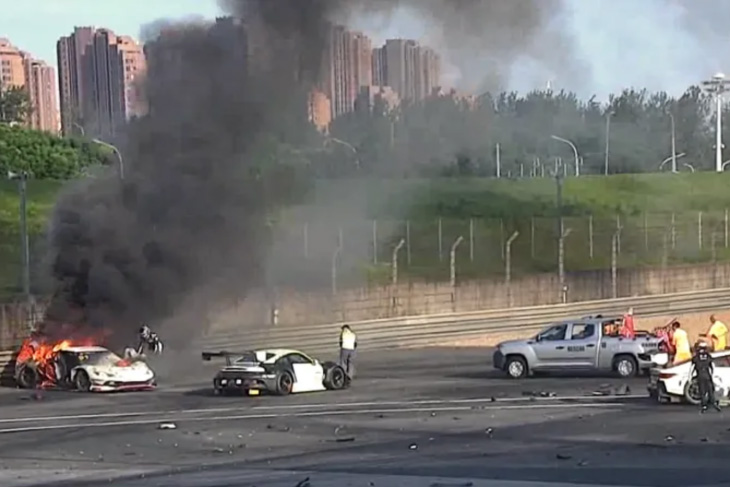
Following the huge and fiery accident involving Ollie Millroy during the China GT meeting at Shanghai earlier this month, mercifully, we can now examine the circumstances from the perspective of learning lessons rather than having lost a life.
In doing that, we should first pay tribute, once again, to the simply heroic effort of Dutch racer Loek Hartog.
His reaction to the unfolding drama deserves applause from across the motorsport world and far beyond. To save a life is a simply awe-inspiring thing; the manner of Loek doing so was some distance beyond that, a sustained multi-actioned act of personal courage.
There will, inevitably, and in part correctly, be plenty of examination of the circumstances leading up to, during and beyond the incident.
We’ll start that ball rolling here by first looking at some issues that we don’t believe should be a core part of the matter in hand – though they will, correctly and inevitably, be interrogated.
First is the initial two-car tangle that led to the high-speed impact with the FIST AAI Ferrari piloted by Millroy.
The two cars involved, the #37 Harmony Racing Ferrari of (David) Chen Wian and the #33 TBC by 610Racing BMW M4 GT3 EVO, collided on the inside of the run down to Turn 14 as the pair tussled for position. It seems the two cars became physically hooked together, impacting the wall on the driver’s right into the braking zone; Chen’s Ferrari then spun back onto the racing line just as Millroy took the corner and collected him at very high speed.
The initial incident (between the two tussling cars), whilst certainly worthy of an investigation (and the issue of incident responsibility has now reportedly been addressed), was no more significant than many other racing incidents on any given weekend.
The second was the circuit’s physical nature and its status as a Class One facility. There are plenty of experts significantly more qualified than this writer to examine and opine upon any factor worthy of review on this basis. In passing, though, whilst there may be lessons to be drawn from this aspect of the incident, it is not, in any meaningful way, a factor anyone should expect to be determined as a matter of direct and serious concern.
The performance of the car involved is another matter. The #91 car’s survival cell structure appears, from available images, to have held up very well to the simply enormous initial impact. Both that aspect of the performance of the 296 GT3 Evo and the causation, and the seriousness, of the fire, which started almost instantly after the initial impact, will inevitably and entirely correctly be investigated by Ferrari.
All of that leads us onto another list of matters. All of which most certainly need to see honest and straightforward responses from the relevant authorities and race organisers if China GT is to retain a reputation consistent with a premium national/regional championship.
The first, and indeed second, matter is the event’s incident readiness and subsequent fire and medical response.
Avoiding judgement on individual reports of specific response from individual track workers (one report of a marshal ‘running away’ looks likely in reality to have been Loek Hartog (in a fire suit) intercepting a marshal (without a fire suit) running to the wreck with an extinguisher, who then ran back to grab another), there certainly seem to be significant questions to dig into about the planning and execution of the emergency plan.
For clarity, that means that the question of whether there was an adequate emergency plan in place needs to be addressed – though for this writer it is almost entirely inconceivable that experienced race organisers would not have done so.
A plan, though, is only as good as its execution and supervision, and here there are some very pertinent points to note:
Notable amongst those was the performance of both the fire and medical interventions. There were, for instance, multiple reports of an ambulance driver not only being (literally) asleep at the wheel, but so deeply asleep that he did not wake up during attempts to rouse him by other officials banging on the windows!
Also questions about how familiar some attending emergency workers are with the equipment.
There are, though, some interesting insights via a pretty comprehensive time-coded examination of the scene via CCTV imagery provided by our good friends at BEC Motorsports (see below). And there will be questions too about competitors’ reports of post-incident exchanges.
If, and that point is worth repeating, IF, the reports coming via team sources are correct that there was somewhat more concern being shown around matters of reputation than there was about safety, then that is an issue worthy of VERY significant investigation and review.
Finally, and importantly, there’s the matter of information management.
It is not at all acceptable to permit a public statement on a live broadcast, before the facts are clearer, that a driver in Millroy’s situation should be described as being ‘OK’. Competitors, their families and friends, and other watchers rely heavily on the information race organisers relay after any serious incident.
This writer has learned the hard way that when information is incomplete or absent, do not fill in perceived gaps. It seems this is a matter China GT needs to get right, with clear lines of communication and clearance established. That was palpably not the case in this instance.
The TV commentator in this instance has, with a significant show of character, made his own statement and apology for relaying information that reportedly suggested Millroy’s condition was significantly less of a cause for concern. Whatever the full truth of the matter, it certainly deserves attention.
DSC understands that the race organisers, and indeed national authorities, are already conducting a full and comprehensive review of all of the above and more. That is completely correct and entirely justified. DSC would add that openness and clarity about the results of that investigation should be a priority upon its completion.
There’s one other point to raise here too, and it should be a call to action for everyone responsible for the issues covered above, wherever in the world they operate. Whatever plans are in place to prevent and respond to incidents, the realities of modern social media are potentially overwhelming.
The images from the Shanghai incident went global in a matter of hours, and the ‘analysis’ of them, comment on them, and blame-calling followed close behind.
While a significant proportion of comment and coverage focused on Ollie’s wellbeing and Loek’s heroism, many, many more focused elsewhere, and much of it was far from even-handed.
The reality is that every resilience plan needs to be pressure-tested in that not-so-easy-to-manage light. This incident should serve as a wake-up call for many areas of the sport.
In closing, we should all be thankful for the towering professionalism shown by both drivers directly involved: the sheer heroism of Loek Hartog will inevitably, and completely correctly, be recognised formally.
His response to those calls has continued to be humbling. His wish to be part of a society that intervenes rather than observes when intervention can make a difference is a tonic for many in a society where capturing a moment on camera seems a more natural reaction than seeking to change an outcome.
Ollie Millroy is known across the paddocks of the racing world as a true class act, and his personal response to this moment has only underlined that.
There’s little doubt in this writer’s mind that when his body is sufficiently healed, we’ll be hearing more from him on matters of safety. And when we do, it will not be to assign blame, but to help prevent anyone else from finding themselves in the same situation.
Well done, Loek, and get well soon, Ollie.
BEC Motorsports timeline, available in Chinese with the time-coded images here:
On September 5, during Race 1 of Round 4 of the 2026 China GT Championship at the Shanghai International Circuit, a collision resulting in a fire occurred, sparking widespread attention and discussion online. We have compiled surveillance screenshots from the scene and reconstructed the full timeline of events to provide a detailed account of the incident, as follows:
16:47:24 – At Turn 14 of the Shanghai International Circuit, contact between the #33 and #37 cars (GT3 class) caused both vehicles to lose control; simultaneously, the marshal at post MP14 displayed double yellow flags.
16:47:25: Car #37 collided with Car #91, which was proceeding normally; the collision caused Car #91 to lose control and catch fire.
16:47:37 (12 seconds after the fire incident): Twelve seconds after the collision, the command centre ordered the deployment of the full-course red flag to halt the race. In accordance with race incident rescue protocols, it notified track marshals, fire marshals, rescue vehicles, rapid intervention vehicles, medical cars, rapid extrication vehicles, and ambulances to proceed immediately to the scene of the accident.
16:47:41 (16 seconds after the fire incident): The driver of car #79 passed the scene while driving on the track and attempted to rescue the driver of car #91;
16:48:12 (47 seconds after the fire incident): The first track marshal arrived at the scene with the first fire extinguisher and handed it to the driver of car #79;
16:48:20 (55 seconds after the fire incident): The second track marshal arrived at the scene with a fire extinguisher;
16:48:31 (66 seconds after the fire broke out): The first rapid-response fire truck arrived at the scene;
16:48:40 (75 seconds after the fire incident): The driver of car #91 escaped;
16:48:57 (92 seconds after the fire broke out): The second rapid-response fire truck arrived at the scene;
16:51:33 (4 minutes and 8 seconds after the fire incident): The medical supervisor and medical vehicle arrived to conduct medical checks, assess injuries, and provide emergency care for Driver 91 and Driver 37.
16:52:45 (5 minutes and 20 seconds after the fire broke out): Fire trucks arrived at the scene to carry out firefighting operations;
At 16:53:41 (6 minutes and 16 seconds after the fire incident), the first ambulance stationed at the venue arrived at the scene to treat Driver #91 and subsequently departed at 16:58:52 to transport him to Ruijin Hospital North Branch for further care; the second ambulance first transported Driver #37 to the medical centre for examination before taking him to Ruijin Hospital North Branch for treatment.