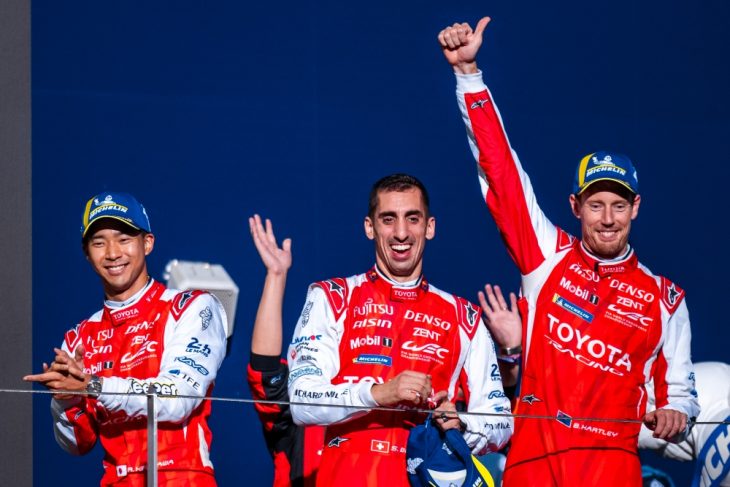

Ahead of the 2026 season, the big question mark overhanging Toyota was whether its overhauled Hypercar would help the team rediscover its mojo after a lacklustre trot through 2025.
Fast forward to the present day, and with three victories pocketed through six races (including at Le Mans), we have our answer. For Toyota Racing and its TR010s, just 12 hours of racing remain, and both the Hypercar Drivers’ and Manufacturers’ World Championships are in sight.
The strategic gamble in Sunday’s 6 Hours of Fuji to take fuel only with the #8 at the final stops to gain track position led to one of the team’s most unlikely victories in the Hypercar era, elevating Sebastien Buemi, Brendon Hartley and Ryo Hirakawa to the top of the standings.
The gap is now 10 points over the drivers in the sister #7, and 14 over BMW’s lead duo of Rene Rast and Robin Frijns, who failed to finish in the top 10 for a second straight race. And in the Manufacturers’ tally, Toyota leads on 169, with BMW second on 146 and Ferrari third on 115.
In years past, Toyota has been a dominant force at the Fuji Speedway. It has six 1-2 finishes to its name and 10 wins on home soil in 13 races. But in the Hypercar era, where BoP plays a role in keeping things tight, adding to the tally has become tougher and tougher. And this year, its latest victory came not by speed, but by smart decision-making during a critical point in the race.
“When you looked at our averages in the race, I think we were the fifth-fastest car,” Buemi said in the post-race press conference. “And yet we managed to win. It’s a massive achievement for us because we didn’t have the pace. We won on strategy and no mistakes, so you cannot dream of a better result.”
After the final stops, finishing the job required a standout performance from Hirakawa, who, to the delight of the home fans that packed the stands, kept Victor Martins, who had a tyre advantage and a faster car, at arm’s length in the closing minutes.

Hirakawa looked composed and entirely unfazed by the task of bringing the car home, but admitted in the aftermath that it was tricky and stressful in the cockpit during arguably the most impressive drive of his career to date.
“The conditions were changing, the tyres were cold, and the track was a bit damp. I was lucky that I had a BMW in front, so I had a reference, and behind me the other BMW was blocking the Alpine. But it was a lot of pressure. One lock-up, and you could throw it away,” he said.
“The last couple of laps were stressful, but I had good feedback from the team about where I need to block and where I need to push. The last two laps were not only me, but the whole team’s victory.”
With just Barcelona and Monza left on the schedule, the #8 crew are now in the driving seat. But they’re not getting ahead of themselves, as one false move in the races to come could change everything.
“I’ve learned in the last few races that with so many safety cars and full-course yellows, you can go from being completely out to being in winning positions,” Buemi noted to DSC.
“Even if it looks way better now for us in the championship, we have to take it step by step. Car #7 was looking amazing at one point in the race; we were not looking good, then all of a sudden, a small bit of strategy and we are winning the race.”
As for Toyota’s rivals in the championship fight, the hard work to keep the title fights alive after the WEC’s first-ever race weekend in Spain starts now. Whether or not they can claw their way back will be the big storyline of the final two races.
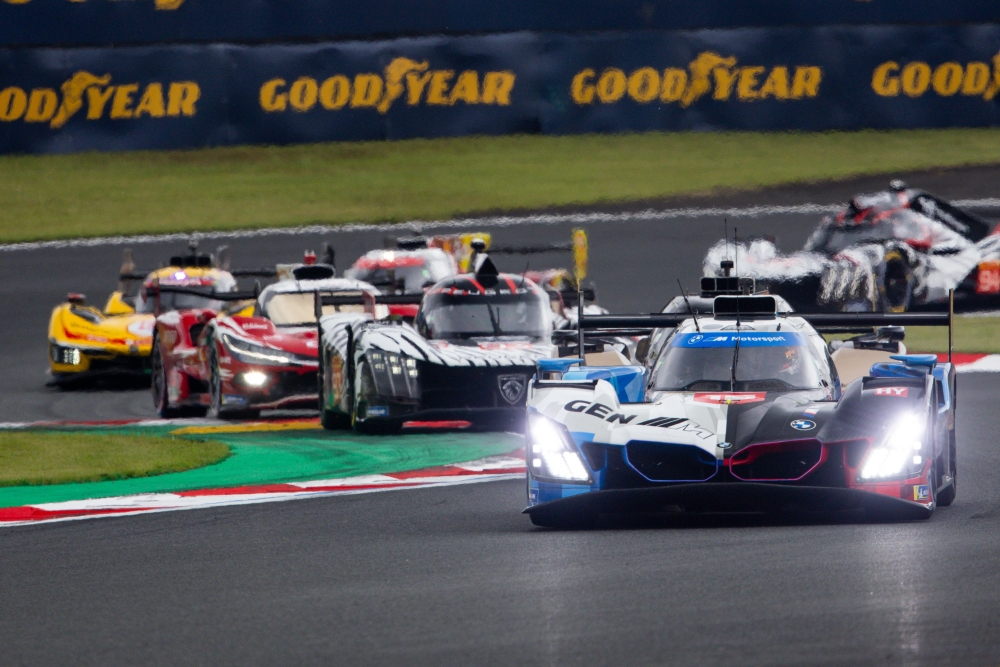
BMW limited the damage last night by guiding the #15 crew to third with a similar strategy call to the #8 Toyota. But the #20 car, better positioned in the championship, missed a chance to turn a setback into an unexpected result after dropping a lap down with damage and a puncture from contact with Ferrari’s #51 car.
“We are still in the fight,” WRT boss Vincent Vosse stressed. “And on top of that, in the Manufacturers’ standings, we lost a bit to Toyota but gained a bit to Ferrari. It’s not perfect, but with a difficult starting position for both cars, we did well.”
As for Lone Star Le Mans winner Ferrari, the #50 retired with a “pneumatic leakage”; the #83 was nowhere on pace and finished 12th, leaving the highest-placed 499P as the #51 car, which was eventually classified 10th after post-race penalties. Its dream last-gasp win in Austin was followed up by yet another nightmare at the Fuji Speedway, which remains the toughest nut for the team to crack.
“The slow corners (at the end of the lap) have never suited the 499P,” Giuliano Salvi, the 499P’s chief race engineer, admitted. “We go better in other speed ranges. We still struggle on that. There are some things in our car layout and DNA that you can improve, but you cannot completely change it.

“We are able to cope with more or less all the WEC tracks and corners, but these kinds (at Fuji) are pretty peculiar.
“We will wake up every day; until it’s over, we will fight. Both circuits ahead should be better for us. For Barcelona, we have less information, but it should not be a nightmare like here.”
Just three weeks ago, we were left pondering whether the #7 Toyota’s retirement in the final moments of Lone Star Le Mans was a key moment that would define the Japanese brand’s season. But by hook or by crook, it has swung the balance of power back in its favour, ensuring it heads into the final two races with something it didn’t have for much of last season: momentum.
The TR010 may not have been the fastest car at Fuji. But after a year in which Toyota struggled to consistently convert its pace and opportunities into results, the team has shown that it remains a threat to win races through strategy, execution, and keeping its mistakes to a minimum.
With the season finale in sight, that could prove just as important as outright speed.
Images courtesy of DPPI