With the actual racing still many weeks away it can be a trial for the major manufacturers to keep fan and media interest bubbling.
In the LMP1 stakes Porsche have been issuing regular video updates – a sort of ‘New LMP1 101’ to deal with various aspects of their programme, testing, simulator work etc.
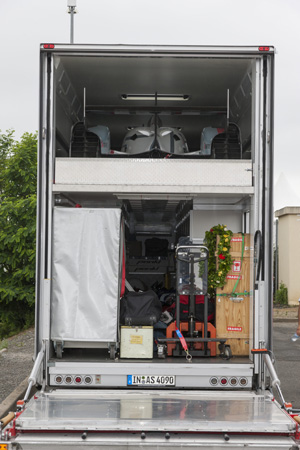
Audi’s latest offering takes a similar tack, explaining what goes into supporting a global motorpsort programme, the logistical challenge of getting two cars (and in some cases three), to eight races in Europe, Asia, North and South America in the 2014 season.
“A World Championship such as the WEC is not only a great sporting and technological challenge but has to be prepared with high precision in terms of logistics as well,” says Head of Audi Motorsport Dr. Wolfgang Ullrich. “In Audi Sport Team Joest we’re relying on a squad that has been at home on the world’s race tracks for decades and that knows what counts – with respect to major tasks as well as details.”
While the team has, of course, already been out testing, the actual racing season, in logistical terms, starts with the easiest part.
After the season opener at Silverstone in the UK on April 20, the Spa 6 Hours in Belgium will follow two weeks later. Four weeks after Spa, on the first weekend in June, the team will require the material on the test day at Le Mans, where the 24-hour race will be held 14 days later.
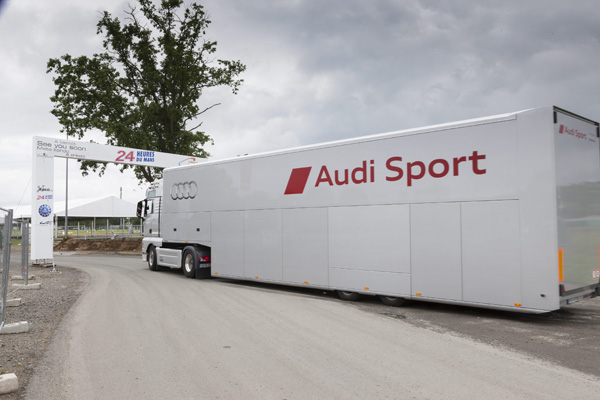
Within Europe, the entire hardware as well as the race cars of Audi Sport and Audi Sport Team Joest will be transported by road.
Audi is preparing three hybrid sports cars for the races at Spa and Le Mans. The squad will be contesting the other WEC rounds with two R18 e-tron quattro cars. 14 weeks after Le Mans, the first of five overseas races follows at Austin in the USA.
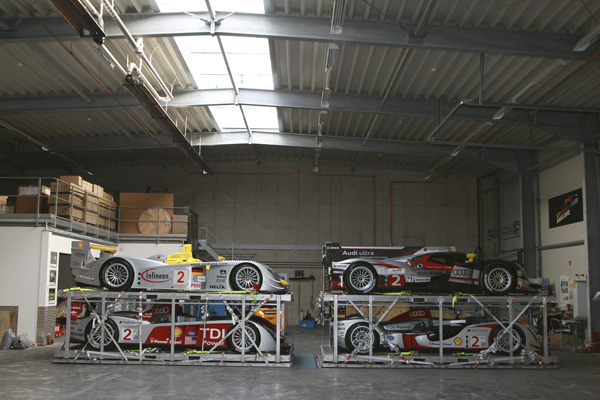
The FIA World Endurance Championship has set up a logistical infrastructure for all teams and will be moving about 200 tons of components to the events by cargo aircraft. (The pic below shows how the cars travel, though if this quartet emerge at Shanghai or Fuji we’ll be pretty surprised!)
In addition, some material, time permitting, will be transported to individual races by sea freight. Starting in Europe, a distance of about 49,000 kilometres will be covered to travel to the stops at Austin/USA (Sep 20), Fuji/Japan (Oct 12), Shanghai/China (Nov 02), Bahrain (Nov 15), São Paulo/Brazil (Nov 30) and back to Germany.
“The material doesn’t return to Germany between these stops,” says Chris Reinke, Head of LMP at Audi Sport. “This means we’ve got to consider the mileage limit of the individual components plus possible accident damage in our planning. There are some particularly stressed components, which are subject to defined replacement cycles, as well as single components that are used several times.” In addition to the race cars and the spare parts for the vehicles, tools – from wrenches through to lifting platforms and other garage infrastructure – travel by air.
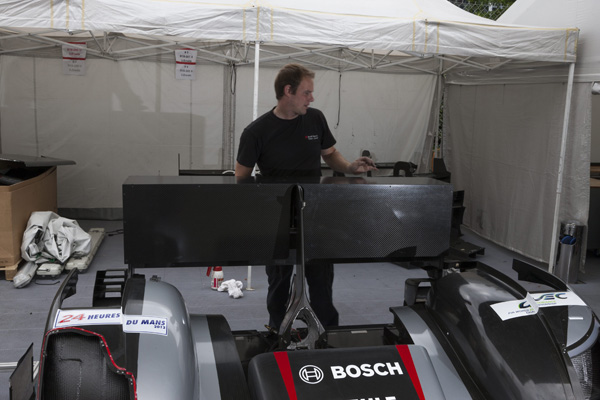
The team members stow around 36 tons of materials in 176 flight cases – these are rugged containers that are typically equipped with castors. This means that, together with the race cars, about 38 tons of equipment are packed on 19 aircraft pallets. In addition to the transportation of the material, the company plans the deployment of its logistics experts with pinpoint precision.
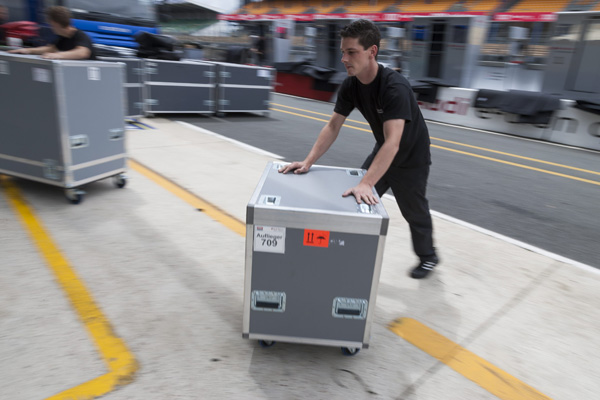
A set-up and dismantling team travels to the 6-hour races a day earlier to receive the shipment and to set up the garage, and stays a day longer to dismantle the equipment after the race. Consequently, an event may last between ten or twelve days for some team members, depending on the location. And for the logisticians, a new year always begins in December. Immediately following their return from the last round of the 2013 season in Bahrain, they started to prepare for the new season.