


50 years after the last of Ford’s impressive four-year overall winning streak from 1966-1969, Ford has confirmed the factory GTE Pro programme is to end with this edition of the race in 2019.
With a debut victory in 2016, followed by a second place and a third place in 2017 and 2018 respectively, would Ford finally slip off the podium or book-end its short but glittering career with another victory?
Three consecutive podium finishes in the last three years is something that none of the other five manufacturers can lay claim to, but Ford obviously wants to go out with a bang.
The livery and the line-up of Bourdais, Muller and Hand might both be carried over elements of the formula from 2016’s class-winning #68 car, but what did Sebastien Bourdais think it would take to repeat the feat in 2019?
“Honestly, we are in a really good position. Looking at the analysis from last year, on #68 we probably didn’t make the right call on the way we ran the car on the Balance of Performance and aero side and we lost a lot of time.

“The guys have done a stellar job so unless the competition has found a significant amount of pace we should be better this year. You never really know until you get here, but if we can execute and the car turns out as good as we think it will be, we have a pretty good chance.”
Richard Westbrook drives the #69 car, which pays hommage to the car placed second overall in 1966. Does he think a repeat of a 1-2 is possible?
“The past two years we’ve certainly learned how it can go wrong. The BoP has definitely made things really close, probably more for the driveability of our car rather than outright speed, and tonight we will see who is where I suppose. We need to end this programme on a high and it certainly feels like we have a good chance this year, it certainly feels like a level playing field, which it didn’t feel like last year.”
Harry Tincknell, driving the 1967 winner’s red and white retro-liveried #67 Ford, explains the full-on commitment required in today’s top GTE class:
“GTE Pro is by far the most competitive of the four classes, with all manufacturer teams and fully professional driver line-ups. P2 is extremely close too, but there you have the Pro-Am element. GTE Pro is close every year and it is always a battle for that last tenth of a second.

“Last year the Porsche got away in front but second to sixth was still raging to the end. You never give up in this class. In 2017 I was ‘pootling’ on the last lap in third place, about 50 seconds behind the Corvette but then I got the radio message that he had a puncture and I was smashing all the kerbs to catch him. I only passed him with two corners to go at the exit of the Porsche Curves, so it was pretty crazy.”
With so many variables influencing the outcome of this race, we asked what the crews’ feelings were following the test weekend and the Balance of Performance adjustments for their car:
Dirk Muller, 2016 winner with the #68 Ford: “We have a little power boost which we needed from last year, but I don’t really like the way the car feels with the extra weight; I think it’s like 15 kilos or something… the second bit of the Ford Chicane is also a bit different this year, so I think the track is a tiny bit slower.”
“At the Test Day we started with the car from last year and did some improvements that we were missing from the year before. The engineering department behind us is working really hard and we are always changing something.
“For the first two hours we were just doing random checks to see if the data is consistent for all the nose variations, aero data, diffusers, etc. The big surprise was that it took a long time for the track to settle in, and everyone was afraid to show something.
Nobody pulled any special moves or did anything that would show any advantage. My feeling right now is that the category will be extremely close, more so than ever.”
“We are not running the same monocoque [(chassis)] as 2016 because after the victory it went straight back to Ford to go into the museum exactly as it finished the race. So yes we got a new car but it’s still the same pieces and homologation, we haven’t done any updates. We know what we have, but the set-up is quite different [to 2016].”
Billy Johnson, aboard the distinctive and prestigious, black and white 1966 winning liveried #66 entry:
“We have a little more power and weight with the new BoP and I’m hoping it gives us a more raceable car. We should have a similar laptime but last year we achieved it with very little power, so we would lose a full four to five car lengths on acceleration along the straights so we were too far back to overtake and we had to attack the kerbs really hard to stop losing too much time. This year we shouldn’t lose so much ground and we should be in a position to fight.”
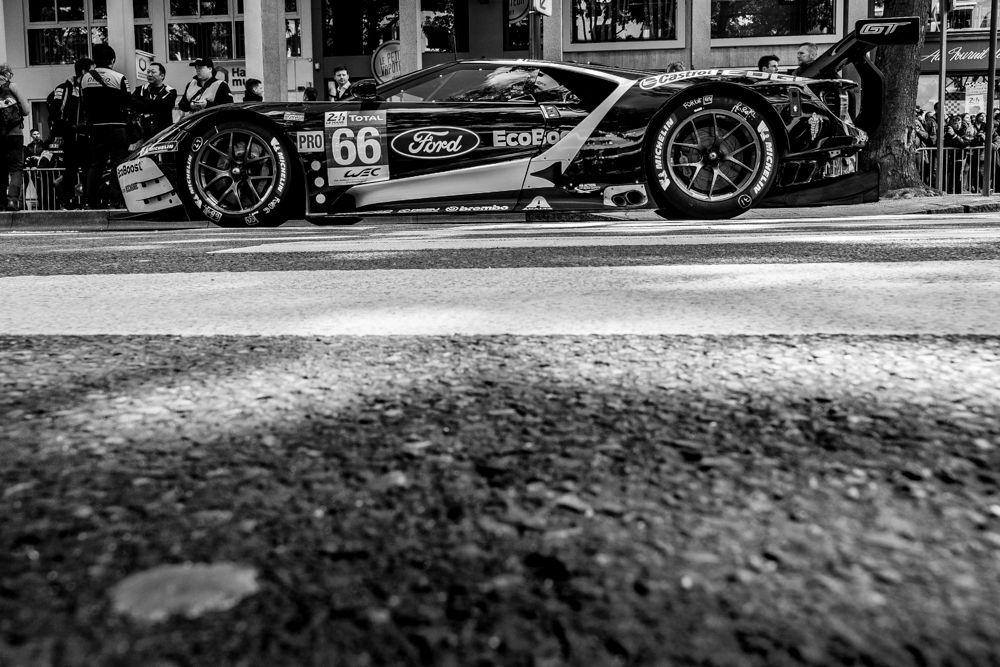
“The GT has a lot of similarities to a prototype, but the weight (we are one of the heaviest GT cars) and the ride height make it more difficult to drive than a DPi in some ways, it is less planted and as a car it has a pretty unique character.
“Compared with the other GTs I think we have a low centre of gravity and that affects the load that we can put into the tyres. In the dry that is good, but in the wet it is more difficult. It also means that even if the Balance of Performance is about right, if we don’t have a tyre that matches the characteristics of the car, it is a problem.”
The preceding round at Spa threw the most dramatic variations of weather seen in the WEC 2019-20 Super Season. With the 24 Hours of Le Mans notorious for climatic changes and rain already predicted during qualifying and the race, how does the team handle the less than predictable conditions?
Sebastien Bourdais: “If it is 10-20 degrees C and dry, so not too hot, that will be the best scenario for us. No-one really knows how the weather will be though because it keeps changing and if it stays really wet then it becomes a ‘big casino’. The track here is flat and you get rivers across it.
“The road section in particular doesn’t drain well. Visibility is a nightmare and even if you keep it on the island you can be caught up in something you were no part of. The speed is high so aquaplaning is also a concern. Every four minutes you come round and you have no idea what you are going to find each time, it can be quite different.”
Harry Tincknell also thought the weather was going to be the biggest factor to Ford’s prospects of success:

“It could sound like a load of excuses but a crash, losing points due to a driver time error and not being able to get the wet tyre to work are the three things that have cost us what would probably have been third place in the Championship.”
“100% I want it to be dry for the race. We know we have a good plan for set-up and we had the second fastest time [in the dry] at the Test Day. We’ve got a solid pace, even if we have some patches of wet weather during the race. Even if it stays wet, you can still feel the rhythm of the track and if the week goes from wet to dry it is not so bad. If it goes dry to wet it is a lot more difficult.”
Jonathan Bomarito, Tincknell’s teammate in the #67 car, ponders the dilemma:
“This rain predicted tonight is limiting how much real practice we get for the race, as the race conditions now are looking drier. It’s risk versus reward: in order to learn something you have to push the car, and so in the wet that risk goes way up. I don’t think we will run much in the rain.
Billy Johnson (#66) adds: “In terms of the car’s performance, there is a lot of difference between our wet and dry set-up and the conditions are set to change during the race. We are so dependent on the forecast, it’s definitely something that is hard to change during the race. So the challenge of biasing the car is tough: do you compromise for a little bit of wet and hope it doesn’t affect your dry running too much..?
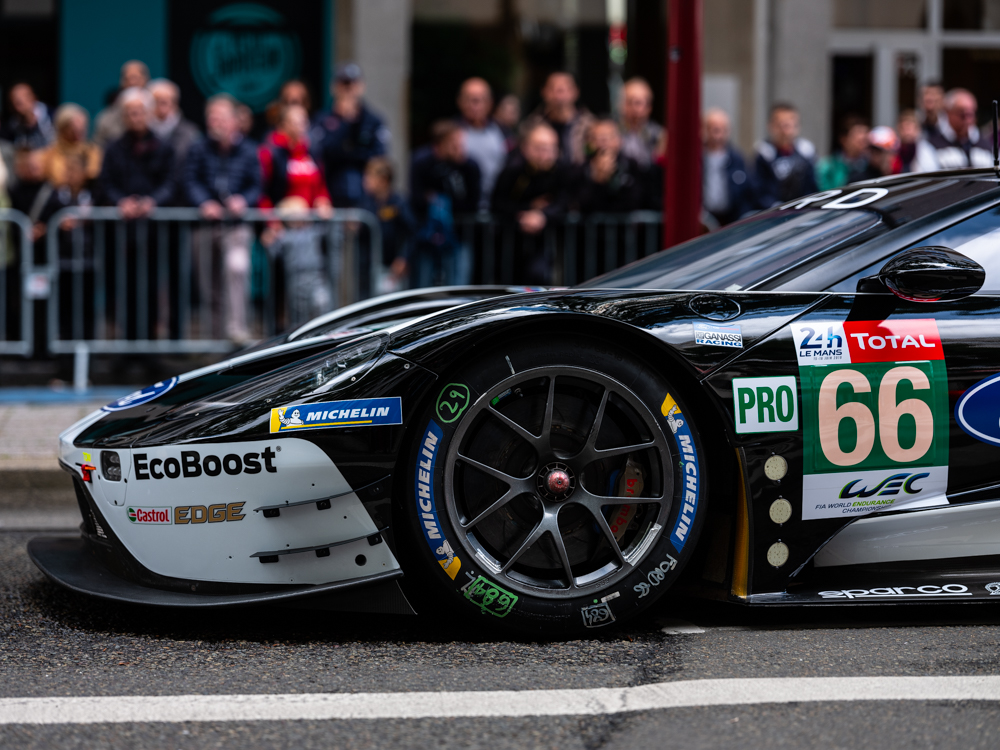
“There are so many different possibilities, and the nature of this race now is that it has turned into a 24 hour sprint. The circuit itself isn’t that physically demanding, but those little variations can make it mentally demanding if things go the wrong way.”
Richard Westbrook’s view from the #69 car is rather more pragmatic: “Wet running is meaningless really, to practice in the rain is a bit pointless. This track rubbers up so much and it evolves quite quickly, so we would prefer to work on the car rather than outright speed, which we know is there and will come as it does for everyone.”
Billy Johnson commented on the conscious decision of the organisers to use more Full Course Yellows and gave his view of the difference of approach in the USA:
“Racing in Europe compared with the US is quite different, there seems to be a real focus on rewarding perfection in Europe. We have more yellows in the US, more Safety Cars and procedures like wave-arounds, getting a lap back and I think it improves the spectacle for the fans and makes the strategic calls so much more important than in Europe. I think we have to remember that the reason we race is for the fans. The Safety Car has been pivotal in the past.
“I think this year the organisers have acknowledged that the Safety Car split gave the race to the Porsche last year and killed the GT race so hopefully, they will keep it closer together.
“In my car in 2016 I got split by a Safety Car too and I lost a minute and a half. If you get stuck behind the third Safety Car then straight away you are nearly a lap down and it can make a huge difference in GTE where the cars are so similar.
“The organisers have said that there is more of an intent this year to use Full Course Yellows instead of Safety Cars, which should stop anyone getting a big advantage, but it still rewards perfection rather than closing us up and providing a spectacle. If the field keeps getting closed up then it makes Balance of Performance less important too, because we are then able to race and make a difference. You only have to watch the IMSA races to see that.”
Dirk Muller: “They can still use the Safety Cars of course, but they are saying they will try to deploy the Full Course Yellow to avoid the situation last year where the Porsche gained the advantage that handed them the race so early on. We simulated those situations as much as we could during tests and I think it works out; it seems like a fairer way of doing things but at the same time it is not predictable.”

So, with the first of the sessions just ahead of them, how much more important have the qualifying runs now become for their race prospects? Andy Priaulx shares the #67 car with Tincknell and Bomarito and carries plenty of Le Mans experience at the front of the class:
“Last year we had a difficult qualifying and it took us the whole race to get back through the grid, so we will absolutely be on it over the two sessions. If you’re in the wrong position in GTE-Pro qualifying it’s not a question of pass this car, pass the next car, we’re all so close: there’s not one bad driver on the grid, they’re all fighting for their careers and they defend well. It’s just a tough race.”
Richard Westbrook: “Qualifying position is so important. If you start sixteenth or seventeenth you will probably lose this race. The field is a train now and you want to be at the front. It’s like a peloton, you need to be part of it and you need to work towards the front rather than at the back.”
Is it fair to say the Ford has not looked at its most comfortable in the wet?
Andy Priaulx: “Absolutely correct. I think the Multimatic guys will give us a set-up that works better than Spa; we understand the problem better now, but we’re not the best in the rain. I think the tyre choices were not great. But it looks dry here, mostly, and I think we’re in it. We’re not the bottom of the pile, but I think we’re in the mix. It’s a hard one to call, it’s so tight and there are so many variables: it doesn’t bear thinking about just how tough this race can be either from the driver and the team’s perspective – you have to be on your ‘A-game’ throughout without any question.”

So, to conclude Ford’s latest Le Mans presence in the best possible way, if one thing was singled out as the most important factor of victory, what would it be?
Andy Priaulx: “That’s a really tough question (very lengthy pause…). You know what, that’s what makes this race so hard… I think you need all of everything.
I always said winning races in normal sprint series is really hard and winning championships is almost impossible. If you go about your racing and you take on your championship on that basis of it being an almost impossible task you may be successful.
And I think this race is almost impossible to win. You need everything right: good pit stops, a very fast car, very strong driver line-up, top calls on strategy. Performance under pressure, that and concentration; that’s the one thing you need. Your race needs to be concentrated, precise and faultlessly executed.”
How much pressure does that put on consistency of driver performance across a crew?
Andy Priaulx: “This is three strong factory drivers per car now, no ‘Am to fall back on, everyone at their best. It is THE race. As far as the #67 is concerned, I’m very happy – no worries at all. Jonathan (Bomarito) did a great job at Sebring.

“Harry and I have lived in that car and so it’s been a tough call for him. But he is a solid, reliable and quick driver and we feel strong as a crew. Last year was my best ever Le Mans and it was a shame we got screwed by the safety car. We were edgy at the start and were on our guard with the set-up but we were pushing really hard and in the fight.
In modern BoP you have to drive beyond the car all the time; you can’t have anything in hand.”
Jonathan Bomarito concurs with his colleague and concludes:
“In testing my pace was getting better and better and we have the six-hour rule for the race on drive time. So as the ‘third driver’ I’m still in for a fair chunk of the race. They’re going to use me for a third of this race, and the remaining eight hours is still going to see me in the car. The plan is to be on pace always. Every aspect of this race has turned into a sprint race, driving the car flat out all the way. That includes qualifying.
“This race doesn’t have the traditional need to just stay on the lead lap any more and wait for a safety car – you have to be right up there.”


