


The DSC Editor caught up with ACO President Pierre Fillon at the recent ELMS event at Spa Francorchamps as the H24 programme team opened their doors to show progress on the zero-emissions project, the plans for the current car, and more particularly the progress being made towards a new set of regulations for the top class at the Le Mans 24 Hours.
The LMPH2G technology Demonstrator took part in competitive sessions alongside other race cars for the first time at Spa, running in both Free Practice sessions for the Michelin Le Mans Cup. The car is also currently set to appear at Portimao but again will not race.
The car features a new front end component, incorporating the running lights necessary to run in traffic.
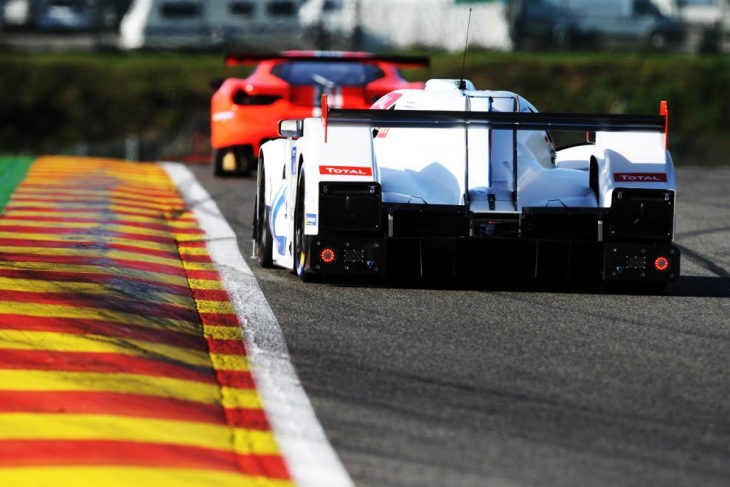
The car is still some way from the targeted pace (the aim is to get it to GT3 pace) but there is much more to come. The car is significantly heavier compared to the other LMP3 cars (c.1.4 tonnes) with progress set to be seen on reducing the weight of key components as well as improving the output and efficiency of the whole package.
First though, the big news in Spa wasn’t about the car, or the regulations, but rather a very clever development from TOTAL.
TOTAL is a technical partner to the H24 project, and brought with it to Spa, for the first time, a development that transforms the ability to race a hydrogen-fuelled car:
Pierre, we’re looking at what I have to say is a pretty remarkable achievement. The first-ever transportable fuel station for a fuelled race vehicle.
“Yes, it’s a beautiful day, not only for the sunshine.
“If you remember one year ago, we presented here the Green GT LMPH2, a fuel cell-powered race car. And we did a refuel in hydrogen to show that technology is available, and with safety. But then it was just a simple bottle refuel.
“One year after, we have developed the car and the fuel station.

“This morning was the first time (in the FP1 session of the Michelin Le Mans Cup at Spa) that the car ran on the track in the same session with classic competition cars, LMP3 and GT3 and the gap between the GT3 is seven seconds at this time, so a big improvement on last year.
“But you know, the plan for the ACO is to promote Hydrogen technology for the future in competition and to compete, you need of course a race car. But you need to have a race-car that is able to go far. And to go far you need to refuel. And that’s why this day is very important because with TOTAL we developed a mobile station able to refuel this car on all the tracks in Europe because this car will compete in Michelin Le Mans Cup next year.”
So we know already, there’s a commitment. And we’ll talk about that in just a moment. It’s not just to a zero-emission formula, but also for the infrastructure to be installed at Le Mans to refuel these cars. That was a key part of the announcement of the new building for the centenary of the Le Mans 24 Hours in 2023, wasn’t it?
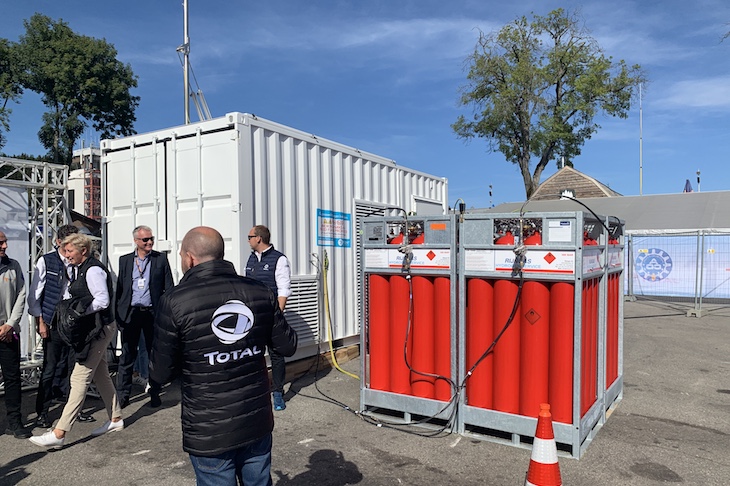
But I should describe what we’re looking at here. This is effectively the size of a standard shipping container with the fuel bottles in a cage behind the refuelling station on the other side from us, with all the control functions contained within the station. So this can be taken by truck to a race track anywhere in Europe?
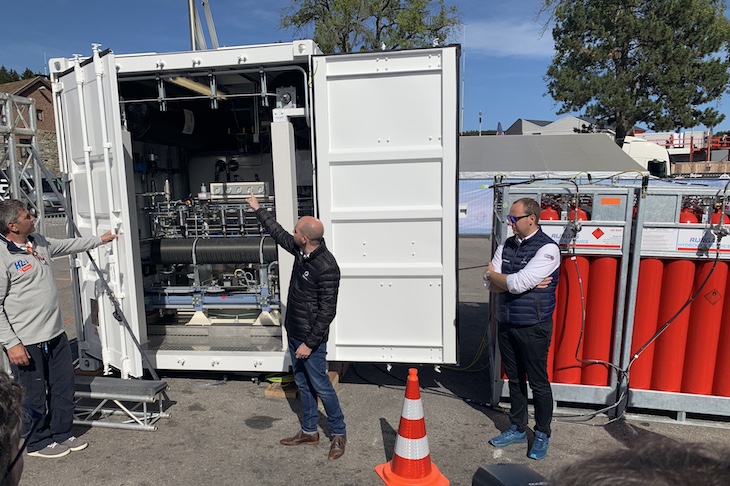
“Yes!”
Where it’s capable of fuelling the race car for what I’m told by the team is effectively a full GT3 race stint, around an hour’s running, just without (yet) the performance of a GT3. But presumably, that’s what comes next?
“This is a target clearly. We expect by the middle of the season of the Michelin Le Mans Cup to have the same performance as a GT3 for the first time.
“It’s impossible right now to have hydrogen infrastructure at every track. So it’s the reason why we needed this mobile station and effective with this station we can move from yesterday to Monza to Barcelona, etc, etc. This is the step for 2020.
“In the meantime, we will continue to work with manufacturers, we have five manufacturers, who are working on the rules, to write the rules to have a hydrogen category at Le Mans in 2024 able to win the race.”
Is the target for these cars to win the race overall?
“Able to win the race yes. Maybe not in 2024 but the idea is that these rules give us the framework to allow these cars to have the same performance as current cars and that they would be able to win Le Mans.”
Just a word or two about progress on that. It is a challenging timeframe. We’ve got ‘hypercar prototype’ coming next year. That will be what three, four years before we see cars running with zero emissions against those rules if that process is successful, that is a very challenging target?
“Yes, it’s a challenging target. But competition is here for that.”
The idea is that these rules give us the framework to allow these cars to have the same performance as current cars and that they would be able to win Le Mans
In terms of the drive behind that, clearly, there’s a global process about climate change, etc. We know the pressures that are at the moment on governments and on the OEMs about a fundamental change in the way that we have human mobility. Is this a change to reflect the way in which the OEM market is moving, that the real money now into motorsport inevitably has to come from R&D?
“Yes, for sure the main pre-occupation of people now is climate change. And we are obliged to respond to where governments and manufacturers are working. They are working on zero-emission vehicles.

“Electric with battery. Electric with hydrogen. I think you see that in China the government puts a lot of money now on fuel-cell and it’s a reason why it’s important that motorsport shows the example.”
Can you give us an indication, in an extraordinary time for the automotive industry, as to just the level of interest from the major OEMs in the zero-emissions target you’ve got?
“Yes, there is a good number of OEMs. I can tell you at this time that we have five manufacturers involved in the working group on the fuel cell regulations.
I can tell you at this time that we have five manufacturers involved in the working group on the fuel cell regulations
“But we have other manufacturers who are also engaged, asking us questions about that. You have French you have US, you have German and for sure you have Japan and Korea.”


