LMP1 (9 Cars)
1 LMP1-H Audi Sport Team Joest Lucas Di Grassi/ Loïc Duval/ Tom Kristensen Audi R18 e-tron quattro
2 LMP1-H Audi Sport Team Joest Marcel Fässler/ André Lotterer/ Benoit Tréluyer Audi R18 e-tron quattro
7 LMP1-H Toyota Racing Alexander Wurz/ Stéphane Sarrazin/ Kazuki Nakajima Toyota TS 040 Hybrid
8 LMP1-H Toyota Racing Anthony Davidson/ Nicolas Lapierre/ Sébastien Buemi Toyota TS 040 Hybrid
14 LMP1-H Porsche AG Romain Dumas/ Neel Jani/ Marc Lieb Porsche 919 Hybrid
20 LMP1-H Porsche AG Timo Bernhard/ Mark Webber/ Brendon Hartley Porsche 919 Hybrid
9 LMP1-L Lotus LMP Christijan Albers/ James Rossiter/ Thomas Holzer Lotus T129 AER WITHDRAWN
12 LMP1-L Rebellion Racing Nicolas Prost/ Nick Heidfeld/ Mathias Beche Lola B12/60 – Toyota
13 LMP1-L Rebellion Racing Dominik Kraihamer/ Andrea Belicchi/ Fabio Leimer Lola B12/60 – Toyota
A nine car LMP1 entry is a pretty healthy picture for the 2014 FIA WEC, add to that the fact that we have a trio of full season two car efforts and the picture looks better still.
Lets look at the privateers first – It’s been a difficult run in to the start of the season for both teams in the LMP1-L sub class made more difficult still that the very first concrete information we received from the Lotus LMP team about their new T129 LMP1 car was that it was withdrawn from the Silverstone race.

We know the car is based on the same monocoque as the 2013 T128 LMP2 car and that the car is powered by the new AER built twin turbo engine after plans changed from the initial customer (Audi DTM based) V8, but just a single rendering has thus far been released.
Thomas Holzer and James Rossiter were initially named on the Silverstone driving crew, both carried over from the LMP2 effort with Christijan Albers returning to the Kolles/ Kodewa fold after racing for the team in their customer Audi R10 TDI days.
Rebellion Racing are fielding their now grandfathered Lola Toyotas as the team waits for the completion of their new (and still Toyota engined) Oreca built R Ones – The Lolas looked fantastic but were way, way off the ultimate pace at the Prologue Test and have since been dealt an 890 kg minimum weight limit, 83 litre fuel tanks and slightly larger restrictors than in 2013. They can only hope at this point that the factory cars hit trouble.

They do have some real quality in the driver line-up, Nick Heidfeld will be squeezing all he can again from the Lola Toyota, and Nico Prost too will bring his A game. Young Fabio Leimer joins the team fresh from his 2013 GP2 championship winning season. He’s joined by fellow new boy Dominik Kraihamer, the ex Lotus LMP and Oak racing man continuing a climb up the sportscar ladder.

Rebellion regulars Mathias Beche and Andrea Belicchi return but for all of them it looks set to be a weekend to learn about the task in hand for the remainder of the season.
Now here’s where it all gets a bit complicated!
The six factory cars, a pair each for Audi, Porsche and Toyota are all running to the brand new LMP1-H regulations, designed to accommodate and encourage fuel efficient hybrid powertains.

The new LMP1’s have all new monocoques, are narrower, with narrower rubber all round. That means less drag, and with the level of power permitted by the regs, more speed – BUT! The cars are only allowed to expend a certain amount of energy over a rolling three lap window, the ultimate values for which are decided by a decision from each team on what level of hybrid power they are opting for. Clear? thought not!

As you’ll read in the DSC editorial ahead of this race there’s really a choice around how you approach the WEC this season. You can glory in the new tech, analyse with pinpoint precision the nuances of the energy values allowed and expended and make a broad calculation as to the likelihood of each of the three very different solutions arrived at by the three factory teams being the most successful – OR – You could just enjoy the race!
Let’s start along that road and see where it takes us.
Audi’s new R18 etron quattro is a very different car from the WEC and Le Mans winning 2013 car – so different indeed that not a single component is carried over from the older car.

Audi continue, of course, to have their hybrid power delivery via the front axle (as indeed do all three factory teams) but there’s an important number of differences between the Audi and the other two.
First is that the Audi is fuelled by diesel once again, that means different fuel tank size, and different fuelling regulations (nozzle diameter). The V6 twin turbo TDI engine is increased in size to 4 litres for 2014.
Secondly, Audi abandoned their planned Exhaust Recovery System, a second hybrid harvesting method, earlier in their programme, Audi saying that the system did not give them the improvement they were looking for.
The net result is that the R18 will be running in the 2mJ category, that means that the values applied by the regulations to allowable fuel are different for the Audi, it COULD be a major disadvantage, but with the Audi decision described to us by another competitor as being “a very, very conservative approach” it does rather beg the question – “What do Audi know that we yet don’t?”

Another important change to the regs sees the 4wd cars able to utilise their hybrid boost from zero mph, last year they were restricted to harvesting over 120 km/h, something Tom Kristensen described to DSC as “We didn’t realise how big a disadvantage it was until we could do it ourselves, out of the slower corners there is a major difference.”
Reliability is going to be key this year, new cars, new tech, and a rule book that will make it more difficult to play catch up if (and when) there are issues for any of the LMP1 runners. That will have played a major part in the Audi decision.
On the driving front the #1 car is Scot-free! Allan McNish though will be in attendance in his new role at Audi Sport, still to be fully outlined publicly, it looks to involve drive preparation and development.
In the car though will be a new look squad with Audi’s talismanic Tom Kristensen anchoring the Championship effort. He’ll be joined by fellow 2013 World Champ, the super quick Loic Duval and Lucas di Grassi,the Brazilian looking to make history this year in a number of ways, if he does so it will surely give the WEC a lift in his homeland.
Toyota are back too of course, another new car, the TS040, and a reshuffled driver line up, Stephane Sarrazin joins Alex Wurz and Kazuki Nalajima in the #7 car whilst Nicolas Lapierre moves over to the #8 with Anthony Davidson and Sebastien Buemi.
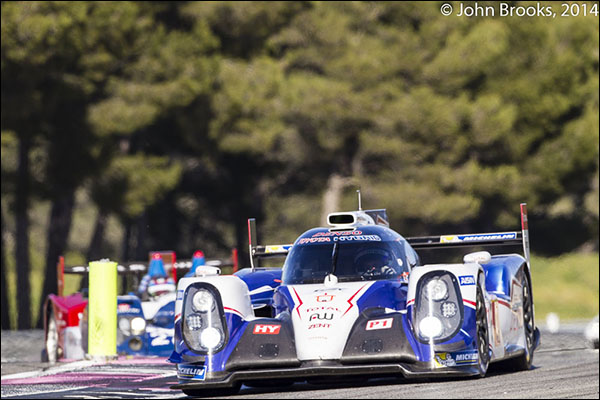
Toyota have switched to harvesting and deploying on both axles using a single, enlarged from last year, super capacitor for 2014 and have released some quite amazing power figures for the TS040 – The headline ‘One THOUSAND Horsepower!’ achieved via 480PS of four-wheel-drive hybrid boost in addition to the 520PS 3.7litre petrol engine. they’ll race in the 6mJ category.
Toyota have long had an advantage in aerodynamic design and they presented and tested two versions of the car at last month’s Prologue test – The higher downforce version will be seen at Silverstone and, with much of the tech, if not the componentry, carried over from the TS030 there are plenty of pundits who believe that Toyota might be bringing an advantage to the start of the season.

That’s something we haven’t seen so far from the boys (and girls) from Cologne, year one was meant to be a development effort and year too saw the introduction of their evolution TS030 delayed – Has the sleeping giant now awoken? We’ll soon see!
Finally it’s the new boys, though describing Porsche in such a way does seen very, very odd. The reality though is that the factory team has not fielded an entry at this level since 1998 – That’s too long away for one of the most successful endurance racing marques on the planet and it is great to have them back.

The 919 Hybrid certainly looks the part, was quick at the Prologue and, Porsche say, has been reliable over 6 hours (but not yet over 24!).
Quick enough? Reliable enough? Again we don’t yet know, and likely neither do Porsche! The power train is, unsurprisingly, all new, a two litre direct injection V4 petrol engine coupled to a pair of energy recovery systems allowed Porsche the opportunity to choose between the 8mJ category or to join Toyota on 6mJ – They opted for the conservative option, though this is cutting edge stuff for both teams, these are levels not so far seen in motorsport.
The driving squad is an eye-catching blend of youth and experience – Mark Webber is the star signing for Porsche and the popular Aussie gets some down under company in the #14 car with young Kiwi Brendan Hartley graduating from F1 Sim test duties (for Mercedes) and some stellar outings in LMP2 (Murphy Prototypes) and DP (Starworks) leaving nobody in any doubt as to his speed and race smarts. Timo Bernhard adds some Porsche (and Le Mans winning) heritage to the line-up.

The sister #20 car sees fellow Le Mans winner Romain Dumas joined by his long-time Porsche factory buddy Marc Lieb, both hugely experienced, and both very quick. Neel Jani got the Porsche nod early on, his speed and consistency for Rebellion Racing will have caught the eye.
Lots of unknowns then to contend with in the top class – This one will be a learning curve for all of them, and for all of us too!