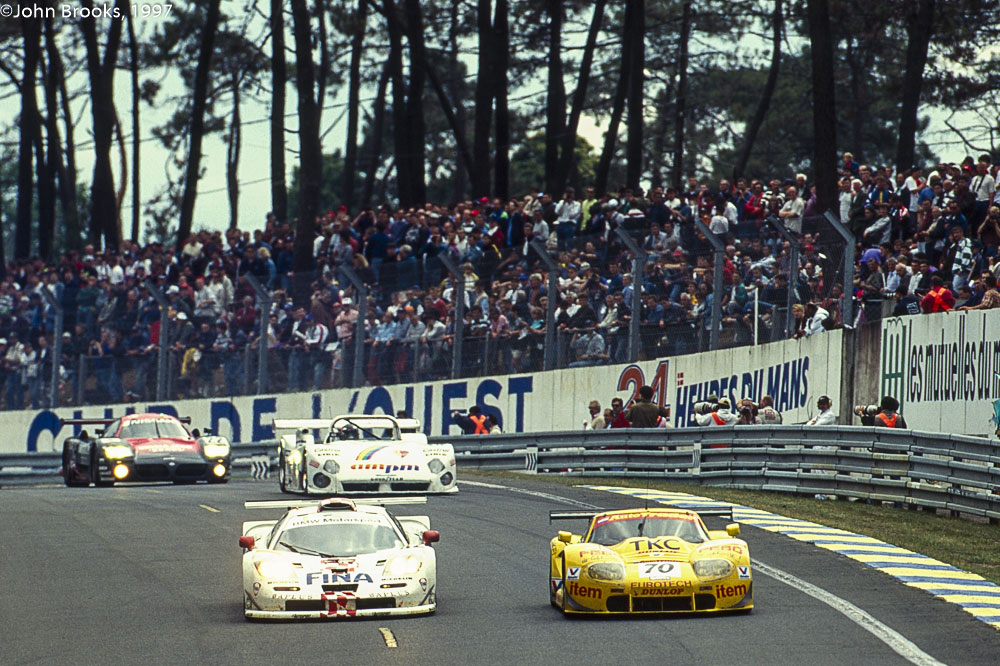
John Brooks and Marcus Potts remind us of some of the runners and riders from the Le Mans 24 Hours of 1997
First shown on DSC in our lockdown GT1 Week – here’s another showing for John Brooks’ and Marcus Potts’ 1997 Le Mans Gallery – and the start of a week of Le Mans retrospectives leading up to the 2022 24 Hours of Le Mans.
The Joest Racing TWR Porsche WSC-95 had an interesting history; the chassis taking a back-to-back win in 1995 despite being out-performed by the newer GT1 entries from Porsche and McLaren. Notably, it gave Tom Kristensen his first win at La Sarthe, alongside Michele Alboretto and Stefan Johansson.
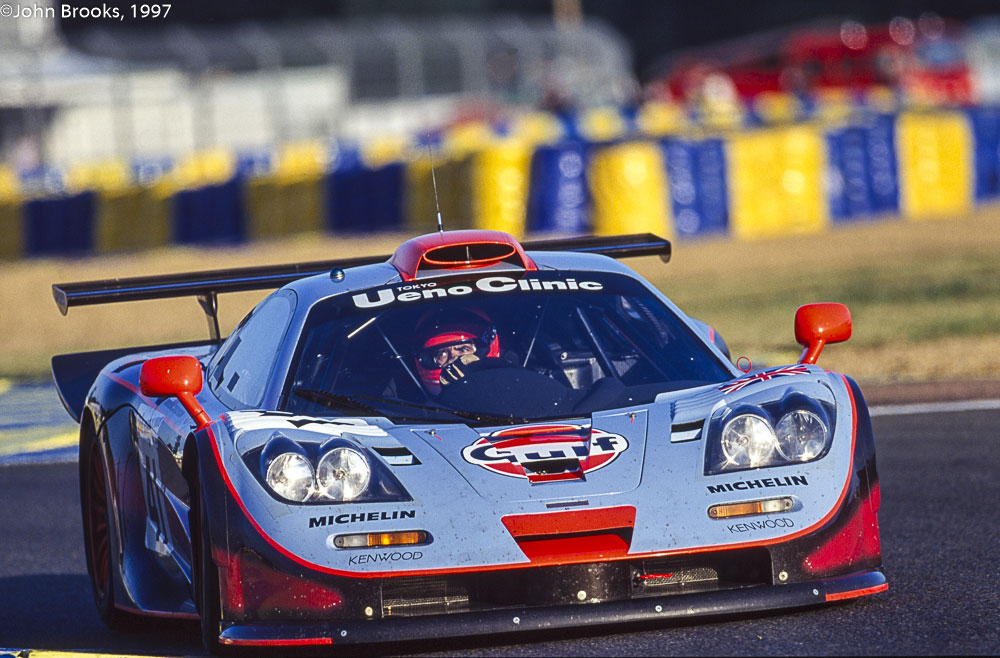
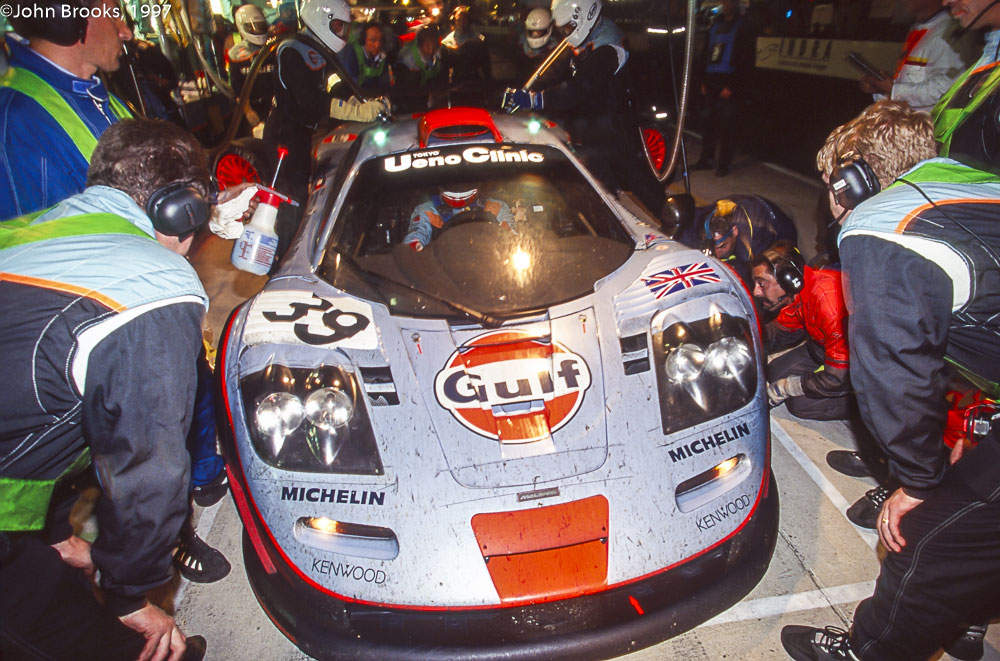
With the #40 chassis burned out in qualifying, and the #39 suffering a similar fate during the race, second at the flag was a fitting reward for Gulf Team Davidoff, with Jean-Marc Gounon, Pierre-Henri Raphanel and Anders Olofsson crossing the line second in the long-tailed McLaren F1 GTR.
Peter Kox, Roberto Ravaglia and Éric Hélary secured third for Team BMW Motorsport’s #43 McLaren F1 GTR, three laps down on the winners.
Twenty years ago and Michel Vaillant was riding high in the popularity stakes – some things never change. The #13 Courage Compétition Vaillante C36 gave Didier Cottaz, Jérôme Policand and Marc Goossens (plus the enigmatic Michel Vaillant) fourth place.
Pedro Lamy joined Armin Hahne and Patrice Goueslard to give Porsche’s new 911 GT1 its highest position in 1997, fifth for Schübel Engineering. The factory duo failed to finish.
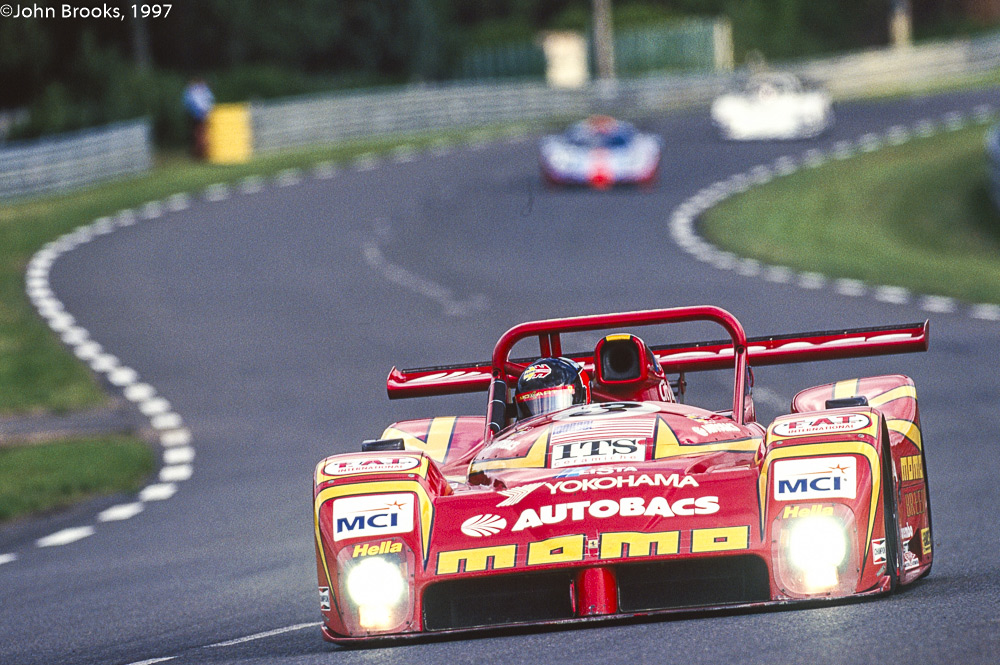
Gianpiero Moretti, Didier Theys and Max Papis gave the delightful Ferrari 333SP its best-ever result at Le Mans, with 6th at the flag for Moretti Racing.
Our gallery is missing the 7th (La Filière Elf Courage C36, Henri Pescarolo) and 8th (BMS Scuderia Italia Porsche 911 GT1) placed finishers, and 9th across the line was the Elf Haberthur Racing POrsche 911 GT2, giving Michel Neugarten, Guy Martinolle and Jean-Claude Lagniez a class win in 1997.
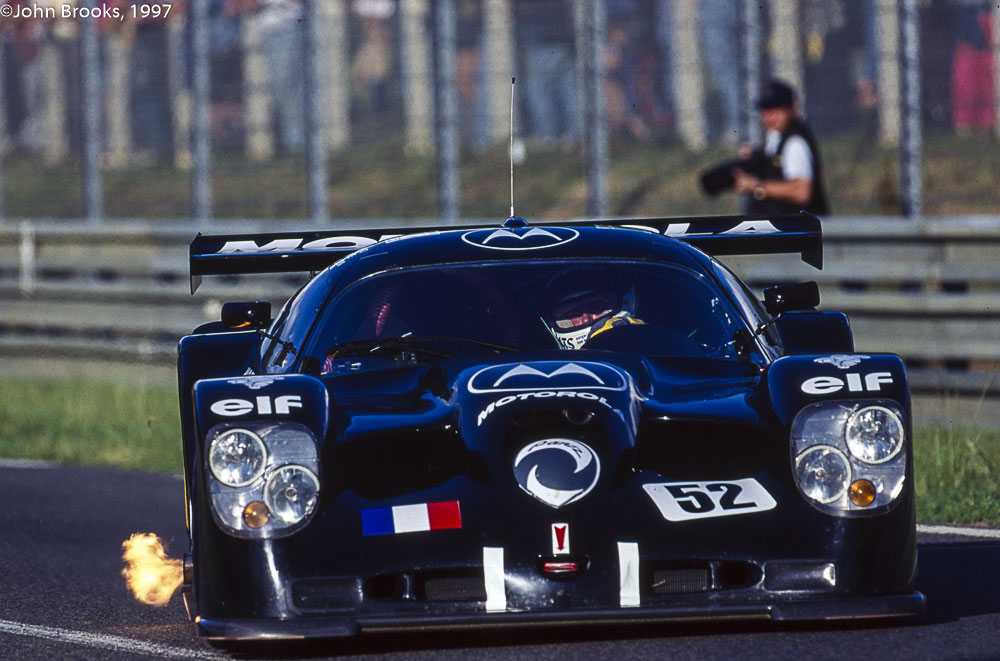
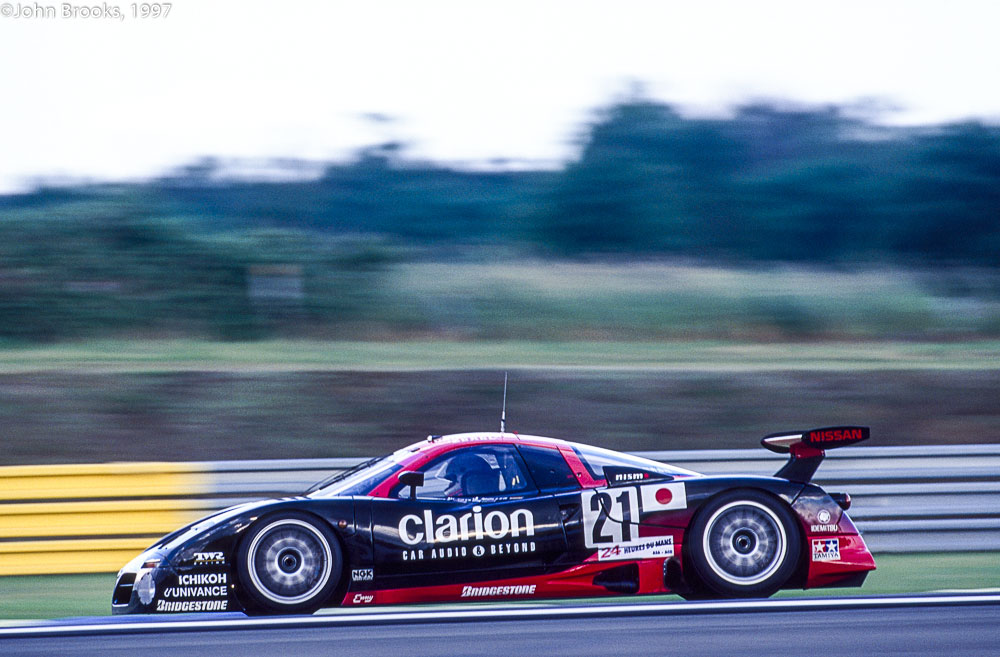
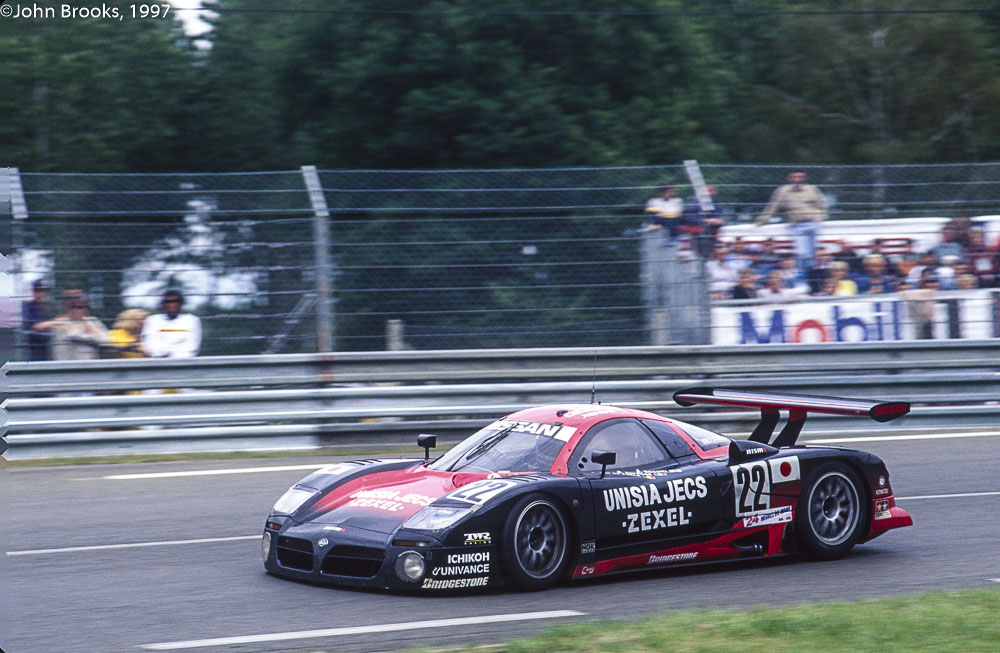
Much was expected of Nissan’s all-new R-390, with a pedigree that again included technical and design input from TWR – a relationship that contributed to some familiar XRR-9 styling features. Brundle’s fastest time in pre-qualifying promised much, but gearbox issues resulted in a best of 12th at the flag for Hoshino, Comas and Kageyama.
The #80 GT Racing Team (with Roock Racing) Porsche 911 GT2 placed Claudia Hürtgen as the top female in 1997, 13th and partnered by the British duo of John Robinson and Hugh Price. Not pictured, Roock Racing’s own cars, the #74 and #73 finished 10th and 11th overall, 2nd and 3rd in class.
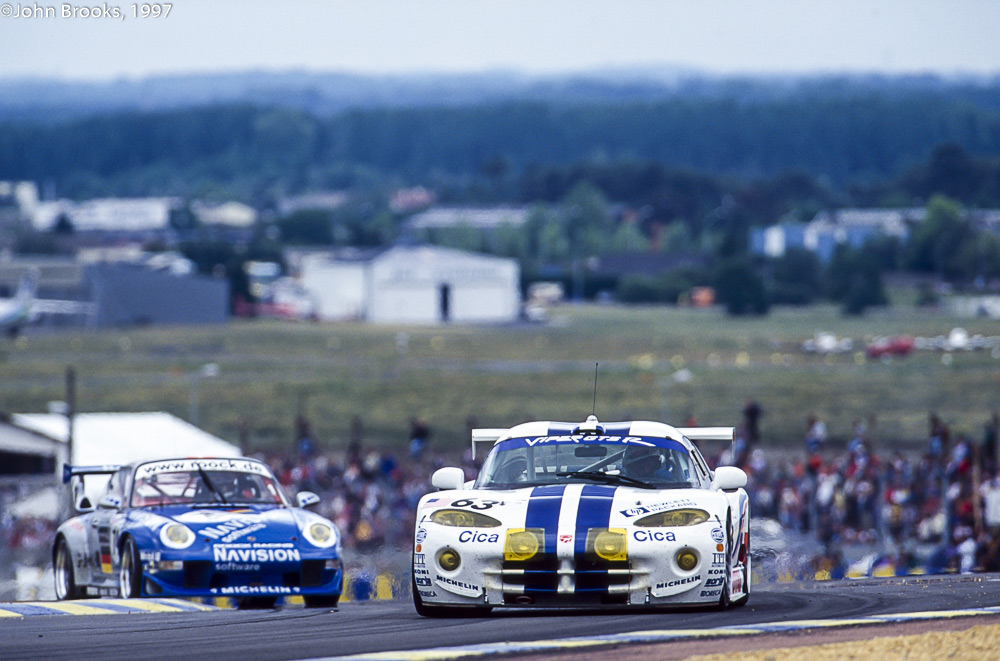
The best of the Vipers in 1997 was the #63 Team Oreca GTS-R, shared between the multi-national Justin Bell, Pierre Yver and John Morton. This was probably the Viper’s most disappointing result of the year, with impressive wins over Porsche elsewhere in the then-new FIA GT Championship.
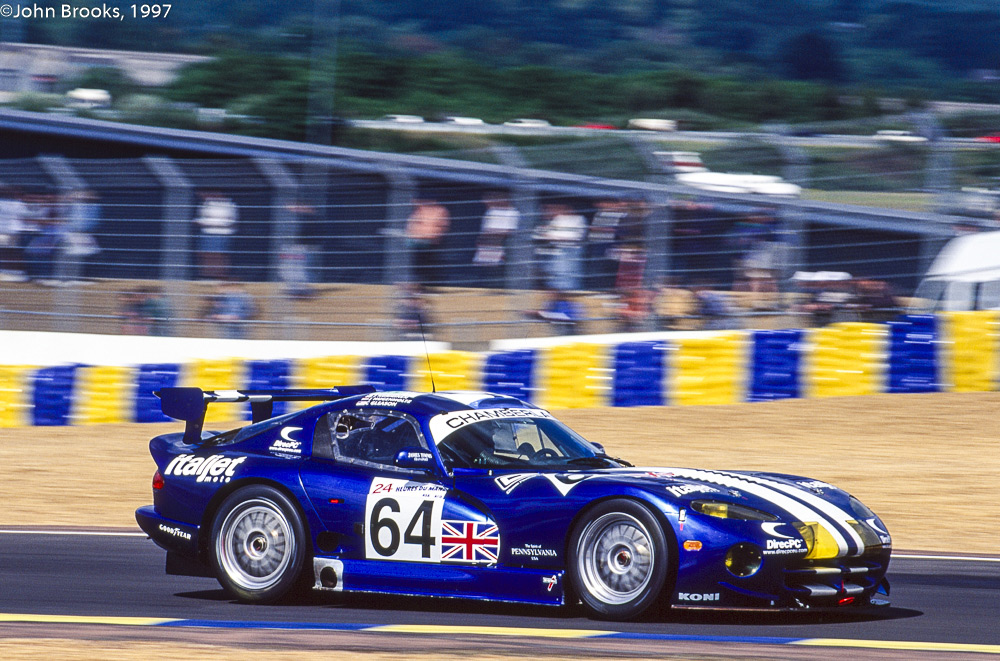
Back in the 1990s it was hard to imagine a Le Mans 24 Hours without an entry from Hugh Chamberlain. This was one of his highest results with the Chrysler Viper GTS-R, 15th overall (in a race with high attrition) and 6th in GT2. The #64 was shared between Hans Hugenholtz, Jari Nurminen and Chris Gleason.
16th overall gave 5th in LM P1 for the #10 Courage Compétition Courage C36, the Porsche Type-935 3.0L Turbo Flat-6 powering the chassis for Ekblom, Ricci and Libert.
The Team T.D.R. Mazdspeed Kudzu DLM-4 (not pictured) took 17th and was the last classified finisher in 1997. Porsche’s leading works 911 GT1 Evo had been on course for the class win before Kelleners hurriedly pulled over on the Mulsanne with the GT1 erupting in flames after 327 laps. It was Emmanuel Collard’s third 24 Hours, partnered by Kelleners and Yannick Dalmas. Manu is now facing his 23rd Le Mans start.
With 326 laps completed, the #39 Gulf Team Davidoff McLaren (Ray Bellm, Andrew Gilbert-Scott and Masanori Sekiya) deserved better than an unclassified 19th, but at Le Mans you have to cross the line, and this Longtail F1 GTR retired from 5th after the team’s second fire of the week, this time for Gilbert-Scott.
Philippe Gache, Olivier Beretta and Dominique Dupuy shared the #61 Team Oreca Viper, effectively 20th but unclassified at the finish on 263 laps.
It was not a good weekend for the works Porsches, the new Evo variant showing unexpected unreliability. The impressive first-string line-up of Hans Joachim Stuck, Thierry Boutsen and Bob Wollek must have hoped for more after qualifying on GT1 pole, but Wollek uncharacteristically crashed out after 238 laps, possibly due to a broken drive-shaft.
The second BMW Team Schnitzer McLaren F1 GTR couldn’t match the performance of the sister car, third overall, but in the hands of JJ Lehto, Steve Soper and Nelson Piquet had qualified fourth, the quickest of the McLarens. Late in the race JJ nosed the barriers, and the car was out …
JB Racing’s distinctive red and white Marlboro colour scheme made the Porsche 911 GT1 easy to spot on track, where it was co-driven by Jürgen von Gartzen, Olivier Thévenin and Alain Ferté.
The Panoz Esperante GTR-1 was created for Don Panoz by Bicester-based Reynard Motorsport, at that time best known for single-seater chassis, principally for Indy Car. While successful in the States, the Panoz never quite matched the pace of Porsche or McLaren in Europe, despite an impressive LM driver squad that featured Andy Wallace, James Weaver and Butch Leitzinger. Woes with the Ford-based Roush Racing 6 litre V8 scuppered the team’s chances.
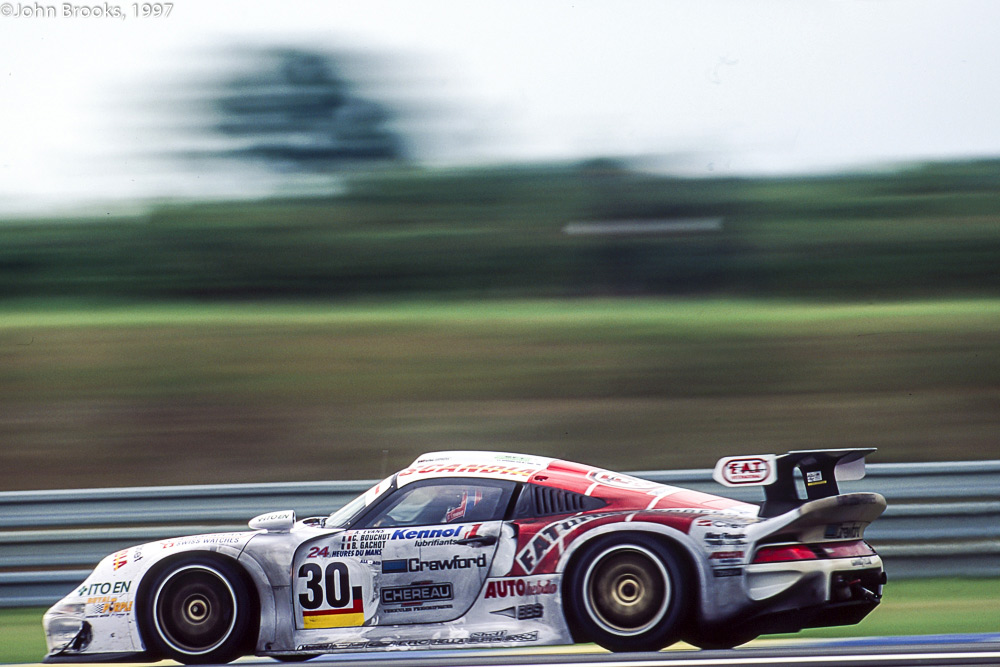
Kremer Racing was another customer squad for the Porsche 911 GT1, a strong line-up of Christophe Bouchut, Andy Evans and Bertrand Gachot securing 8th on the grid for the start of the 1997 24 Hours.
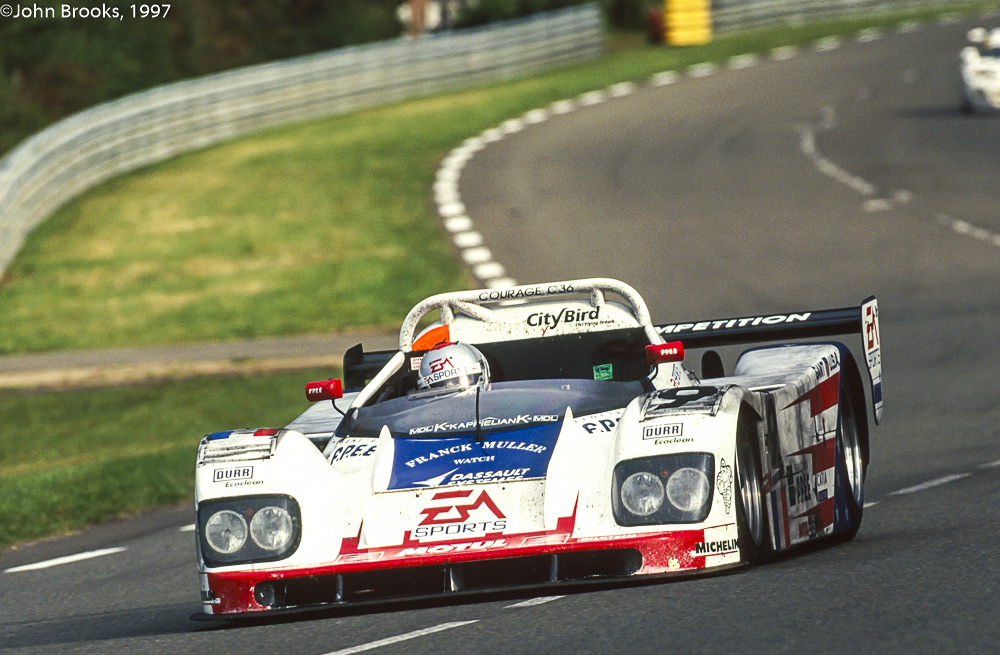
As Oreca does in LMP2 today, Courage was the mainstay of French privateer prototype chassis in the mid-nineties. The #9 Courage Compétition C36 boasted the impressive father-and-son pairing of Mario and Michael Andretti with Frenchman Olivier Grouillard. Mario had his best Le Mans finish in 1995, finishing second with Courage – a race that still frustrates him, convinced the team “lost” through poor organisation and denied him the one accolade he still craved.
French outfit DAMS took two Panoz Esperante GTR-1 chassis for the 1997 season, the first car making the team’s debut at Silverstone in the FIA GT Championship in May. Again, only one car appeared at Le Mans in June, for Franck Lagorce, Éric Bernard and Jean-Christophe Boullion, and retired with a major oil leak.
The second of Dave Price Racing’s Panoz Esperante GTR-1s hosted David Brabham, one-time Stig Perry McCarthy and American Doc Bundy. Despite the team’s best efforts, 29th overall was an unclassified finish, with the car’s massive 6 litre V8 proving fallable once again, this time bringing the car’s race to a fiery conclusion.
Having set a blisteringly quick time of 3:43.152 in pre-qualifying, Martin Brundle wasn’t quite able to match that pace come qualifying, and the #25 Porsche took GT1 pole with a best of 3:43.363. In the race, the car retired after 139 laps with accident damage.
Franz Konrad, partnered by Mauro Baldi and Robert Nearn, started the race from 24th, but an accident after just 138 laps put paid to their chances, and the car was retired from 31st.
Konrad Motorsport ran cars in both GT1 and GT2, with the #79 qualifying almost at the back of the grid, and not faring a whole lot better in the race, retiring after 126 laps following an accident. Elsewhere, the team enjoyed better fortunes, competing widely in the FIA GT Championship, IMSA GT Championship, and the Porsche Supercup.
On paper, the Nissan R390 was a race-winner, but in practice, it struggled to offer the kind of returns the investment in technology, design and development warranted. Another impressive squad, comprising Riccardo Patrese, Eric van de Poele and Aguri Suzuki, qualified third, but suffered gearbox troubles in the race and retired after 121 laps.
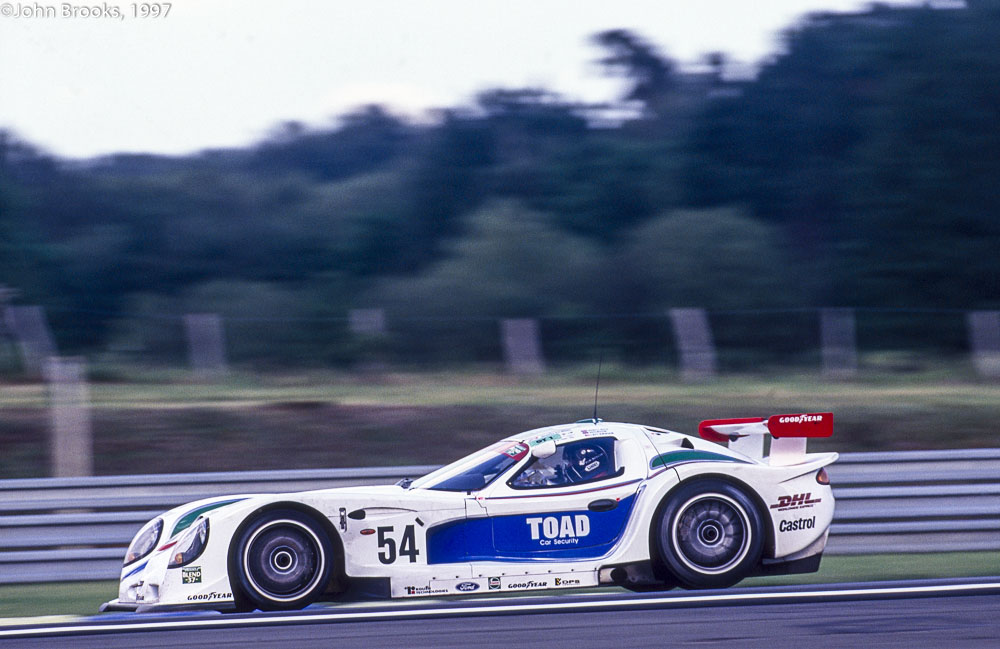
Just a single Lotus Elise GT1 made it through to raceday, piloted by Jan Lammers, Mike Hezemans and Alexander Grau. The factory conceded that the chances of going the distance were slim, and forecasts were proved right when the oil pump failed after 121 laps. The car lacked speed, and against the highly specialised equipment from McLaren and Porsche, was always likely to struggle. Being pretty wasn’t enough, and 8th (Spa) was the year’s best result.
Hidden beneath the open-cockpit bodywork of the Kremer K8 Spyder were many key elements of the all-conquering Group C Porsche 962. Developed from Kremer’s CK7, the K8 was nearing the end of its development by 1997, although it would soldier on for two more years. The car had won at Monza earlier in the year, but the engine failed at Le Mans, leaving Tomás Saldaña, Carl Rosenblad and Jürgen Lässig twiddling their thumbs after just 103 laps.
The Lark-sponsored McLaren was one of six F1 GTRs entered in the 1997 race, and among the four which failed to reach the chequered flag. Akihiko Nakaya, Keiichi Tsuchiya and Gary Ayles had qualified tenth, but an accident put paid to their hopes.
With changes in the regulations, Lister looked likely to strugggle in GT1 against the likes of Porsche and McLaren, and opted for a radical redesign of the Storm for 1997. A longer, more aerodynamic variant appeared, still powered by the Jaguar V12 that had served TWR so well in the Group C days. Two cars were entered for Le Mans, but an accident put paid to the #45’s chances, while the complex transaxle gearbox failed on the #46. They sounded fantastic, however, and were a great favourite with the crowd.
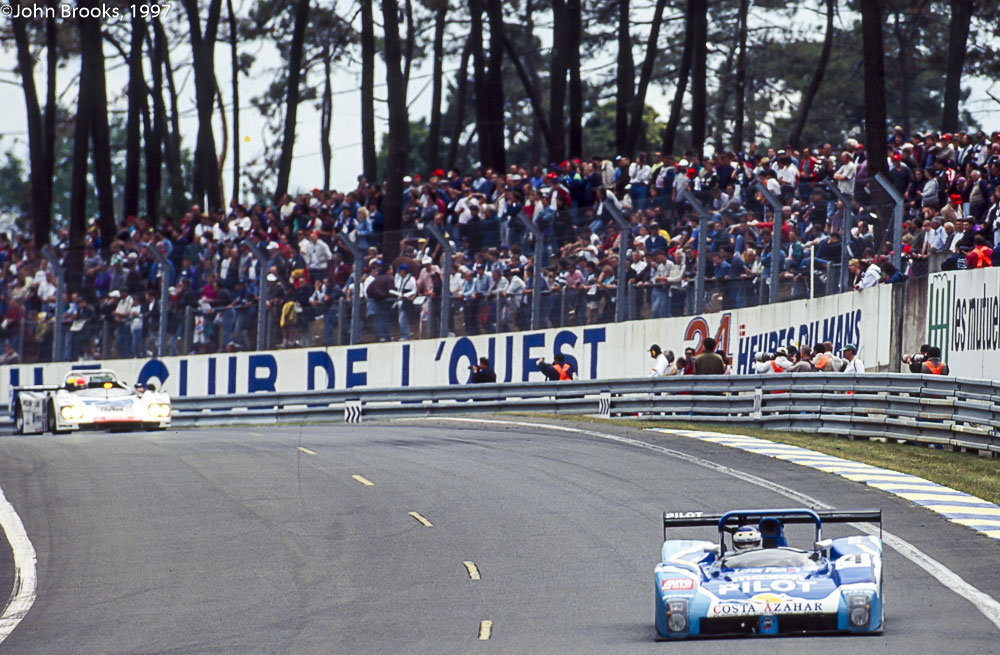
Our archive isn’t quite complete, and missing here are the second Lister Storm, a works Oreca Viper, and two Saleen Mustang RRRs entered by Speedlab and Cirtek racing. The svelte #60 Agusta Racing Callaway Corvette was an un classified 42nd. 45th was the pretty French-blue Pilot Racing Ferrari 333SP of Michel Ferté, Adrián Campos and Charlie Nearburg,
The LM600 had made an emotive and highly popular return to Le Mans for Marcos in 1995, with a factory-entered pair that captured the crowd’s imagination – as much by their Chevrolet V8’s mighty bellow as anything else. Two years later the noise had been tamed, and the cars were never quite as impressive again. The #70 managed just 15 smoky laps, while the #71, shared by the now-disgraced Dominic Chappel, never even qualified.
Added in here just for quirky interest, the #6 Kremer K8 shared by Lavaggi, Rosenblad and Saldaña had run well in pre-qualifying, topping out 36th quickest (out of 68 hopefuls). In race qualifing it again emerged 35th fastest, but was excluded when two of the drivers failed to fulfil their qualifying requirements.