

This past Thursday, the Eneos Super Taikyu Series powered by Hankook held its annual pre-season test at Fuji Speedway. Of the 62 teams registered to run this season, 41 of them attended this test including several teams that have entered new cars.

First, there was Team 5Zigen (“go-jigen”), last year’s champions of the ST-Z class using a Mercedes-AMG GT4. This year, they’re stepping up to the premier ST-X class with a Nissan GT-R NISMO GT3. The new 5Zigen GT-R recorded the fastest time of the test day, a 1’39.095 set in the third daytime session. They also led the first session with a time of 1’39.822, the first car to dip under the one minute 40 second threshold.
Team 5Zigen haven’t officially announced their drivers for the upcoming season, but through social media posts we may already know that Shintaro Kawabata and Yusuke Shiotsu will be two of their drivers for the upcoming season. Kawabata, in fact, was the driver that recorded the fastest time in the session – in his first time driving the Nissan GT-R.
https://twitter.com/shin_kawabata/status/1628721268852936705

The new #14 Zhongsheng ROOKIE Racing Mercedes-AMG GT3 made its first public on-track appearance (seen running ahead of the #28 ROOKIE Racing Toyota GR86 CNF Concept, from the ST-Q class).
While they didn’t lead any of the sessions, the quartet of manager/driver Tatsuya Kataoka, Naoya Gamou, Hibiki Taira, and Ryuta Ukai were able to log nearly 700 kilometres on the day.

And then there was the new #202 KCMG Honda NSX GT3. KCMG participated in the pre-season test in 2020, but withdrew due to the effects of the COVID-19 pandemic. Three years later, they’ve returned with big ambitions.
The bare carbon KCMG NSX recorded the quickest time in the two-hour Night Practice, at 1’39.481. The team’s regular trio of owner/driver Paul Ip, Ho-Pin Tung, and Marchy Lee were joined by Edoardo Liberati, a mainstay of the team’s international GT efforts.

Donning the champion’s number 1 plate for the first time, the HELM Motorsports GT-R of Yutaka Toriba, Yuya Hiraki, and Reiji Hiraki went quickest in the second daytime session with a 1’39.589.
The ST-Z class had nine cars participating, including the brand-new Nissan Z GT4.

A concept version of this car made its debut at the Fuji Super TEC 24 Hours last year, and now the customer version is ready to embark on its maiden season. The #26 Team ZeroOne Z GT4 of Ryuichiro Otsuka, Ryuichiro Tomita, and Takuro Shinohara recorded the car’s best time with a 1’47.589. Teppei Natori, who was not listed with the team in the pre-event entry list, will complete the team’s driver line-up.

Naniwa Denso Team Impul’s #20 Z, seen with its bare composite fibre bonnet, recorded a 1’48.502. Yuki Tanaka and the ‘Three Kazukis’ – Hiramine, Oki, and Hoshino – will be the team’s drivers for the full season.

By no means brand new, but definitely new to Japan, is the McLaren 570S GT4 that will compete this year with BUZZ Kota Racing, managed by Kota Sasaki. Their best time was a 1’48.613.
Sasaki will share the car with an eclectic line-up of new gentleman driver Ken Alex, Max Salo (son of F1 and sports car racing alumnus Mika), Legends car racers Naoto Uzuka and Kazutaka Tokufuji, and experienced GT4 runner Ryosuke Kagami.

Neither new nor new to Japan, but new to Saitama Toyopet GreenBrave, is the Toyota GR Supra GT4. Taking the step up from ST-3 after retiring their beloved Toyota Crown RS sedan, the GreenBrave Supra GT4 recorded a best time of 1’48.419.
This year, Manabu Yamazaki, formerly of Corolla Shin-Ibaraki Racing, joins the mainstay GreenBrave trio of Naoki Hattori, Hiroki Yoshida, and Kohta Kawaai.
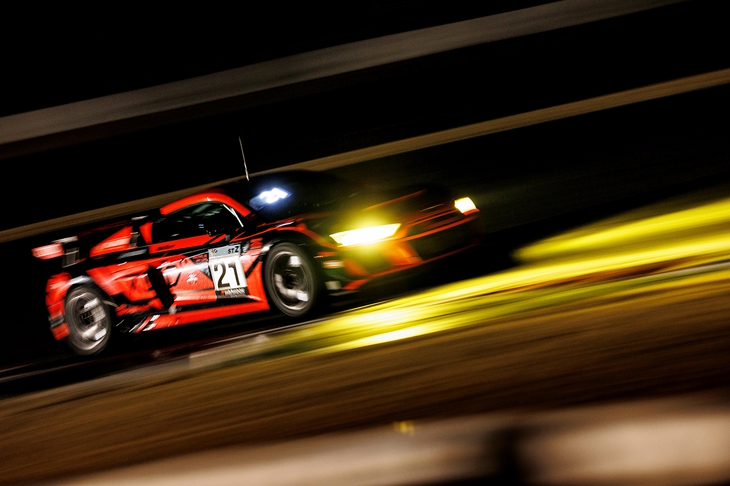
In the end, however, the #21 Hitotsuyama Audi R8 LMS GT4 – a returning challenger from 2022 – led three out of the four sessions, and set a blistering pace as the only ST-Z car that set a time below one minute 47 seconds. They set a benchmark time of 1’46.901 in the first session, and a 1’46.979 in the second. They also led the Night Practice run, for good measure.
This team has a retooled driver line-up with Shinichi Takagi taking over as team manager and part-time driver, Daisuke Yamawaki following from Grid Motorsport as the new gentleman driver, and Sean Walkinshaw returning to Japan after a year out. Young drivers Seiya Jin and Yuki Ano return from last season.
The other big development from this test comes out of the ST-Q class, where after almost a year of planning, the Toyota GR Corolla H2 Concept and its hydrogen-powered combustion engine have taken the next step forward in its development.

The #32 ORC ROOKIE Racing GR Corolla H2 Concept will now be powered by liquid hydrogen, making it the world’s first liquid hydrogen race car. The first liquid hydrogen test was conducted in late October and continued from November onward. This was the public’s first look at the rebuilt “Hydrogen Corolla”.
By changing from gaseous hydrogen tanks to liquid hydrogen, the footprint of the hydrogen refuelling station has been reduced to one-quarter of its sprawling size – in fact, the station is now tucked away in the garage behind the blue plastic banner (seen above). And, the GR Corolla H2 Concept can now be refuelled in the pit lane, just like a traditional gasoline/CNF powered car (albeit with its own proprietary rig). Toyota also claims that this change will double the cruising range of the GR Corolla H2 Concept, which has been significantly range-limited compared to its peers.
There are, of course, unique challenges to this set-up. The liquid hydrogen needs to be cryogenically stored at -253°C (near absolute zero) and even then, Toyota is trying to find ways to prevent hydrogen from vaporizing inside the tank.
For safety reasons, the GR Corolla H2 Concept is still equipped with protective structures that increase the car’s kerb weight. In the event that hydrogen spills out onto the race track due to a problem, the car has a built-in fan that blows it away. At the test, there was even a special safety truck with a giant fan in the cab, meant to blow away the hydrogen.
https://twitter.com/SuperTaikyu_STO/status/1628674501172137986
Due to a myriad of issues, the GR Corolla H2 Concept completed only 20 laps in the daytime, with a best time of 2’03.710 that still places it between the pace of the ST-4 and ST-5 class runners. It’s still very much a new challenge and it would be foolish not to expect teething problems in its first full season.
But Masahiro Sasaki, the lead development driver for the GR Corolla H2 Concept, feels very optimistic. “In a world where no one has ever seen a temperature of -253°C, we are fighting to preserve the internal combustion engine for the future by taking on the challenge of a technology that is said to be even impossible to tackle in a car,” Sasaki said to Toyota Times.
“There are still a number of issues to be solved, but like gaseous hydrogen, we hope to provide feedback to ordinary vehicles through development on the race track.”

The series begins its season on 18-19 March at Suzuka Circuit, where an expected 54 cars representing all nine classes is due to race for five hours.
Live English-language coverage of the Super Taikyu Series will be carried on Twitch.tv/MotorsportJapan throughout the 2023 season.


