

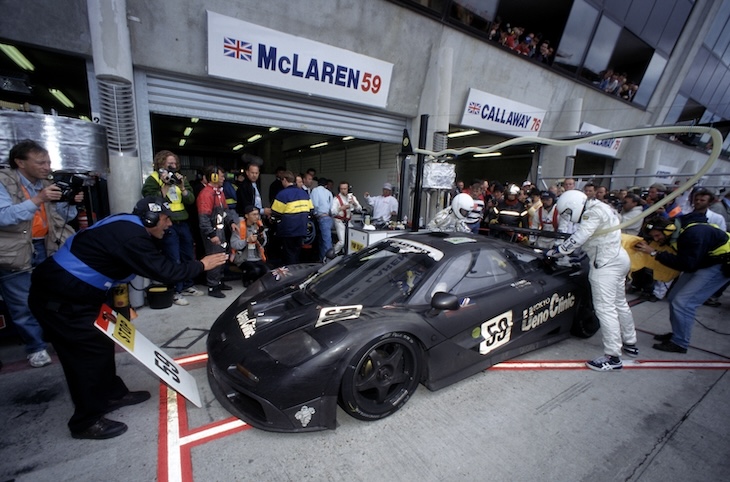

The 1995 24 Hours of Le Mans holds a very special place in my personal history of sportscar racing.
It was my first, and together with my then 7-year-old son, James, it proved to be pretty life-changing! 2025 is my 30th (I missed 1996 with work commitments), and I believe, my 100th 24-hour race in total. The McLaren F1 GTR has much to answer for.

The 2025 race week will have more chapters to add for McLaren, on-track in LMGT3, and off-track with more details set to be announced of its planned 2027 Hypercar programme.
That’s for the (near) future, though. For now, let’s take a look back at the past, 30 years ago at a (very) rainy Le Mans, and a set of circumstances that conspired to bring one of the great wins in the race’s history.
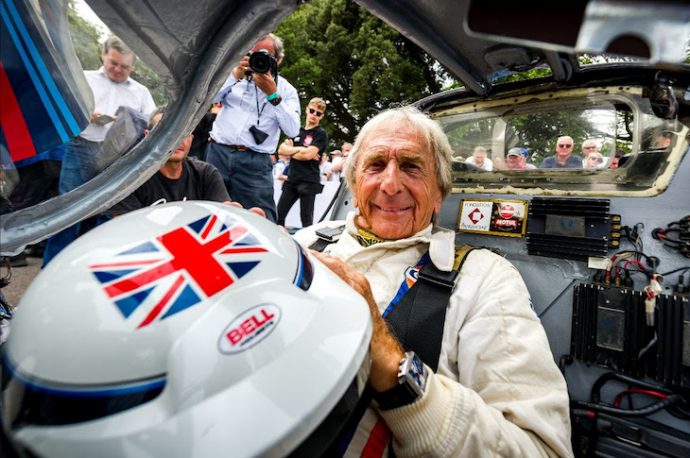
To do so we’re delving into the DSC archives with three key players who talked to yours truly and Stephen Kilbey: David Clark, now of course one of the team owners at Cadillac Hertz Team Jota, but back then the commercial director of McLaren Cars, Derek Bell, one of the driving trio for the Harrods -liveried #51 Mclaren and eventual race winner, and the standout performer of the event, JJ Lehto.
David Clark went on to own the Harrods car for many years and remains a world authority on the vehicle.
Back then, though, entirely remarkably with the benefit of hindsight, McLaren was struggling to progress the road car programme, having overestimated the number of cars that it could sell.
“It was quite difficult,” he reflected. “I don’t think anyone had heard of a car at this price from a car manufacturer that had only existed for 12 months. McLaren had never built a (purpose-built) road car before the F1.”
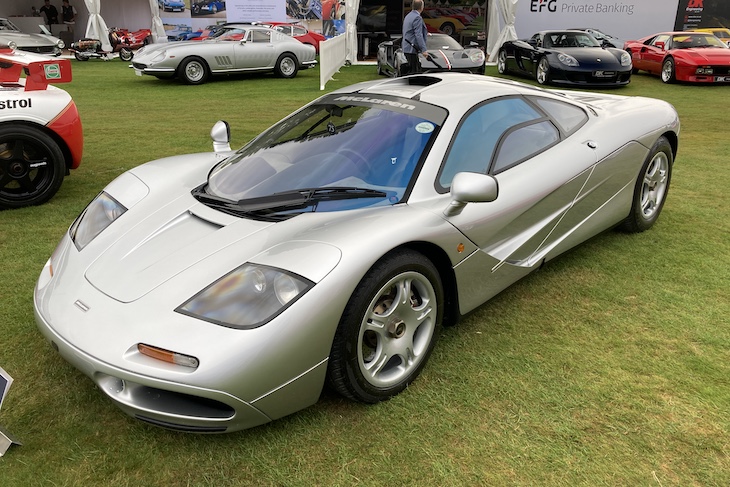
“I went there because I loved the programme and because I was very friendly with both Ron Dennis and Mansour Ojjeh, got on very well too with Gordon (Murray) and Creighton Brown. When I arrived, I found that some had unrealistic expectations of what could be achieved commercially.
“That was where my role evolved. My view was that we might sell 100 or so cars; there were others who had been convinced that we could sell 350, and it became clear that my number was far more realistic (David was correct – 106 cars were eventually built!).
“So one of the first things I had to do was to help negotiate our way out of a contract with BMW for 350 engines! (A deal was done that included a reduction in the number of engines traded against, amongst other things, a McLaren-conducted ABS development programme for BMW’s Super Touring programme).”
So, just how did the racing programme evolve from a project that was only ever supposed to be about a road car?
“McLaren is a racing company,” Clark continued. “And I think it was always the dream to take the car into racing for many people at McLaren Cars, which was a separate unit, about 100 yards away from the main factory. It had some fantastic people, including Jeff Hazell, who had been in racing all his life, and Gordon (Murray) and others, of course, had massive motorsport experience.
“At the same time, it was getting difficult selling the cars; they were moving, but not quickly, but a couple of clients had asked about racing the car, and it went from there really.
“Having decided to adapt cars for racing, there’s no doubt that the early success in ’95 in racing greatly helped the sale of the road cars.”
So the early takers were the names we remember from the BPR?
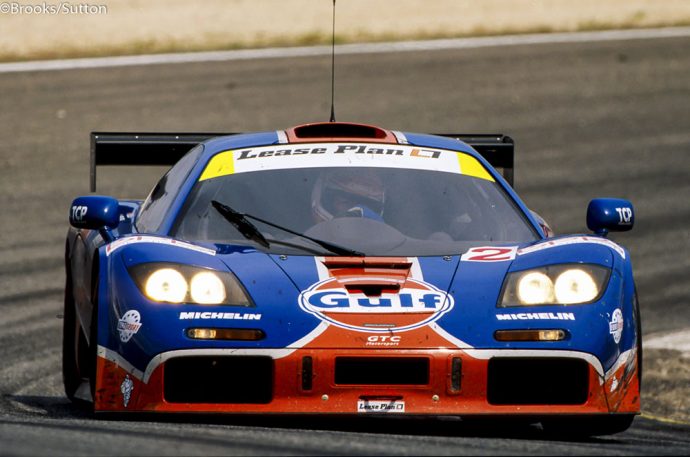
“Yes, Ray (Bellm) was a racer, and Thomas Bscher was a historic racing guy, but wanted to go modern racing,” Clark pointed out.
“Stephane Ratel introduced us to a great character called Jean-Luc Maury Laribiere and, pretty quickly, there was a lot of impetus behind it, not least of course from Stephane and from Patrick (Peter), who had a racing platform with grids to fill.
“I came up with a package that effectively said: if you want to buy a race car, then you have to buy a road car as well! It worked, and we got the best of both worlds, and were selling more cars.”
So a ‘buy two get none free’ deal?
“I suppose so!” He chuckles. “It was a package; it encompassed parts and technical backup.
“It included a process whereby we had a test car, and when we were testing if there was any improvement in anything, we always gave that option to every team. There was no favoured team.
“It was great for McLaren in ’95, ’96 and even ’97, which changed a little bit. It was also fantastic for the brand at probably what wasn’t the greatest time for the Grand Prix team. We gained a lot of credibility from it as a brand, I think.”
And you dominated!
“BPR had been going for a few years, and the rules were that you had to have a road car made into a race car, which basically, totally fitted what we were doing. Even though it was expensive, we just happened to have the best road car!
“I’m not saying this in hindsight, and it’s easier to say it when you had the best car, but it’s a great shame that it changed. But, I suppose like anything, when the big boys want to come into an established scene, it just ruins it.

“But the actual concept that Stephane, Jurgen, and Patrick had, I thought was fantastic.
“And even today, Stephane still has those concepts in his mind. I think he’s probably one of the best, most in-touch race organisers in the world. I think he’s done a great job.”
Often forgotten in the mists of time is that the 24 Hours of Le Mans was not in a strong position at this time; the damage inflicted by the meddling with Group C was eventually terminal, and attempts to fill the void after the class imploded had struggled.
The emergence of BPR breathed life back into endurance racing, not least with a real focus on the Pro-Am marketplace. And in 1995, some 30 of the 50 cars on the grid had heritage in the BPR paddock, with a further significant group of Japanese factory-backed entries from Toyota, Honda, and Nissan that further boosted the GT contingent.
Despite that, the clear favourites for the race were the WSC prototypes from Courage and Kremer. In particular, the Chevy V8-powered factory C41 of Henri Pescarolo, Franck Lagorce and Eric Bernard and the eye-catching C34 Porsche of Bob Wollek, Eric Hélary and Mario Andretti, stood out, with the first and last named chasing their first wins at Le Mans!
Against them were ranged an array of exciting, road-based GT1s, headed by no fewer than seven McLarens.
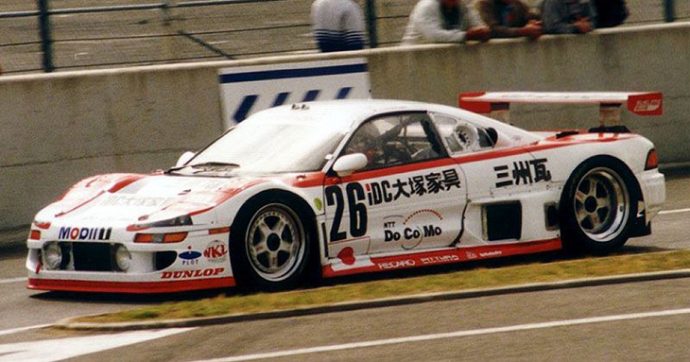
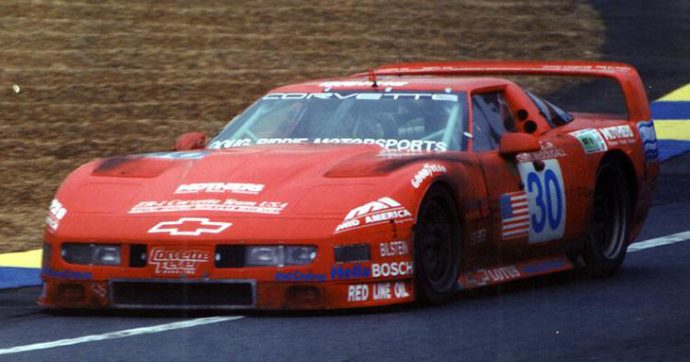
There was also a trio of very rapid, but somewhat fragile, Ferrari F40s plus additional GT1 contenders from Jaguar (XJ220) Lister (Storm), Porsche (911 Biturbo and 911 GT2 Evo), Honda (NSX), Nissan (Skyline GTR LM), Venturi (600LM), Toyota (Supra LM and the quirky, Toyota MR2-based SARD MC-8R, pictured above) and a rather odd Chevrolet Corvette ZR1 (below).
JJ Lehto takes up the story of the 1995 race.
“Le Mans that year was definitely special because back then we still had really fast prototypes and we ‘just’ had a GT car,” he said.
“The whole project, and certainly my involvement, came quite late. Paul Lanzante formed the team; he was a friend of Ron, and they had decided to have an extra car at Le Mans. The whole thing came together really very quickly and at the last minute.”
“I did some testing with the car and, you know, it was a really nice car. I really liked the McLaren from the very first time I drove it, there was something very special about it, a sportscar with the seat in the middle and an absolutely incredible V12 BMW at the back. It was heavy, but very, very powerful and the torqueiest engine I have ever driven, just so friendly to drive. The power was so smooth, so nice.”
“There were, though, a lot of issues with the car, especially when we went to Le Mans. We knew that the Prototypes were faster and that we couldn’t really compete against them. Then we had some suspension problems, I remember that we bent the rear wishbones in qualifying.”
“I am saying we, but it was me who did it!
“Gordon Murray was thinking ‘What the hell is going on with the car’. We had changed a lot of things during Le Mans week, including the ride height, and had got the car better and better to drive. I really liked the car and had the privilege to drive it as much as I did.
“After the wishbone issue, though, it left us worried about them for the race, wondering if they would last, so we decided that during the race itself, we wouldn’t use the kerbs as much, as most probably that was the reason for the damage. That worked, they didn’t bend again, they lasted for 24 hours with no problems at all.”
Did you have the gearbox issues that plagued some of the other cars?
“No, all the cars had the issue because of the gear linkage wires. They started to stretch, and if the gears didn’t go all the way in, you started to break the dog rings. I’m pretty sure that the team changed absolutely everything before the race. We were aware of the risk, so we tried to shift a little bit easier.”
“From the start of the race, we were going well, but started very easily. Sekiya was very quiet, I think he had a translator, Yannick (Dalmas) had, of course, already won the race three times, so he was ‘The Man’ – I guess I was the bullet!
“Yannick decided that we should start easy, and he started the race and ran it nicely and easily, very smoothly because, as he said, you can’t win the race in the first hour, the second, or even in the tenth, but you can lose it!

“The plan then was to be steady, keep it on the track and out of the pits with no extra problems and luckily the rain came, and it was a long rain, and that evened things up a bit.
“That was really the thing, because then I was able to compete against the prototypes and against the cars with better downforce.
Were you aware of how much of an impact you were making on pace at that time?
“I had a good day, I guess! I just found the lines. I really enjoyed the car, though; it was just such a great car to drive, and you could really drive it! Definitely the sportscar that I liked the most.

“It was my first win, McLaren’s first win, and I know a lot of people refer back to it being a great win, but I guess I’m not sure whether it feels like a long time ago or not!”
Back in third meanwhile was the iconic Mach One Racing Harrods liveried F1 GTR run by the late and very great Dave Price.
Driven by Andy Wallace and the father-son duo of Derek and Justin Bell, it crossed the line two laps off the winning #59 car, a result that saw the McLarens finish 1,3,4,5 and 1,2,3,4 in LM GT1
The best of the WSC entries, the Mario Andretti-led, Porsche-powered Courage, finished just a lap down by the end of the race, despite losing five laps (and 29 minutes) to an incident. Andretti hit the barriers at the Porsche Curves while navigating traffic, caught out by a recalcitrant gearbox.
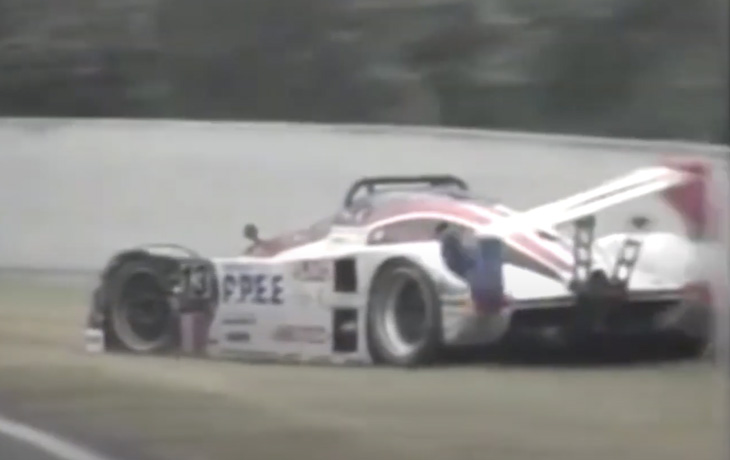
Instead of a famous win for McLaren, it could easily have been a memorable first overall victory for Andretti, Bob Wollek and plucky French constructor Courage and a second win for 1993 winner Eric Helary. But they would have to settle for a class win and an overall podium spot on this occasion.
As for the Mach One Racing (Harrods) #51 McLaren, after 16 hours of rain, it looked poised to deliver a historic sixth victory at the event for a 53-year-old Derek Bell. At the time, before Tom Kristensen emerged, it would have tied him with Jacky Ickx for a record six Le Mans wins!
It would have also provided Derek with an unforgettable win with his son, and Andy Wallace a second trip to the winner’s step off the podium, adding to his 1988 triumph with Jaguar.
What’s remarkable about all this, as Derek reflected in conversation with Stephen Kilbey, is that he wasn’t supposed to drive at Le Mans that year. He hadn’t planned to and didn’t want to, yet it turned out to be one of the more significant races of his career.
“It was Justin’s idea,” he said. “After I finished sixth in the open cockpit Spyder K8 in 1994, I really thought that was my last race. I said to my manager David Mills, ‘do not let me do that again!’ I hated being so tired. I never slept at Le Mans. So I’d retired from Le Mans by the end of 1994 in my own mind.
“Then Justin was driving with Andy Wallace in the GT stuff in the Harrods McLaren. Four weeks before Le Mans, he said: ‘Hey dad, by the way, you’re driving with us at Le Mans’. And I thought ‘oh god, here we go…'”
While he wasn’t one to run great distances every day or lift weights at a gym religiously, Derek always wanted to be in tip-top shape for Le Mans. He would play rugby, squash, all sorts of sports to keep himself physically and mentally ready for such a challenge.
On this occasion, though, he was thrown into it with little notice and as a result, was worried about going in.
“It was a strange thing because normally at Christmas I’d know I was doing Le Mans the next year,” he said. “I would ensure I was in the right frame of mind by January, get really fit and be ready. I was never paranoid about fitness, but I did what I could, so I was in reasonable shape.
“That year, I went to Le Mans with a few weeks’ warning, and for the first time in my life, I realised I hadn’t prepared myself mentally for it. I don’t need to pace around reading a book or a bible, but I do like to know I’m doing it far in advance, on January 1st.
“You want to do your best, and you can’t unless you’re in perfect shape. But we went to do Le Mans and it was just fantastic. The car was good, but we didn’t think we would win because the components in the transmission were unreliable after five hours of any race. I thought we’d be out by midnight…
“As luck would have it, though, it bucketed down and by Sunday morning we were leading the race. I was so impressed by Andy, whom I knew well, and Justin, for driving as they did in those conditions.”
And the conditions really were horrible. The rain was torrential and lasted from the second hour through to Sunday morning. It was relentless, and made for a race that was littered with incidents and saw 25 cars retire, three end up unclassified and only 20 cars officially named as finishers.
For the McLaren teams, though, the rain meant their short-tailed F1S had a shot at victory, the weather being a leveller against the faster prototypes. The slower pace of the race also meant that the F1 GTR’s reliability woes (its gearbox was a real weakness) were less of a factor.
“It was a true challenge and a race which had some of the weirdest moments of my career,” Bell added.
“I remember a pit stop during the night. The door opened, I leapt out to let the next driver get in, and in that case, it was Justin. It was something like 2 am, and he looked at me with a very drawn face for a 23-year-old. He said ‘tell me dad’, asking for me to brief him for 10 seconds. It was sheets of water, and I had no idea what to say to this young kid who was pleading with me. I just looked at him and walked away.
“It was terrifying, I couldn’t help him at all, the conditions were so bad. He’d have to find out himself; If I’d have told him that the Mulsanne kink was terribly wet, it probably wouldn’t be by the time he got there. It was unpredictable.
“I remember seeing him after he got out of the motorhome, his eyes were like two poached eggs. I said ‘What the hell? You’re supposed to be out there and you’ve only done 40 minutes?’ He said: ‘Dad, I’ve just terrified myself.’
“He had a spin, he told me where it was just after Arnage. You couldn’t see the track from the grass there because it was all black and underwater. The car looped, and he spooked himself. If you spin off in the rain at Le Mans, it’s so fast in most places that it puts the fear of God into you.
“His lap times dropped as a result, and they decided to keep him out of the car for five hours, which was a good move. He got back in daylight, and I heard from one of the guys that it was an inspired session, and made up for the night when he didn’t complete two of his stints. It was such a battle.”
When the rain stopped on Sunday morning, the track dried and set up a game of cat and mouse between the front-runners.
The Harrods McLaren emerged the favourite with the sun rising, despite suffering from minor mechanical woes (a throttle cable support bracket had to be repaired early on), with the #59 McLaren and the Wollek, Andretti, Dalmas Courage in hot pursuit.
After leading the race briefly on Saturday evening, the Harrods McLaren inherited the lead again at 4 am after the #49 West Competition McLaren of John Nielsen, Jochen Mass and Dr Thomas Bscher (who was named the third driver but didn’t race) retired from the lead with a clutch issue and spent much of the remaining hours out front.
It was a tug of war between the two leading F1s though, they traded the lead throughout Sunday morning until Andy Wallace stalled leaving the pits and lost the lead for the final time at the end of Hour 22 while struggling with a gearbox issue.
Once Wallace returned to the action for the final push, Andretti had clambered back onto the same lap and eventually snatched second off Wallace in the final hour.
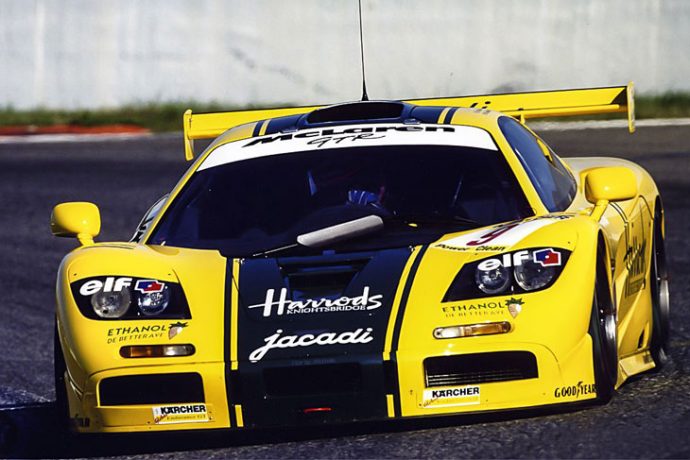
“It was amazing that we were put together like that, and that I could experience so many emotions,” Derek Bell concluded. “At the end of the day, that was the most amazing thing. It was the most memorable race of my life, to finish third on Father’s Day with my son and of course Andy, who I adore. Can you imagine just doing Le Mans with your son, let alone leading it?
“It was a tough race, and you ask Gordon Murray today and he’d tell you that the race was ours, it was cruel that we didn’t win it. But in reality, we knew we couldn’t last once it dried out.”
30 years may have passed, but the stories and the results have moulded the reputation of the winning marque and form a hugely significant chapter in the history of the world’s greatest race.


