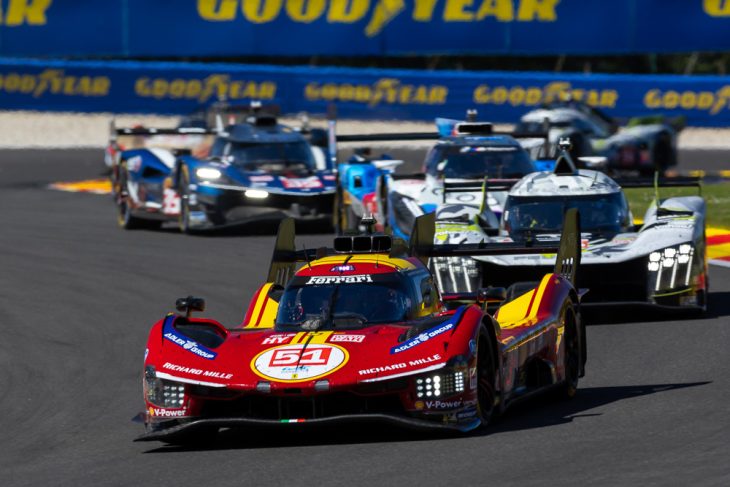

The hugely successful Hypercar regulation set has been extended through to the end of the 2032 FIA World Endurance Championship season, in a bid to prolong the ‘platinum era’ for sports car racing around the world.
Simultaneously, it has been announced that the Hypercar category will be introduced to the Asian Le Mans Series, strictly for privateer teams, and with Pro-Am line-ups, beginning in the 2026-27 season.
These decisions from the FIA and ACO come after the homologation period was extended through 2029 at last year’s pre-Le Mans ACO press conference.
“We are guided by two principles, stability and cost control. Last year, we extended to 2029 and with the FIA we decided to extend to the end of 2032,” said ACO President Pierre Fillon.
Not only does this mean that the current set of LMH and LMDh spec cars will have an even longer lifespan, but the incoming programmes from Genesis, McLaren and Ford have been granted three additional seasons to compete.
Looking wider, these announcements also open the door once again for additional prospective manufacturers to sign off on programmes.
“It was important for us to have a regulation that could extend to 2032. Delighted to see that the endurance committee has been given the green light in Macau this week. We have 12 manufacturers, others are coming,” added Richard Mille, President of the FIA Endurance Commission.
“It’s important to give manufacturers and the fans stability, and it’s important to show that this format we’ve been working on is sustainable and strong. The practical aspects will now be discussed. We want to finalise it by the end of the year. And with the addition of Hypercar to the Asian Le Mans Series, it will allow increased access to the premier category, which has been growing more and more limited, particularly in the WEC.”
As it stands, this extension only applies to the FIA WEC. IMSA has stayed non-committal on this subject for now and is in no rush to confirm a ruleset extension of its own for the GTP class beyond 2029.
“In the coming weeks and months, we are going to put a clear definition around that, hopefully by the end of the calendar year. If not, certainly before the Rolex 24 in January in 2026,” IMSA President John Doonan told reporters at today’s conference.
“We’re committing to convergence continuing. The way we got to today was to get all the manufacturers around the table to define engine, styling, hybrid, all the things that made it so special. In the coming weeks and months, we want to put definition on that.
When asked if there could be differences or changes to the shape of IMSA GTP in the future, Doonan said: “The goal would be sometime after the current extension in 2029. But given the feedback from our stakeholders, we want to set the timing that allows for everyone currently here to stay and for those who are coming to have something to plan for. We’ll see where we end up, but the goal is to be in a converged status for a long time to come.
“You look at the manufacturers that are here, it’s hard to identify who else could come. But there’s still a group of auto manufacturers that aren’t running in the top category, that maybe have a GT programme that I would certainly, as a fan of the sport, love to see in the top category.”
Notably, no mention was made of a future shift towards a single platform, moving away from LMH and LMDh convergence. This is something which Porsche, in particular, has been vocal in support of.
And no additional information about the practicalities of this move or the interest levels from teams and manufacturers was provided.
On the subject of the adoption of Hydrogen race cars, the ACO stated today: “The objective of introducing a Hydrogen category in competition before the end of the decade is becoming clearer than ever.” Hydrogen vehicle regulations had been scheduled to debut in 2028.
“As every year, we have a Hydrogen village at Le Mans with H2 prototypes that will be there as of 2028, but before that, we have to work on promoting hydrogen,” Fillon said of the Hydrogen regulations.