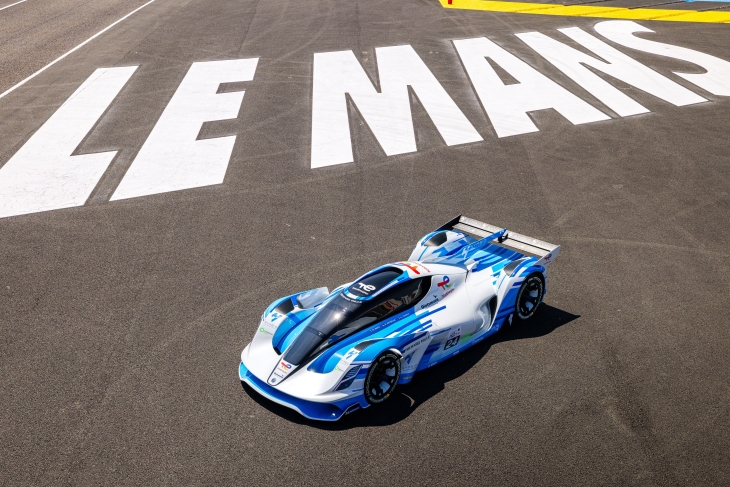

The ACO is set on introducing hydrogen as the zero-emissions fuel of the future for Le Mans and in wider endurance racing, though exactly when it will arrive remains a matter for debate.
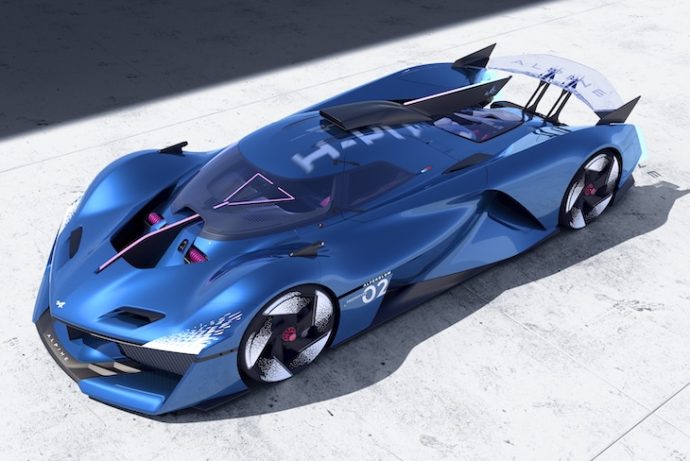
Hydrogen has a lot going for it as a fuel. It can be used in both fuel cells to generate electricity, or, as Alpine and Toyota have shown with the Alpenglow concept (below) and GR Corolla Super Taikyu cars, as a replacement fuel in internal combustion engines.
When burnt, it produces zero CO2 emissions, and performance can match or exceed that of traditional gasoline engines. But, and there is a big but, it has its downsides.
Firstly, it is tricky stuff to handle, and it takes up a lot of space. One kilogram of hydrogen contains more energy than one kilo of gasoline, 120-140 megajoules (MJ) compared to around 50 MJ. The problem is energy density, a kilo of gasoline takes up around 1.4 litres (L) of volume; whereas even liquid hydrogen needs about 14L to store 1kg, therefore, to hold the same amount of energy, a liquid hydrogen tank must be approximately four times the volume of an equivalent gasoline tank.
It is tricky stuff to handle, and it takes up a lot of space
Oh, and liquid hydrogen needs to be cold, very cold, to keep it liquid, -253°C to be exact. You can store gaseous hydrogen under high pressure; the current state of the art is about 700bar (equivalent to the pressure 7000m under the sea), but even this only gives an energy density of 5.6MJ/L, compared to gasoline’s 32ish MJ/L and liquid hydrogen’s 8MJ/L
To put this in the context of a current LMP2 car, these have a fuel tank capacity of 75 L, which will hold around 54kg of gasoline, approximately 2700 MJ of energy. For liquid hydrogen, you would only need about 21kg for the same energy, but that would still require a 280L tank!

The ACO seems to have settled on liquid hydrogen storage as its preferred route. But even ignoring the energy density challenge (if the technical regulations were revised enough, you could feasibly achieve the same lap times and stint lengths as the current Hypercars with weight reduction, ICE efficiency improvements and more potent hybrid systems), it is still a pig to handle.
Toyota has been working through some of these challenges with its Corolla, for example. The extreme cold of the liquid hydrogen and its lack of lubricating properties meant initially, the fuel pumps Toyota developed would only last a few hours.
Tricky customer
There are then various challenges around handling the gas. Entirely new pitlane infrastructure would be needed, and both on-car and pitlane safety monitoring systems to detect any gas leaks. None of these issues are insurmountable, but require time and money to overcome, not to mention the various arguments around how ‘sustainable’ hydrogen actually is.
So called Green hydrogen is separated from water via electrolysis using entirely renewable energy, but is far from common currently, the majority is what is know as either grey or blue, which is produced from natural gas using a process called steam methane reforming, which releases CO2 (in blue hydrogen this carbon is captured downstream).
In short, clean hydrogen relies on having very large amounts of renewable energy (or nuclear) available. Which raises the question: if there is plenty of clean hydrogen and green energy available, why not use it to make synthetic fuel instead?
This is a less efficient route (it takes energy to make the fuel etc), but in the context of racing, it would be a whole lot easier to adopt while still netting most of the green benefits (which we will come onto shortly).
Synthetic reality
To explain, regular pump gasoline, which you buy from the BP or Shell garage (or Total if you’re feeling Le Mansy) is predominantly made up of refined crude oil, which is pumped out of the ground and is not ‘renewable’.
However, it is blended with an element of renewable content (10%), ethanol, derived from plant-based sources. You can get fuel, which is predominantly ethanol-based, E85, which is far more common in continental Europe and South America.
In the case of WEC, the spec fuel from Total is 100% bio-based, making it what is known as a bio-fuel. Note, this is different to a synthetic fuel. The Total fuel is, fittingly, derived from waste products from the wine industry, but bio-fuel can be produced from a plethora of different stocks; sugar cane, wood processing waste, even general food waste. Due to the natural feedstock of the fuel absorbing carbon as it grows, the overall carbon emission compared to fossil fuels is lower, in the case of Total’s Excellium Racing 100 used at Le Mans, by a claimed 65%.
Synthetic fuels are a different proposition altogether. The simplest way to describe them is a fuel built up from a molecular level. They do not use any biomass in their production and instead rely on the combining of hydrogen and carbon. They are far from a new idea and have been around since the early to mid-20th century.
In fact, during WW2, around half of the fuel used by Germany was created in synthetic fuel plants, either from coal using the Bergius process, where powdered coal was mixed with tar and iron oxide, then heated at high pressure with hydrogen, or the Fischer-Tropsch process using hydrogen and carbon monoxide.
Synthetic fuels are a different proposition altogether
Of course, making fuel from coal doesn’t cut it in the 21st century. But using carbon captured from industrial processes, or directly from the atmosphere, and green hydrogen, allows for the creation of carbon-neutral or even, in some cases, carbon-negative fuels. There are still tailpipe emissions when they are burned, but they are not adding to the overall CO2 levels in the atmosphere.
Much as with hydrogen, there are valid arguments and challenges associated with their widespread adoption. A major point of debate is the efficiency of their production. The electrolysis process for hydrogen is energy-intensive with losses (currently 70-80% efficiency, potentially improving to 90% with new technology). There are further losses in the e-fuel production process itself, and then when the fuel is burned in an ICE (thermal efficiency typically 35-40%, or over 50% in F1 power units). Thus, the reality is that well-to-wheel efficiency is about 25%.
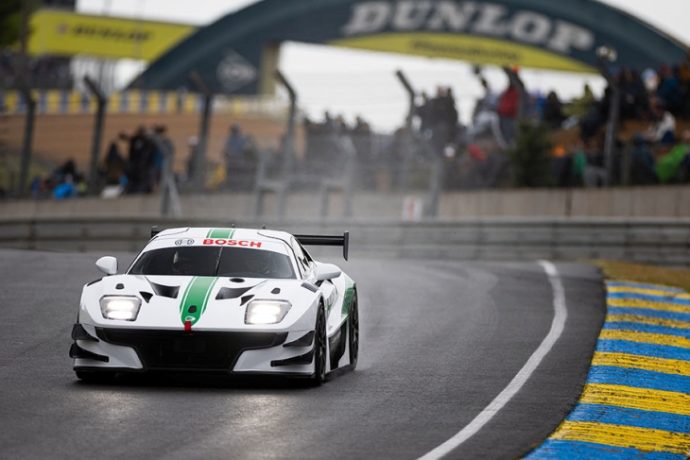
Ultimately, both hydrogen and synthetic fuel rely on an abundance of renewable energy to be classed as truly ‘green’. Which raises the question, if a situation is reached where there is a surplus of renewable energy, or naturally occurring ‘gold’, hydrogen becomes a viable thing, would it not just be easier to stick with gasoline, albeit in synthetic form, than try and adopt hydrogen? The overall net effect, environmentally, would be the same, without the complications.
Yes, you lose the zero-tailpipe emissions claim, but in the wider picture, that is not really an issue beyond marketing. And crucially, the cost barriers to adoption are much lower, particularly if widespread adoption of such fuels outside of motorsport picks up pace.
Hydrogen certainly has a role to play in the decarbonisation of transport. But in the niche that is racing, it could well be that wider developments in automotive and legislation mean that by the time it finally arrives, it will have already become an outdated solution.
DSC’s technical column series from Lawrence Butcher is powered by the industry-only PMW Expo in Cologne, which is set to take place this year on November 12th and 13th at the Köln Messe.
You can register your interest HERE and enquire about exhibiting HERE.