

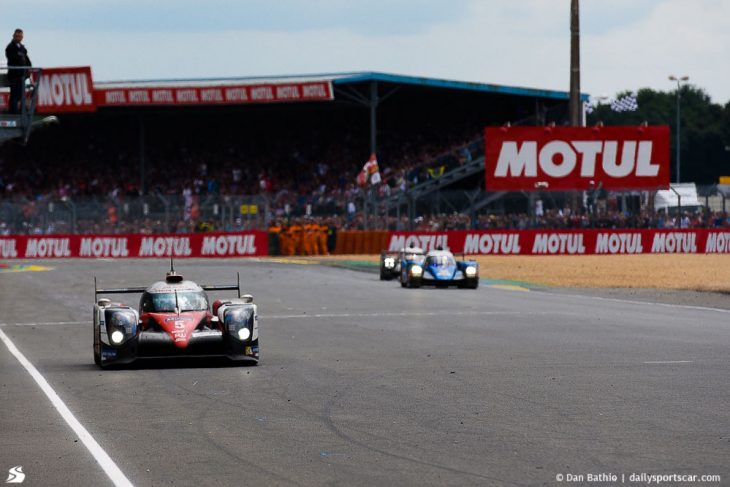

Most sportscar racing fans will remember where they were when Kazuki Nakajima first complained over the team radio that he was losing power while leading the 2016 Le Mans 24 Hours with just over six minutes remaining.
They’ll also remember their reaction when he stopped on the pit straight in front of the packed grandstands and allowed the #2 Porsche 919 of Neel Jani through into the lead three minutes later, right as the Swiss started the race’s final lap on his way to capturing Porsche’s 18th overall win.
I certainly do; I’d just finished writing a lengthy narrative about Toyota finally breaking through and winning a race it had spent decades trying to win. It had to be binned. The press room overlooking the start/finish was in disbelief; there were audible gasps and howls. What at first looked like an attempt to orchestrate a formation finish quickly descended into pure shock and heartbreak.
The raw emotion on display in the Toyota garage and later on the pit wall when Nakajima walked away from the #5 car he shared with Sébastien Buemi and Anthony Davidson, contrasted with the sheer jubilation at Porsche, was absolutely astonishing.

It was a moment in time that went down as one of the most shocking and infamous in motorsport history. And 10 years later, it still feels recent, probably because it’s still brought up regularly in discussions among paddock members and fans about the fabled French endurance race.
For Nakajima, who is still part of the Toyota sportscar set-up as the vice chairman of the WEC programme, has been spending a significant amount of time being asked about the most painful – and famous – day of his storied career, in the build-up to a week that will see the Japanese marque fight for its sixth overall win in the hotly-contested Hypercar class.
“Pace-wise we were there that year, but our biggest concern was reliability. I actually wasn’t expecting much from the race, and up until the start of it we couldn’t believe we were right there to fight for the win. I think until the final few hours of the race, we were still questioning it. That was our mindset,” he tells DSC in reflection. “We were definitely the challenger.”

But the race itself turned out to be a pretty even, three-way fight. The six LMP1 Hybrid factory cars from Audi, Porsche and Toyota all took turns in the lead before the halfway mark, before an off at Karting for the #6 Toyota plus reliability woes for the both Audi R18s (in Audi’s final Le Mans as a factory LMP1 team), and the #1 Porsche 919 opened the door for the #5 Toyota TS050 and #2 Porsche (delayed by an early puncture) to fight it out for the victory on Sunday.
“The pressure at Le Mans is always there. But I felt good in the car, it felt natural,” Nakajima explains. “Porsche went aggressive on strategy in the end, but they had to give up to change a tyre, and we opened up a minute and a half lead. It was only at that point we started to really believe we could win.

“And that was when we had the issue. We couldn’t believe what was going on. We couldn’t understand what was going on. I remember the call from the engineer telling me 10 laps to go. At that point it still felt like a long time left in the race, like 30 minutes. Then I got a call asking me to avoid kerbs to preserve the car. Then I started to lose power. It was like a switch.
“I was stuck at about 200 kph. I tried to think if it was caused by changes we’d made to the switches and settings, but no. They thought I was joking. It was not the case. They looked into the telemetry, and in the end it was a physical part. We tried all sorts of changes, but there was nothing we could do. We’d had an issue early in the race with a sensor where Seb lost power, but we fixed it by killing a sensor. We thought it could be that, but it was a mechanical failure.
They thought I was joking. It was not the case.
“We decided to stop the car to do a power cycle, but it didn’t work, and we had already lost the race.”
Nakajima believes his experience, behind the wheel when it all went wrong, was easier to get through than his teammates’, who were equally helpless in the garage.
“I was busy handling all the changes; I didn’t have the capacity to think about what was happening,” he points out.
“After the race, I felt nothing really for hours. Everyone was crying in the garage, so that was emotional, but I don’t really remember sitting in the garage much. But I remember both the management teams from Audi and Porsche coming in to share their emotions with us. It just took a lot of time to digest.

“But when I look back, I try and think about it as a positive aspect, because it felt like a turning point for the team (which then went on to win Le Mans five times between 2018 and 2022).”
Still, it’s painful to re-live in his mind. When asked how much he hates being asked questions about it, he responds, “quite a lot!” But he knows that, actually, this year’s Le Mans 24 Hours has the potential to become quite poetic.
If Toyota wins at Le Mans up against a huge field of factories, with its new-look TR010 that won on debut in Imola, 10 years on from its darkest day, it would go a long way in allowing everyone involved who are still part of the programme to finally move on.
“Back in 2012, when this programme started, over 100 races ago, I never expected us to be in this position, over a decade later. We are lucky to be involved in this field. We will come and enjoy this fight this year,” Nakajima summarises.
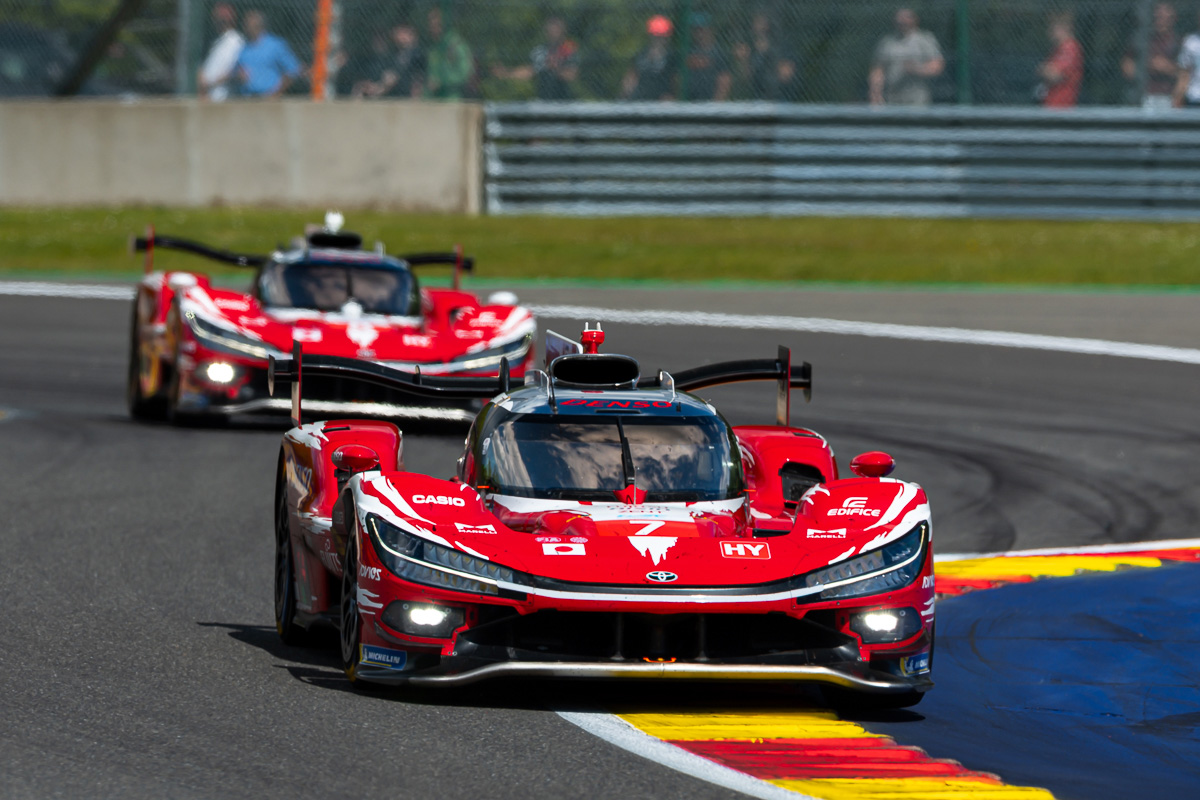
“We should be proud that we managed to stay at such a high level as a team for so long. It would have been perfect if we could have won Le Mans in 2023; it felt like a missed opportunity.
“Then in 2024 and 2025, we weren’t the fastest and maybe not the best operating team. But that’s why we are here, to race, to learn. I hope that 2026 is the year that we come back stronger. Our motivation, 10 years on from that 2016 race, is higher than ever for Le Mans. We are ready to go for it.”


