

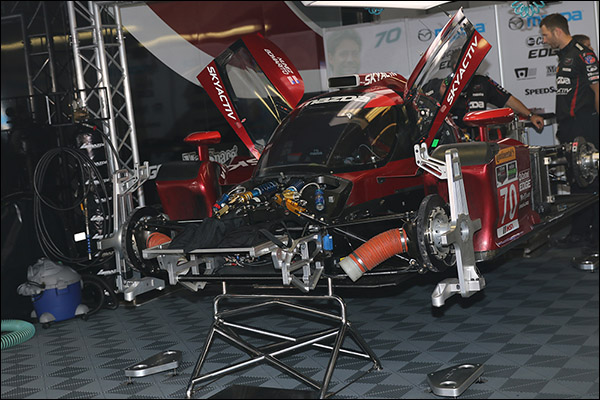
Both Mazda prototypes had issues with walls in the morning session. This was courtesy of local hoodlum John Dagys. These incidents may help explain the bottom of the grid lap times turned in by the cars in that session.
GTLM is shaping up to be a very interesting proposition. As usual in this class, everybody through the paddock is in agreement that anyone is capable of winning the race on Saturday. The keys are to run a clean race and to not get caught in any traffic situations which might allow others in the class to open up a gap. This has been a common issue here at Long Beach in the past and has been a deciding factor multiple times.
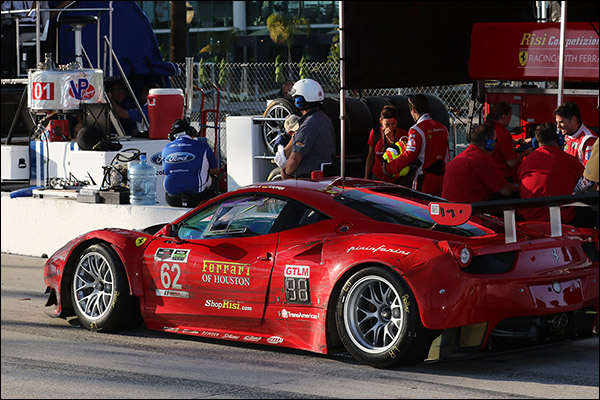
A reoccurring thought amongst the GTLM competitors is also the importance of a fast stop. With the regulations in the TUDOR series allowing fueling and other work to take place all at the same time during the stop, the importance of the driver change becomes even more and more critical. Rushing the driver exchange was one of the issues in the big pit lane incident at Petit Le Mans last season, which eliminated the Risi Ferrari.
That simply wasn’t necessary, according to Pierre Kaffer, who was one of the drivers in that Risi Ferrari last season. “The rules are what they are. You just need to take care of doing things right and practice. If you think someone has an advantage, you need to work at getting yourself better. It is as simple as that. We’ve been working together quite well here at Risi and it shows in the results. There are many times that we gain positions in the pit stops because of our quick stops. That is the result of an entire team working together, which isn’t always easy in a team made up of Italians and various other Europeans.”
Seeking to gain any possible advantage, Team Falken Drivers Bryan Sellers and Wolf Henzler were seen discussing their driver changes and looking to streamline their process as much as possible. Sellers, being rather short has an especially difficult time getting out of the car and finding the ground. But like Pierre stated above, they were looking at making any changes they felt were necessary in order to gain an advantage.
At Corvette Racing, they believe in safety first but also feel that the safe design of their car puts them at a big disadvantage when it comes to making a quick drivers change. The Corvettes are equipped with a crush box between the door panel and the cage, that makes entry and exit a slower process in their car, especially when you are not vertically challenged like the Gavin/Milner pairing. Olly Gavin stated, “that box is a critical safety feature of our Corvettes and we’re not about to remove it, but it definitely makes getting in and out of the car tough, especially for us taller guys.”
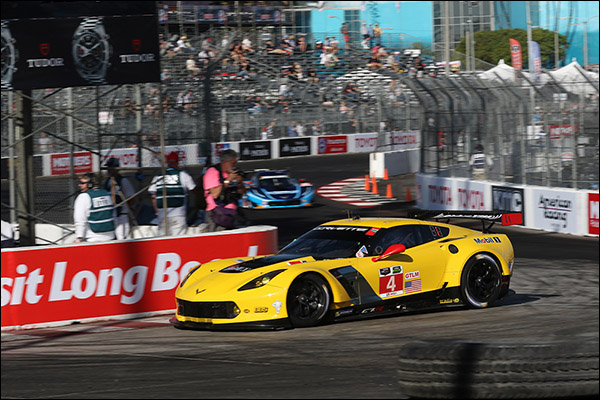
“I already feel that we’ve compromised safety with our stops. I don’t want to see us being penalized for trying to make our cars safe.”
Another issue for Corvette, they have a fixed seat, where most of their competitors utilize a sliding seat. This allows the driver to get in with the seat back, strap in and then move the seat into place, tightening the belts all in one move. Again, Corvette prefers to go with the fixed seat based upon safety concerns.
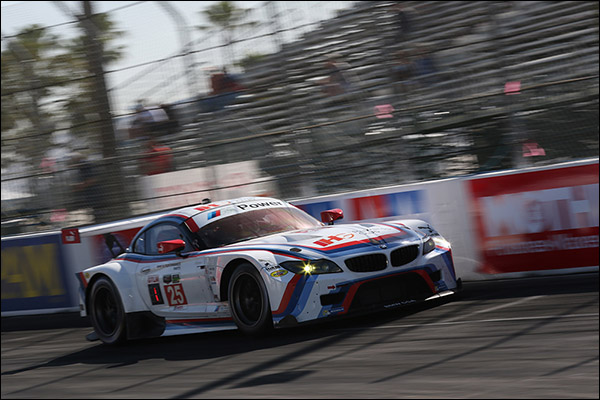
As far as the morning session times, the Corvette team feels like they are in a good spot, despite not leading the times. Both Jan Magnussen and Tommy Milner pointed out that the Risi Ferrari time was turned on new tires right at the end of the session, while the BMWs utilized multiple sets in the session.
A sad reflection of the times was a very empty TUDOR paddock. This was a paddock that just a few years ago was jammed with not just cars and transporters but also fans. Today the 17 entered cars couldn’t take up the full area and the organizers also moved the race tucks into the paddock, as well as the various tire mounting compounds. Also missing was the fans. For one of the few times in my memory, I saw a time when there were no fans standing outside of the Corvette compound. The paddock was simply a ghost town which is a sad reflection on the times. I don’t want to dwell on the past too much, but it seems like it was just yesterday when we witnessed the Audi R10, the Porsche Spyders and the Acura Prototypes battling it out on track and for the attention of the fans. That was when the ALMS really was in a position to overtake INDYCAR Racing in the hierarchy of racing here in the States. Now? Not so much.
Gary Horrocks


