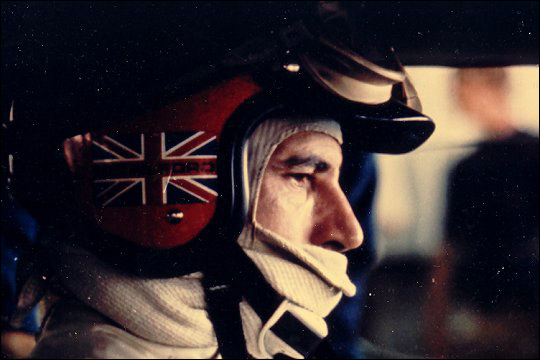
Vic Elford, the legendary driver of Porsches in the 1960s and ‘70s, recently celebrated his 80th birthday at home in Plantation, Florida, with his wife Anita, deluged with cards and messages of goodwill. He was without question one of the best drivers of his era, ranking as an equal with Pedro Rodriguez, Jo Siffert, Jacky Ickx, Brian Redman and Derek Bell, all giants of the Porsche vs Ferrari battles with their 5-liter sports cars.
What made Elford so special? He had a burning ambition to win rallies, races, any event he started, and he was versatile. Like Stirling Moss, who won Coupes des Alpes trophies three times in succession in Sunbeam Talbot saloon and sports cars, like Jimmy Clark, who could turn in maestro performances in anything on four wheels, and traded fastest times in the dark forests of the RAC Rally of Great Britain, “Quick Vic” was a driver of the highest calibre when proving his talents in rallies and on the race tracks.
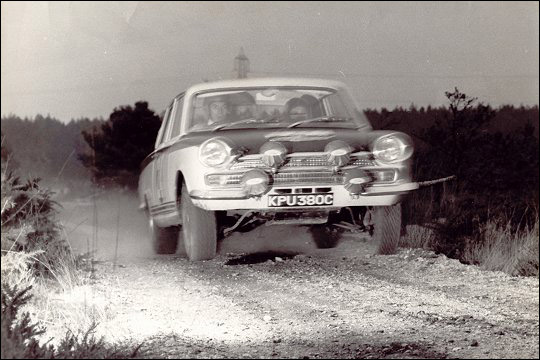
After spending three years as a rally driver contracted to Ford, Elford persuaded Huschke von Hanstein to run a 911S for him in European rallies, in 1966. “First I persuaded him to lend me one for the Tour de Corse, where, against all the odds – no money, no practice car, minimal service – I finished third” Elford tells us. “Still no contract, but suddenly Porsche were interested in their new car so off we went to Monte Carlo. We led all the way until the last time over the Col de Turini, when it snowed and I got caught with no snow tyres (the regulations were, that year, strange to say the least), and I dropped to third.
“Back in Britain, the ITV television channel was preparing to run the first-ever rallycross at Lydden Hill, and they insisted that I should take part in a 911. Of course I didn’t have one but the Aldington family, importers of Porsches at AFN, lent me their showroom demonstrator.
“Having just left Ford in less than ideal circumstances I was savaged by Brian Melia and Roger Clark, both in factory Lotus Cortinas throughout the event. I won, but then I had to take my pitiful, sad looking 911 back to the Aldingtons on Monday morning.
“Overnight anger at what had they had seen happening to their car, live on tv (it was one of only four in Britain at the time) was replaced by a sort of euphoria as the phone had been ringing off the hook with potential clients wanting to know more about this fabulous new car they had seen on television. AFN couldn’t sell the car like that, so it went to Stuttgart and came back as a racing car, with which I won the 2-litre category of the British Touring Car Championship in 1967.”
It was a busy year. Elford and his co-driver David Stone piloted a Stuttgart registered Porsche 911S to three international rally successes, the German Rally, Tulip Rally and the Lyon-Charbonnieres, to be crowned European Rally Champions. During that time he worked with Hermann Breem who prepared his rally cars and even built Elford’s own specification gearboxes.
The best was yet to come. In January 1968 Elford and Stone battled through atrocious weather conditions to win the classic Monte Carlo Rally in a 911S, the first time a Porsche had ever succeeded in this classic event, and incredibly it was the last victory by a British driver!
A week later he was part of Porsche’s winning team in the Daytona 24-Hours, driving a 907 with Jochen Neerpasch, joined by Rolf Stommelen, Jo Siffert, and Hans Herrmann, whose cars had been delayed. From there, he took second place in the Sebring 12-Hours with Neerpasch, third in the Brands Hatch 6-Hours, again with Neerpasch in their 907.
Then came the Targa Florio, the event which was Elford’s tour de force. I’ll mention at the outset that the weather was almost unbearably hot, as a scirocco wind was blowing across the Mediterranean from north Africa. In the ramshackle media room over the pits, my mouth was dry. It must have been like a sauna inside those closed cars, in which the drivers had to work vigorously for hour after hour.
Elford was paired with Umberto Maglioli, the veteran Italian, in an 8-cylinder 907, and he started the race well. Then, he came out of a corner in second gear, accelerated and nothing happened. “I got out thinking that the clutch had gone, or a driveshaft had broken, but found that the centre lug nut on the right rear wheel had come loose.”
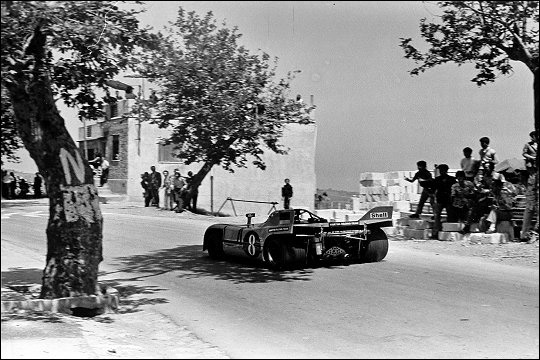
Although the spectators who thronged the roadside around the 72 kilometre (45 mile) mountain route were cheering for the Alfa Romeos, some lifted the car while Elford tightened the wheel, and was able to drive on. Up in the mountains, at the halfway point, the Porsche service crew fitted a new wheel, but a few kilometres down the road it came loose again, this time throwing the Porsche off the road and puncturing the front right tyre. Again, spectators came to his assistance, Elford tightening the rear wheel and fitting his Goodyear Space Saver tyre to the front.
He arrived at the pits 16 minutes late, and was 18 minutes down when he restarted, then began the most exhilarating catch-up drive anyone could imagine, smashing the 35 minute lap record in the process consistently by as much as 67 seconds. He only allowed Maglioli the middle three, of 11 laps then resumed the chase, overtaking the leading Alfa Romeo two laps from the finish.
Even then he kept going at full speed, to make sure, and broke the race record by 11 minutes, a performance that can only be described as heroic. Elford kept driving his coupe-bodied Porsche for all but three laps of the six and a half hour race, severely dehydrated at the finish. He and Maglioli had beaten a pair of Autodelta Alfa Romeos by three and nine minutes respectively and earned the cheers of the partisan crowd.
Nothing could beat that feat of speed and endurance, but Elford just kept going. A fortnight later, in May, he and Jo Siffert won the ADAC Nürburgring 1,000 Kilometre race in the new 3-litre Porsche 908, the first success for the sports car that replaced the 907, and later, went on general sale to race teams.

Wind the calendar forward three weeks, and Elford was in action again, this time driving his ‘works’ Cooper BRM in the French Grand Prix. The event was held at the Rouen-les-Essarts road course in northern France, a tricky track with fast sweeping downhill curves testing the nerves of the bravest drivers when the road was dry…but that day in June 1968 it was treacherously wet. Poor Jo Schlesser lost control of his new Honda RA302 on the second lap and died in an inferno, but the race continued with rain-master Jacky Ickx extending his lead in his Ferrari 312, beating John Surtees’ Honda by two minutes after the two-and-a-half hour race had run its course.
Jackie Stewart was third, and right behind was Vic Elford, having got every ounce of performance out of his outclassed machine to earn a bunch of World Championship points.
I have exampled this sequence of successes before, but they’re worth repeating again because no-one, no driver will ever be able to match Elford’s verstality and success, in such a variety of competition. It as a unique ‘Purple Patch’ on his career.
Monte Carlo Rally 1968
We asked Elford for some reminiscences of his memorable events, something that hadn’t been published anywhere, and he started with the 1968 Monte Carlo Rally.
“Since dragging Porsche into international rallies with the Tour de Corse in 1966, and then the whole season in 1967 when I came oh, so close to winning the Monte Carlo Rally first time out, I went on to rack up more victories and the European Rally Championship in GT.
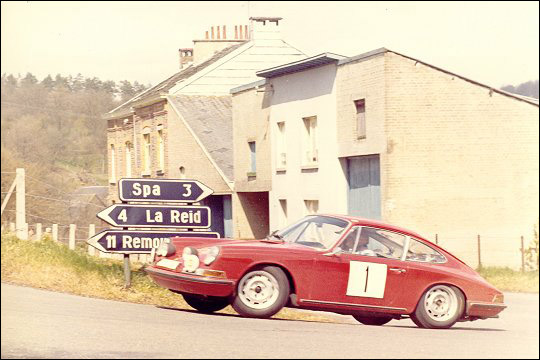
“I always had a great relationship with everyone at Porsche. For the Monte Carlo Rally in 1968 the organisers came up with new regulations and for the first time the event would be decided on scratch times. In other words, music to my ears, the fastest driver in the fastest car wins!
“My love affair with the 911 had already shown we were unbeatable, and I couldn’t wait to get started. As had become usual, for the third time I started in Warsaw, where I already had many friends. With long, empty roads, hours in advance at time controls, meant a relaxing trip to France where the rally would begin in earnest. At the control in Gdansk (Danzig) we arrived so early that we were able to enjoy a sauna, a swim in the Olympic pool followed by a delightful dinner, before setting off again. David was now driving, as after all that effort I decided it was time for me to rest.
“The rally turned into a battle between Gérard Larrousse in an Alpine 110 and me in my 911. On Thursday evening we left Monte Carlo for the 600 kilometre mountain section that would decide the winner, and on the first two stages I was immediately beaten by my team-mate Pauli Toivonen and by Gérard, only by a few seconds but after missing out the year before when the strange regulations meant I had no snow tyres when I needed them, it played on my nerves.
“We then had a long run up to St. Sauveur and the Col de la Couillole, and David took the opportunity to give me a lecture: ‘You know you are the fastest in the mountains. There might be less snow than last night (when we had done a last minute recce) but certainly not more. Forget this is Monte Carlo, just think of the mountains you love…’
“It worked. Tight and twisty on the way up, very high speed on the way down, slithering over icy or snowy sections at 120 mph on the racing tyres I had chosen, we took a minute off Gérard. Of course we didn’t know that yet, but the next stop was the Turini and when we arrived at the control one of the French journalists with whom I was friends, Jean-Francois Rageys, sidled up to the car like some undercover gangster and out of the corner of his mouth whispered into my ear: ‘Sais ce que tu as fait? Pris une minute a tout le monde’ (You know what you’ve done? Taken a minute off everyone).
“Poor Gérard then went off on the next trip over the Turini when a bunch of criminal idiots shovelled snow on the road ‘to liven things up’ but by then we already had it won. And after all this time, Gérard and his wife Michelle are still our best friends in Europe.”
I will add a footnote to this. Vic and Gérard shared a Martini & Rossi Racing Porsche 917 in the 1971 World Endurance Championshp, winning the Sebring 12 Hours, and a few weeks later they won the ADAC Nürburgring 1,000 Kms race in a Porsche 908/3.
The birthpangs of the Porsche 917
“I was at the Geneva Show for Porsche in 1969 when I saw the 917 for the first time. It was love at first sight with the beautiful car sitting on a waist high podium. I couldn’t wait to get behind the wheel! In the run up to Le Mans, both Ferdinand Piëch and Helmuth Bott planned to run only one 917 for Rolf Stommelen and Kurt Ahrens. The rest of the factory drivers would be in 908s. I immediately started lobbying for a 917 and eventually they gave in, but not before warning that they considered it an experimental car that was sure to break. They even knew what would break, and when. Six hours into the race was the official estimate.
“At the time we did not yet have any firm driver pairings in the Porsche team, so Piëch invited me to choose my own co-driver. I figured I wanted someone calm, comfortable with really high speed and who was not going to try and put on a show of being faster than me. I had no hesitation in picking Richard Attwood. He thought it was a good idea too, although he later changed his mind – when it was too late!
“The first time I drove the 917 my immediate reaction was that they must have changed the track since last year: The Mulsanne Straight seems shorter than before! Of course they hadn’t changed the track. It just seemed shorter because the 917 was so much faster than anything we’d driven before. Until then the fastest any of us had driven was 180-190 mph, then suddenly we were doing 220, in a car that had virtually no downforce and wandered all over the road.
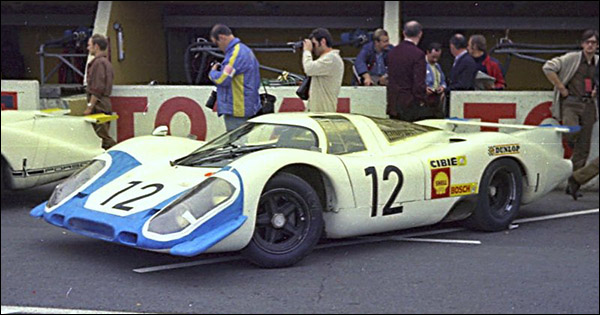
“One of the problems with the first 917 was a complete lack of understanding of the aerodynamics of the car. It was beautifully smooth and penetrated the air efficiently, giving it a very high top speed, but it had almost no downforce. It was almost impossible to drive in a straight line on the Mulsanne Straight, as it just wandered around.
“The 917 had been homologated with flaps that were activated by the rear suspension movement, but the Automobile Club de l’Ouest wanted to ban them since movable aerodynamic parts were banned by the FIA regulations. Piëch and company protested vehemently, pointing out that the flaps were part of the design homologated by the FIA and without them, the car would be dangerous to drive. To prove the point, Rolf went out for a couple of laps with the rear flaps fixed, and did a masterful job of persuading everyone that the car really was undriveable like that. We got our moveable flaps back for the race!
“During practice we managed to scare pretty well every driver we passed, so when it came to the race, virtually all the other drivers would check their mirrors after leaving Tertre Rouge, and if there was a 917 in sight they simply queued up on the right and waited for us to go by. That worked well until at one point in the middle of the night I was at maximum speed, about 225 mph, approaching two 911s on the right side of the road when the second one decided to overtake the other. They were probably doing about 165 mph and it was obvious that the overtaking manoeuvre was going to take some time. I was too close even to think about slowing down so I had only one option, to go past them both with my foot flat on the throttle, and the two left wheels on the grass!
“Because of its lack of aerodynamic balance, the 917 really had to be driven with kid gloves. Even coming off the throttle pedal to go to the brake could not be done quickly as the sudden weight transfer would cause the back of the car to rear up and start steering the front! So we had to ease off the throttle very gently and go gently on to the brakes to keep the car balanced.
“Having started my driving life as a rally driver, I was used to inherently unstable cars so the idiosyncrasies of the 917 didn’t bother me too much. Rather like an ugly child that only its mother could love, I think the first 917 had only three people who really appreciated it: Rolf Stommelen, Ferdinand Piëch, and me.
“Rolf’s car duly retired after about six hours, but Richard and I babied ours along through the night. We never raced anyone. Any time we came up on another car we didn’t get involved in outbraking into a corner, we simply waited until round the next corner and then drove by.
“So we were pretty devastated when only three hours from the finish Richard came into the pits with a slipping clutch. The mechanics tried everything – Coca Cola, fire extinguisher fluid – to no avail, the bellhousing had cracked and the car would go no further.
“We were leading by over 50 miles and then followed one of the most outstanding things I ever saw at Le Mans. Remember this was a German car driven by a couple of Brits, and as the mechanics pushed it away the entire grandstand opposite the pits rose and gave it a standing ovation.”
Michael Cotton