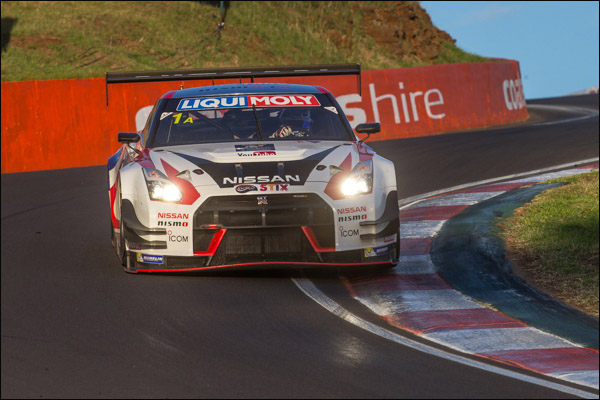
One of the things I like about races like the LiquiMoly Bathurst 12 hours is that the focus of the event is the GT3 entry. Although the race still consists of cars from other classes, and the ability of drivers to deal with the traffic is still of paramount importance, the speed differentials that are seen at Mount Panorama are not as great as at Daytona, nor, it has to be said, as at Dubai.
As a result, Bathurst more than any other endurance race, really is a 12-hour sprint. Thankfully this year saw fewer Safety Car Periods than we had last year, enabling the distance record to be broken by the leading four cars, all four from different manufacturers. For a long time, it looked as if we might break the magic 300 laps, but methinks that will have to wait for another year.

Bearing in mind that the current era of GT3 cars competing at the Bathurst 12 hours only began in 2011, the following table puts things into context.
| Year | Starters | SC Periods | SC Laps | Laps Completed |
|---|---|---|---|---|
| 2016 | 36 | 13 | 40 | 297 |
| 2015 | 50 | 20 | 73 | 269 |
| 2014 | 40 | 9 | 31 | 296 |
| 2013 | 53 | 15 | 43 | 268 |
| 2012 | 25 | 9 | 22 | 270 |
| 2011 | 26 | 6 | 20 | 292 |
| 2010 | 41 | 8 | 42 | 292 |
| 2009 | 47 | 11 | 31 | 239 |
| 2008 | 34 | 7 | 22 | 253 |
| 2007 | 32 | 6 | 10 | 257 |
For teams, much more than for drivers, it is not necessarily as straightforward as you might think, making the transition from Dubai, to Daytona, to Bathurst. Certainly they’re all top-class, international endurance events, but the regulations to which they run are substantially different. Not just from the technical point of view, and I am not going to make this article a discussion on the differences between Creventic class A6-Pro, Bathurst (Intercontinental GT Challenge) class AP and IMSA class GTD – but from the sporting point of view: the regulations around race neutralisations and driving time in particular.
Knowing what to do when the Safety Car comes out is crucial: the trouble is that the rules are different. In Dubai there is Code-60, in Daytona a procedure that allows wave-by and separates the classes, and at Bathurst, well, it’s quite simple… the safety car comes out, and goes in again, with no wave-by under normal circumstances, so track position and staying on the lead lap is all-important as the field is always bunched up before being released.
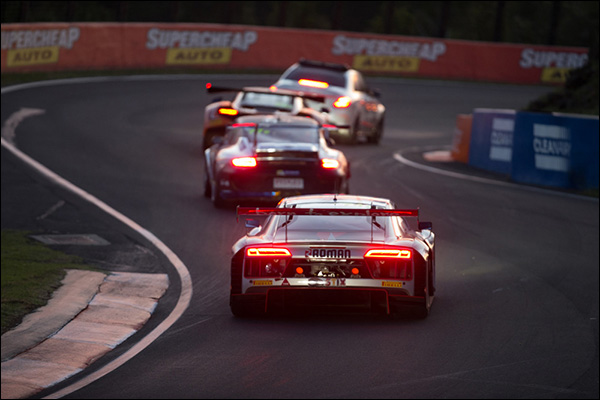
It’s fair to say that the result of last year’s Bathurst 12 hours was determined by this bunching-up process: the winning Nissan would not have been in a position to get ahead of the Phoenix Audi, which had been comfortably quicker over the course of the race, had not the Safety Car closed all the gaps in the final few minutes of the race.
This year, the winning McLaren of the Tekno Autosports team was clearly the fastest car out there, as evidenced by its fastest lap, which was not only a new lap record, but also nearly a second quicker than any other car managed. But to answer the question of whether that was down to ‘quick Kiwi’ Shane van Gisbergen or to the car, let’s take a look at the individual drivers.
| No. | Car | Driver | Laps Completed | Best Lap | Average Lap (Best 20%) |
|---|---|---|---|---|---|
| 59 | McLaren 650S | Shane van Gisbergen | 120 | 2m 01.567s | 2m 02.798s |
| 59 | McLaren 650S | Alvaro Parente | 107 | 2m 01.674s | 2m 03.283s |
| 59 | McLaren 650S | Jonathon Webb | 70 | 2m 04.063s | 2m 04.445s |
| 1 | Nissan GT-R Nismo | Katsumasa Chiyo | 120 | 2m 02.467s | 2m 03.545s |
| 1 | Nissan GT-R Nismo | Rick Kelly | 109 | 2m 03.198s | 2m 04.039s |
| 1 | Nissan GT-R Nismo | Florian Strauss | 68 | 2m 03.639s | 2m 04.294s |
| 10 | Bentley Continental | Guy Smith | 116 | 2m 03.235s | 2m 04.077s |
| 10 | Bentley Continental | Steven Kane | 111 | 2m 03.250s | 2m 04.156s |
| 10 | Bentley Continental | Matthew Bell | 70 | 2m 04.131s | 2m 04.502s |
| 2 | Audi R8 LMS | Laurens Vanthoor | 128 | 2m 03.385s | 2m 04.022s |
| 2 | Audi R8 LMS | Markus Winkelhock | 106 | 2m 03.659s | 2m 04.439s |
| 2 | Audi R8 LMS | Alex Davison | 63 | 2m 04.323s | 2m 05.501s |
The table reveals a number of interesting points:
1) Van Gisbergen and Parente were closely matched in terms of best lap times, but SVG was more consistently quick.
2) The three Bentley drivers were very evenly matched.
3) The Nissan, although it wasn’t as quick as the McLaren, was certainly quicker than either the Bentley or the Audi
4) Webb, in the McLaren, did as much driving as any non-seeded driver (although the he did a greater percentage of his time during the Safety Car periods)
5) Davison, perhaps the most experienced of the non-seeded drivers, did the least driving.
Perhaps now is as good a time as any at which to look at the actual stints. To keep matters simple, the tables below only show the driving stints for the winning Tekno McLaren and the NISMO Nissan, which finished just 1.276s behind.
Interestingly, even though the McLaren made 13 stops, compared to the 11 of the Nissan, each team did the entire race with only five driver changes each. Hence, the tables below show the length and average lap time for each stint, excluding in and out laps and periods behind the Safety Car. I have also excluded the lap (lap 100) on which Parente stopped on the track and lost around 45s.
No. 59 Tekno Autosports McLaren 650S| Stint | Driver | Stint Time | Laps | Average Lap Time |
|---|---|---|---|---|
| 1 | van Gisbergen | 2h 31m 29s | 65 | 2m 04.231s |
| 2 | Parente | 1h 48m 51s | 48 | 2m 04.311s |
| 3 | Webb | 1h 56m 32s | 50 | 2m 05.577s |
| 4 | Parente | 2h 33m 03s | 59 | 2m 05.077s |
| 5 | Webb | 1h 04m 01s | 20 | 2m 06.334s |
| 6 | van Gisbergen | 2h 02m 28s | 55 | 2m 04.250s |
| Stint | Driver | Stint Time | Laps | Average Lap Time |
|---|---|---|---|---|
| 1 | Kelly | 1h 55m 37s | 51 | 2m 05.625s |
| 2 | Strauss | 1h 59m 21s | 53 | 2m 05.833s |
| 3 | Chiyo | 2h 21m 43s | 59 | 2m 05.050s |
| 4 | Kelly | 2h 30m 09s | 58 | 2m 05.224s |
| 5 | Strauss | 0h 50m 31s | 15 | 2m 06.888s |
| 6 | Chiyo | 2h 19m 00s | 61 | 2m 04.443s |
I will leave it to you, dear reader, to draw your own conclusions, but it seems to me that the Woking-built car was a deserving winner, each of its stints being at a quicker pace than the equivalent one of the Japanese ‘Godzilla’, with the single exception of Webb against Chiyo: not surprisingly, Katsu-san was quicker than the Tekno team owner.

Now, there may be some out there who have noticed that, according to this table, the total driving time for Katsumasa Chiyo comes to 4h 40m 43s, and the driving time limit for cars with three drivers is 4h 40m. However, this is where it is important to know how the regulations work.
In the tables above I have calculated the driving time based on the total of the lap times that were completed by each driver. Now, at Bathurst, the stint does not start at the moment you get into the car. Nor does it start as you exit the pits (as in most forms of endurance racing). No, at Bathurst, the driving time starts when you cross the start/finish line at the end of your out lap from the pits. Hence Chiyo’s official total driving time was only 4h 32m 27s.
These things are important (ask Wayne Taylor), so when you watch and enjoy, the thrilling races that we’ve seen in the first few weeks of this endurance racing season, spare a thought for the strategists on the pit wall while you applaud the skills demonstrated by the drivers behind the wheel.
Paul Truswell