Here’s Part 2 of DSC’s in-depth Super GT season preview, if you missed Part 1, which covered the Lexus teams in GT500, you can find that HERE.
Jenson Button’s full-season debut, and a rapidly-developing NSX-GT, has Honda supporters hopeful of a return to championship form.
The 2017 Autobacs Super GT Series could not have started better for Honda. Coming off their first winless season as a manufacturer since 1997, their newly-redesigned NSX-GT took pole position for the very first race of the season.
Within the first handful of laps of the race, four of their five cars had broken down with the same electrical issue. The one that finished was “lucky” enough for it to happen in qualifying. It could not have started off worse after one race. But something interesting happened as the season went on. The Hondas got better. A lot better. They had chances to end their winless drought at Autopolis and Sugo, unlucky not to have cashed in due to a few bad strategic missteps.
Then they won the next two races back-to-back: The last running of the Fuji GT 300km Race in August, and three weeks later, the 46th and final running of the Suzuka 1000km, on Honda’s legendary home circuit.

Honda spared no expense to make the once-tricky NSX-GT a more driveable car at the limit. They did exactly that. But it’s another breakthrough Honda made late in the season that could be a game-changer. While the struggles of their Formula 1 engine programme in recent years are well-documented, Honda were able to apply a piece of their F1 development into GT500, introducing Turbulent Jet Ignition (TJI) to their HR-414A powerplant. Using less fuel to create a “spark” in the engine, TJI can be used to create better fuel economy, or more power.
Lexus and Nissan are reportedly using the same system, but Honda have a headstart. In fact, in the midst of a solid pre-season testing campaign at Okayama and Fuji, the revelation was made that Honda weren’t even using their 2018-spec engine as they will when the season gets underway.
And oh yes, there’s the full-season debut of the first-ever Formula 1 World Champion to race in Super GT, one Jenson Button, who will take his place amongst the ten-driver, five-car fleet of Honda NSX-GTs:
#8 | Autobacs Racing Team Aguri | ARTA NSX-GT | Bridgestone | Tomoki Nojiri & Takuya Izawa
The end of Honda’s 22-month winless drought in GT500 was also the perfect crescendo of Autobacs Racing Team Aguri (ARTA)’s 20th anniversary season.

Not only did their Honda win the summer race at Fuji from pole position, their GT300-class BMW M6 GT3 also won from pole position. The first time a single team had ever scored a double pole-to-victory in Super GT history.
The perfect way for Aguri Suzuki and his squad to not only celebrate his team’s 20th anniversary season, but for ARTA themselves to announce their return to top form in GT500 after years of struggling for consistency, either finishing last or second-to-last in the Teams’ Championship in five of the last six years.
The pace that the bright orange ARTA NSX displayed at Fuji was no fluke, and in fact, were it not for their heart-wrenching DNS from pole at Okayama, or a spin early in a wet race at Sportsland Sugo, their winless drought could have, maybe should have, ended much sooner. It was still a good season, with a series-leading three pole positions and five top-10 finishes, ARTA are on the way back to being the perennial front-runners that they were 10 or 15 years ago.
Returning from ARTA’s resurgent 2017 campaign is 28-year-old rising star Tomoki Nojiri, now in his fourth GT500 campaign with the team, a breakout star in 2017 as he took two pole positions, and his first career victory at Fuji in August.
Nojiri was another Honda Formula Dream Project (HFDP) talent that never got on the track to a Formula 1 or IndyCar career, but through hard work, he’s become one of Honda’s top GT500 talents, and he could be poised for an even more successful season in 2018.
Nojiri is ARTA’s present lead driver. Their new recruit, Takuya Izawa, was once in the place that Nojiri was a decade ago: A young Honda protege making his full-time GT500 debut with ARTA. But this run with ARTA is different for the 34-year-old veteran Izawa, now in his tenth full season as a GT500 driver for Honda.

Honda busted up Izawa’s long-standing partnership with Naoki Yamamoto at Team Kunimitsu in the off-season, as Izawa was moved over to make room for Button after spending seven of the last eight years of his career driving the Raybrig NSX. There were also questions about Izawa’s pace in the end of some races, especially in comparison to his co-driver Yamamoto, who by and large was Honda’s fastest driver all season long.
Back at ARTA, the former GP2 Series driver Izawa comes into a team that’s on the rise from recent struggles, and that’s a perfect scenario for a driver who also wants to get back to his winning ways, to where he was in his first run with ARTA where he won two races and finished 2nd in the GT500 Drivers’ Championship, or even to where he was in 2015, when he finished 3rd with Team Kunimitsu.
ARTA will have a massive contingent of supporters, such is the benefit of being the team sponsored by the title sponsor of the series, of being led by a local racing legend in Aguri Suzuki. ARTA’s goal for 2018 will be to get back into championship form and build upon the sustained and consistent success they had in 2017, and win a race or two for good measure.
#16 | Team Mugen | Motul Mugen NSX-GT | Yokohama | Hideki Mutoh & Daisuke Nakajima
No matter how great a team’s prestige, coming back to the premier class of Super GT is never an easy task after a decade and a half away. That proved true for Team Mugen in 2017.

The excitement surrounding the return of Mugen was astonishing going into 2017. One of the Japanese houses of performance that have appeal worldwide due to their global motor racing successes. A team that had won Honda’s very first GT500 championship, all the way back in 2000. Even if one knows very little about Japanese motorsport or automotive culture, they’ve at least heard of the Mugen name, synonymous with Honda.
And as the season started with the Mugen NSX being a points-scorer at Okayama, there was optimism that a second Mugen dynasty in GT500 was about to begin. It didn’t exactly pan out that way. They would score points in only one other race all year, a sixth place at Sugo was as good as it would get.
The Yokohama tyres did not work particularly well with the car in terms of grip and performance. That manifested itself in five non-scoring results, more than any other GT500 team. Not even the Suzuka 1000km debut of Jenson Button could salvage a sterling result for Team Mugen, in a race compromised by penalties and punctures galore.
As their Super Formula team shined on the strength on Naoki Yamamoto and Pierre Gasly’s success, Team Mugen finished bottom of the table in the GT500 Teams’ Championship. But they aren’t going to blow it all up for 2018, the goal is simply to build on a difficult season and improve with the pieces they have.
Ace driver Hideki Mutoh is back for another go-round, still looking for his first Super GT race win since November 2006, when he was a rookie bound for a future in IndyCar. He’s driven for every Honda team in GT500, and in 2013, he won the GT300 championship with Mugen in their CR-Z GT hybrid.
Mutoh is out-and-out the team’s quicker driver in most scenarios, now an experienced and hungry veteran. Since his return to GT500, Mutoh has just 3 podium finishes, the last coming in 2016. But his consistency, focus, and professionalism drives Team Mugen further towards their ultimate goal, of one day returning to their heyday.

Daisuke Nakajima is also back, his second year as a GT500 driver with Mugen. The younger brother of Kazuki is focusing on Super GT only in 2018, dropping his Super Formula programme seeking a change of mindset from where he’d been in recent years.
After struggling at the start of the year, as the season went on, Nakajima started to feel more comfortable with the car on its Yokohama tyres, and his race stints began to exceed the pace of those of his co-driver Mutoh.
What also bodes well for them is the improvements that have been made from Yokohama, if the pre-season testing pace of Kondo Racing and Lexus Team WedsSport Bandoh. If that couples to the unique characteristics of the Honda NSX-GT, and its supposed power advantage, Team Mugen will not be lamenting upon the struggles of 2017 for long, instead they could be basking in the glow of victory as they did two decades ago.
#17 | Keihin Real Racing | Keihin NSX-GT | Bridgestone | Koudai Tsukakoshi & Takashi Kogure
While they don’t have the same history as the other Honda teams, Real Racing have quickly established themselves as one of Honda’s consistent front-running squads in the last decade.

It may not show in their victories, of which their dramatic final-lap victory at Sportsland Sugo in 2010 is their only win. But they’ve also finished runner-up in the championship as recently as 2013, they have 14 podium finishes since that race, and even in Honda’s deepest of struggles, they’ve led the way for the NSX contingent.
In one race, team principal Katsutomo Kaneishi and his team experienced the highest of highs, and the earth-shattering lows at the Suzuka 1000km. A race they dominated. A race they appeared certain to win in its swansong before the switch to the 10 Hours. But then, with 25 laps to go, their rotten luck at Suzuka came up again, a rear tyre failure ending their race within sight of the goal.
Their Summer Series was a write-off with retirements at Sugo and Fuji, but they salvaged the season with a dramatic comeback from the back of the field to finish 2nd at Autopolis, and ended the year with a 3rd at Thailand, and a hotly-contested 4th at Motegi, to finish on a high note.
Honda led two pre-season test sessions of the eight run this season, both at Okayama, and the metallic blue Keihin NSX led them both, guided by the most experienced driver combination in the stable.
For his entire career, Koudai Tsukakoshi has been with Real Racing, starting as a 22-year-old rookie under the wing of the Kaneishi cousins, eventually becoming the #1 driver of car number 17. With this team, he’s experienced the joy of victory, when he edged out Takashi Kogure by 0.025 seconds at the line at Sugo in 2010. He’s also experienced a frightening crash at Suzuka in 2012, and the entirety of the team’s 7-year winless drought, which is now the longest in Super GT.
But that does not tell the story of what Tsukakoshi brings to the team, consistent and relentless pace, and incredible tenacity in the heat of battle. His comeback drive at Autopolis was one of the best individual performances in a race.
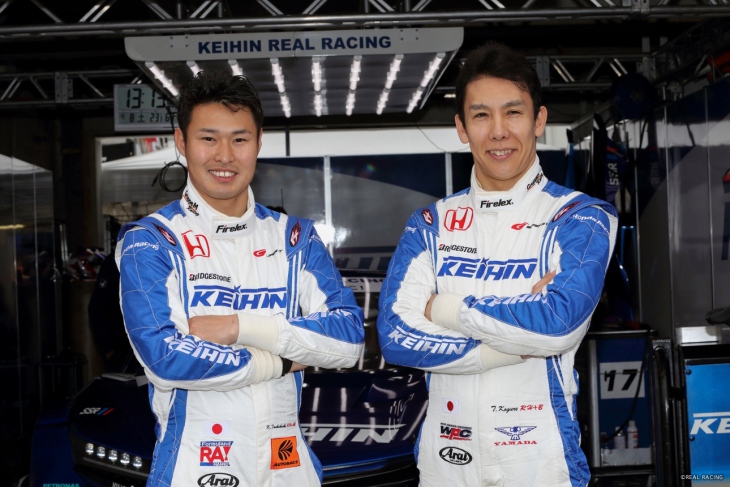
When the season starts, it will have been 58 races since Tsukakoshi’s last Super GT race win. After a strong pre-season testing run, this year looks like it’ll finally be the end of it.
Takashi Kogure is Honda’s most experienced GT500 driver, set to begin his 15th season. He’s also Honda’s only active former champion on the roster. And he too wants to end a personal winless drought dating back to the 2013 Okayama race.
Kogure is no longer the one-lap qualifying maestro of Super GT that he was 10 years ago, but as his pace showed in the Suzuka 1000km, he still has the ability to command a race at any time, and Kogure and Tsukakoshi get on very well with one another.
Years of near-misses with victory could finally come to an end for Keihin Real Racing, which combined with the team’s consistent and strategic approach to the championship battle, could parlay into their first GT500 championship titles.
#64 | Epson Nakajima Racing | Epson Modulo NSX-GT | Dunlop | Bertrand Baguette & Kosuke Matsuura
Out of the heartache experienced by Keihin Real Racing in last year’s Suzuka 1000km, emerged the triumph and jubilation for Epson Nakajima Racing when they took the lead, and eventually the victory, in the final running of Japan’s great race.

It was the perfect way to end a winless drought dating back to 4 November, 2007. An unexpected victory. A brilliant victory. A richly-deserved victory for a team and its drivers who have worked for years to get this once-proud team out of the cellar of the GT500 standings.
Nakajima Racing’s Suzuka 1000km victory, one of the great upsets in recent Super GT history, ensured that they would end a run of finishing last in the GT500 championship for four years in a row. And the thing about this team in 2017 was, they weren’t just good in one race. At Sportsland Sugo, before they got caught up in a Safety Car intervention, they were in the running for a podium. Their season finished strong, with two more top-ten finishes after Suzuka.
Satoru Nakajima, one of the most beloved drivers in all of Japanese motorsport through his exploits back home and on the world’s stage, had waited a decade to see his team reach the top step of the Super GT podium, where they regularly climbed to in the late 1990s and early 2000s, with an all-star cast of former drivers like Coronel, Firman, Ito, Matsuda, Lotterer, and Duval.
Give credit where it was due to their longtime class-exclusive suppliers in Dunlop: After years of struggling to field a strong dry-weather tyre, their work towards Suzuka gave them the advantage in conditions where they were expected to fold.
This is yet another team retaining the drivers who raced for them in 2017, and deservedly so, starting with Belgium’s Bertrand Baguette.
Baguette arrived in Super GT four years ago with an international racing pedigree decorated with championships in single-seaters and prototype sports cars, and his victory at Suzuka was the culmination of four years of hard work to revive the fortunes of Nakajima Racing’s Epson NSX.

His performance at Suzuka, three awesome stints en route to victory, shined the spotlight on just how much he means to this team as a driver, carrying them with all of his strength through the absolute lowest points of their drought with little reward to show for it until then, often performing well above the potential of the car.
What’s next for Bertrand Baguette? Staving off rumours of a Super GT departure, Nakajima Racing’s “bread-winner” is back and hungry for another victory, for him, and for his team.
If Kosuke Matsuura had opted to walk away from GT500 after last season, he couldn’t have signed off in finer fashion than his tearful, emotional Suzuka 1000km victory – but the 38-year-old veteran isn’t ready to walk away just yet.
Ending his own personal winless streak dating back to July 2013, Matsuura would love to spark a late-career renaissance with another win in 2018 aboard the Epson NSX, where after initial struggles in the start of 2017, he’s looking much more comfortable on the Dunlops, in a more potent car.
Nakajima Racing’s partnership with Dunlop is both a blessing and a curse: No other teams to give them feedback, but no other teams for which their tyre supply can be compromised. The pre-season testing form once again had the Epson NSX towards the bottom of the timesheets, but the power boost for Honda on the whole could prove beneficial once the season gets rolling.
#100 | Team Kunimitsu | Raybrig NSX-GT | Bridgestone | Naoki Yamamoto & Jenson Button
And now, the main event players.

The Raybrig NSX is Honda’s most famous car. Much like the Calsonic GT-R from the Nissan camp, the Raybrig NSX is famous abroad for its exposure in video games, and famous back home for being the car fielded by the iron man of Japanese motorsport, the great Kunimitsu Takahashi.
Kunimitsu and his team were Honda’s very first GT500 squad, dating back before they had a proper GT500 car, when they essentially took their GT2-class winning car from Le Mans in 1995 and ran it against more powerful GT500 cars in ‘96. The man himself is a legend: Isle of Man TT winner, MotoGP race winner, the most successful driver from the days of Group C prototypes, a competitive career that spanned from 1958 to 1999.
Team Kunimitsu were around since the very first season of the All-Japan GT Championship in 1994. But in 25 years, the GT500 championship is the only prize they’ve been missing. As close as third in 2007 and 2015, as close as runner-up in 2006. Through a quarter-century, most of it with Honda, the senior NSX runners have yet to capture Super GT’s ultimate prize.
The lineup that Team Kunimitsu have assembled is truly world-class. And that world-class prestige begins with the arrival of Jenson Button.
There’s little to be said about Button’s racing pedigree that hasn’t been said already. 306 Formula 1 Grand Prix starts. 15 career victories and 50 podiums. And the pinnacle of his career, spanning from 20-year-old playboy phenom to respected veteran of the paddock: His run to the 2009 Formula 1 World Championship with Brawn GP, born ironically, out of the ashes of Honda’s old factory F1 squad.
After seventeen seasons, Button has left Formula 1 behind. And instead of tackling the WEC, instead of IMSA, or rallycross, he’s hanging his helmet in Super GT with Honda full-time. His Suzuka 1000km debut was a boon for the series, but having Button around for the full season is massive beyond belief.
Much like the “Alonso effect” that his former F1 teammate brought to last year’s Indianapolis 500, and the WEC Super Season to come with Toyota, Button’s arrival has brought in an immediate impact to the series. Packed pre-season testing autograph lines. A YouTube channel bringing unprecedented on-site access to the circuit once thought unimaginable for Super GT fans outside of Japan. It’s the cumulative effect of Super GT signing a F1 World Champion, who could make a case to be Japan’s most popular “gaijin” racers since the late Ayrton Senna – just on his run with Honda power alone.

The adjustment Button has had to make from single-seaters to GT cars is pronounced, but the British racing legend has handled it admirably, and he looks every bit as quick as his co-driver, the man who brings the experience in Super GT, Naoki Yamamoto.
It’s understandable for a new fan to see Yamamoto as just being Button’s running mate. Truth be told, Yamamoto is Honda’s top man in the GT500 circuit, and the 29-year-old is about to become a lot more popular this season, of course. The surge of popularity will be much deserved for a driver whose podium-scoring drives at Autopolis and Suzuka, the comeback at Suzuka from 9th to 3rd in the final stint of the race in particular, were utterly sublime.
A former Japanese F3 National Class champion, a man who defeated André Lotterer for the Super Formula title in a controversial 2013 tilt, a Suzuka 1000km winner and one of the most consistent points-scorers in Super GT history. Yamamoto is every bit the accomplished racing driver that Button is. He’s a better GT500 racing driver, not a dig against Button, just a commendation of a young driver that’s still hungry for his first championship with Honda.
In pre-season testing, Team Kunimitsu, Button, and Yamamoto were confident of the car’s ability to perform well from the start of the season. There’s still learning curves ahead for Button – from communicating with his engineers, to adjusting to driving a heavier car with a roof over it.
Jenson Button may very well be the missing piece that Team Kunimitsu needed to win their maiden GT500 championship. But if they do, it won’t just be one person making the difference. It will be an all-out team effort, and it will be an immensely popular victory celebrated from Tokyo, to Los Angeles, to the tiny town of Frome.
Image Credits: Manabu Takahashi / JRPA.org
Additional images courtesy of: Honda, ARTA Project, Team Kunimitsu, Real Racing, Nakajima Racing, Mugen Power