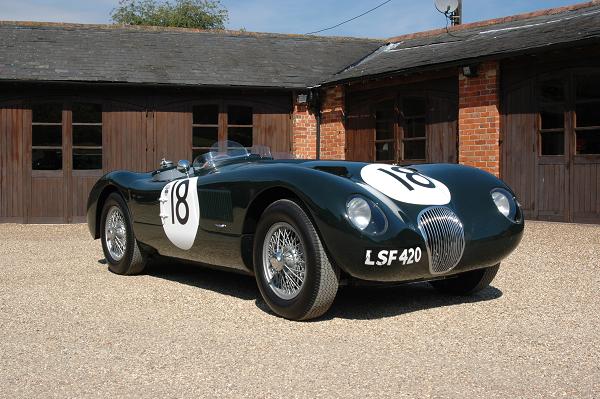
Having enjoyed Ian Wagstaff’s insights of the Rover-BRM recently, I was delighted when he told me he had caught up with another old ‘friend’ of his – the Jaguar C-type.
I had gone to interview Adrian Hamilton about his father, Duncan. “We’ve warmed the car up, would you like to take it out for a while?” was his unexpected greeting. Well, er, yes. This wasn’t any Jaguar C-type, it was the Jaguar C-type, that which had won Le Mans with disc brakes. It was XKC 051.
Outside of motor racing, much of my writing has concerned the automotive components industry. I had lost count of the number of times I had used this specific car to illustrate the ‘racing improves the breed’ cliché. A C-type had won at Le Mans in 1951 but in 1952 all the factory cars, with that year’s constrictive, sloping noses, had dropped out, mainly with overheating. Jaguar founder William Lyons was determined that one of his team would win again in 1953. All the panels on the cars were lightened, an innovative rubber fuel tank was fitted and a new Borg & Beck clutch installed. Three dual-choke Weber carburettors and a new induction system were used with engine performance increased to 220bhp. The Webers greatly increased the torque of the engine in the lower ranges and consequently, as Duncan Hamilton recalled, “improved the pick-up when coming out of the slower corners”.

What everybody remembers, though, was that the cars were fitted with disc brakes designed and developed by Dunlop Aviation. The conventional drum-braked Ferraris may have been quicker that year but the Jaguars could stop and, at the end of the Mulsanne straight, that was rather important. “These brakes will bring the Jaguar down from 150 to 40mph in under 300 yards and they do not wear out,” said Dunlop development engineer Harold Hodgkinson.
A C-type had been the original sports car to race with disc brakes when Stirling Moss had run XKC 003 in the Easter Goodwood event the previous year. According to Jaguar historian Andrew Whyte, the first report appears to have been seen in Road & Track magazine, which noted “We had a good look at the Jaguar in the paddock and it is fitted with aircraft pattern disk (sic) brakes made, it is rumoured, by Dunlops. Three lugs operated to each plate on the front wheels – two at the rear.”
The same disc-braked car was entered for the Mille Miglia where it was again driven by Moss assisted by Norman Dewis. The first win came that June when Stirling persuaded the factory to lend him XKC 005 and to fit it with disc brakes for the Reims Grand Prix meeting.
A type of disc brake had been first raced in 1938, a rear-engined, four-wheel-drive Miller, built for that year’s Indianapolis 500, had used what were, in effect, pressure plates working on one face of the disc. Disc-and-calipers were initially used on aircraft before finding their way onto the Formula One BRMs and Tony Vandervell’s Thinwall Special Ferrari in 1952. It was a British ‘thing’ in those days as can be seen by the fact that, although the Owen Racing Organisation and Stirling Moss experimented with disc brakes on their privateer Maserati 250Fs a few years later, the Maserati factory never raced its 250Fs with them. The reason given was that it would have to go outside Italy to find a supplier.

Over the winter of 1952/53 Jaguar had still had not made up its mind about disc brakes. A memo from Bill Heynes, who played a senior role in engineering the C-type, stated “It is proposed to investigate the position of three-shoe Girling brakes, and alternatively Girling/Dunlop disc brakes for this car. Dunlops are making up prototype samples of this disc brake, but it is felt essential that a shoe brake is available as well.”
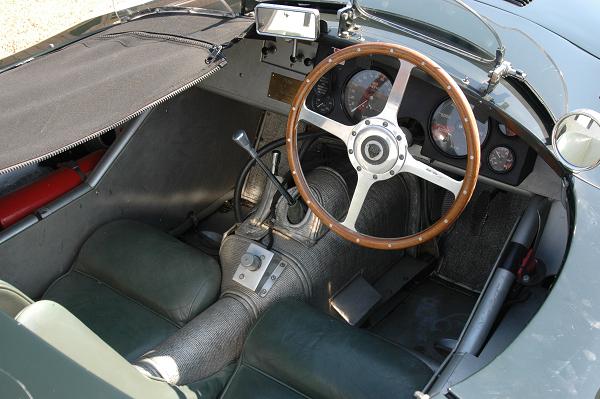
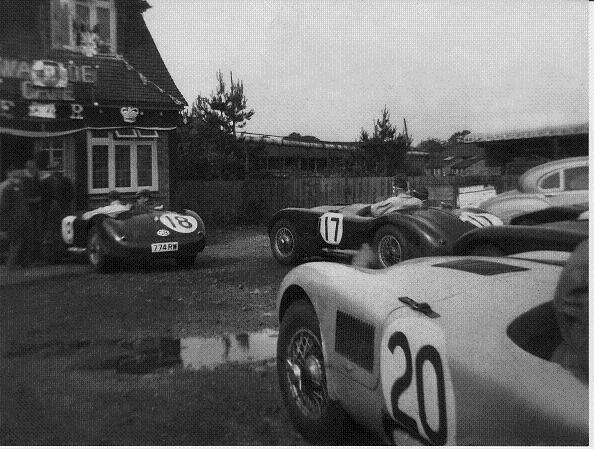
In the event, Jaguar went with the discs and history was made in the braking areas around La Sarthe; Duncan Hamilton and Tony Rolt winning the 24-hours ahead of team mates Moss and Peter Walker. Peter Whitehead and Ian Stewart came in fourth with only a Cunningham getting in the way. The “Dunlop discs gave us a great advantage over our principal adversaries, and we knew that they would last the twenty-four hours without having to be nursed,” wrote Hamilton.
I wasn’t about to test Hodgkinson’s claim for the discs on the Basingstoke by-pass. The responsibility was – how should I put it – overwhelming, even if I kept telling myself that the original bodywork was now hanging up and what I was driving was clad in new clothing. For goodness sake, the car was still being raced even if, at that time, the only people allowed to do so were Gary Pearson and Sir Stirling Moss. Pearson Engineering had been maintaining the car, which had been restored to period specification.
I came to a halt on that by-pass; the traffic lights were red at the roundabout. So far, I had only driven the car away from Adrian’s premises. There was plenty of traffic around and I felt so obvious. There I was, with a huge number 18 on the Jaguar’s flanks, with the feeling that everybody was thinking ‘look at him in his kit car’. There could be no half measures with the clutch. This was, after all, a racing machine even if it was based on production parts. Stall and I would appear a right ‘wally’, blast off the line and that would underline what those around me probably already thought.
I managed not to shame myself and set off for the country lanes where I could only marvel at the car’s tractability. This, surely, was what a Le Mans car should be all about – a real racing car and one that looked the part, yet one that could be comfortably driven in these conditions. When the cars were first entered in 1951 they were originally as conventional XK120s but Lyons did describe them as “a prototype of a new 3.5-litre sports model which we hope to build for sport.” Unlike the XK120, there was no intention that the XK120C should be a dual-purpose car. (The ‘C’ stood for ‘competition’ but it was still followed by the D-type, E-type and now F-type, even if there was no A- or B-type.) The car, with its Malcolm Sayer designed bodywork, consisted of production XK components in a short and rigid triangulated steel-tube frame. The engine was the six-cylinder 3.4-litre that had, by then, become quite familiar. Harry Weslake was involved in increasing its power output. The opportunity to get away with just one small door gave Jaguar the ability to increase vertical height just at the point where rigidity tended to be lacking.

It seemed so easy progressing round those lanes but then, as I reminded myself, I wasn’t on the Mulsanne at night and in the rain. As I drove through one village an elderly lady pruning her roses looked down at the car. After a while I returned down the same road. Still busy with her shears, she cast her eyes over the car again. You’ll tell me that it was all in my imagination but she knew, she really knew, unlike all those reps on the by-pass.
I confess, I almost got lost; it’s not easy to find Adrian’s place. It was an appalling thought, adrift in the Hampshire countryside and not able to get such a car back to its rightful owner. However, I recovered and after about an hour I was back driving over the gravel round his workshop.

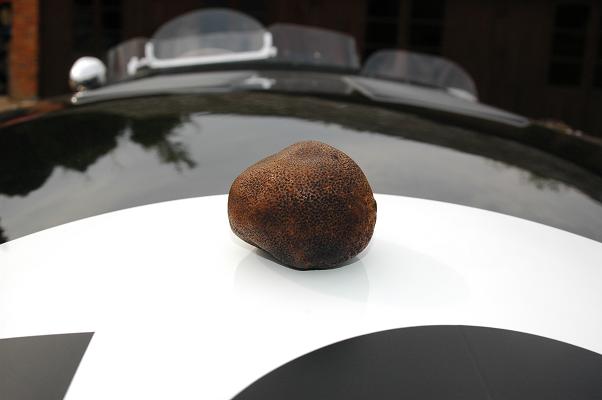
You’ll ask me if that orange was still in the car. I have to admit: it wasn’t, but Adrian did show it to me and a poor, shrivelled specimen it is too. It is just part of the legend that goes with XKC 051. Duncan Hamilton’s biography, Touch Wood! is arguably the most enjoyable tome ever written on motor racing but the proverbial pinch of salt is needed, particularly when it comes to the tale that he and co-driver Tony Rolt were drunk the night before the 1953 24-hours, having been disqualified after practice. Just add the impossibility of winning Le Mans following a serious hangover to the fact that Jaguar team manager ‘Lofty’ England refuted the story and that Tony’s son Stuart once threatened me with dire consequences if I repeated, in print, a tale that his father denied strenuously. Having given the true facts on camera, England said, “Don’t tell Duncan. It would spoil a good story.”
I met Duncan Hamilton just once when, as a student earning a crust during the vacation as a hospital porter, I was called upon to convey him to the X-Ray department. He seemed delighted to learn that I had read Touch Wood! and yarned away – to the obvious contempt of the nurse – as I wheeled him along. At X-Ray reception he was asked about any previous hospital experience. ‘You’d better ask the porter,’ he said. ‘I think he knows more about that than me.’
Not so, but to have driven his car many decades later arguably transcended any motoring experience I have had before or since. Just think, you could buy a C-type Jaguar for £2,327 1s 1d in 1952.

Ian Wagstaff