At a Bentley reception the day before the 2003 Le Mans, Derek Bell, a consultant to the marque, was very much in evidence. You had the feeling that this man, easily the most successful Brit ever to contest the 24-hour race, really should be driving one of the patriotically green cars himself. Then you realised it had been a full seven years since his last appearance on the entry list. This year, we celebrate the 30th anniversary of his final race there.
The article is intended to commemorate this; given the fact that it was one of Derek’s least memorable races at Le Mans, it seemed a travesty to refer to it in the opening sentences. The man himself now says that he does not remember much about what happened the second year that he raced a McLaren F1 there. ‘As far as I can remember, we just drove the car to the finish. There were no heroics. It was no doubt rather dull after the previous year’s excitement (when he was in contention for a sixth outright win for many hours).’
Derek contested the Le Mans 24-hours on 26 occasions, winning five, coming second twice and third on a similar number of occasions. He is mainly associated with Porsche, driving Porsche-engined cars 15 times and scoring four of his wins for the marque. However, his Le Mans career was bookended by two totally different cars, a Ferrari 512S and a McLaren F1 GTR, and it is to the latter that we must draw attention.

Derek had made a ‘farewell’ appearance in 1995 driving the Kremer-Porsche K8 (‘one of the nicest cars I ever drove at Le Mans’) but farewell appearances have a habit of being repeated and he was unable to resist the chance of driving a David Price run, Mach One Racing, Harrods sponsored McLaren F1 with son Justin as one of his co-drivers. Also at the wheel would be another former Le Mans winner, Andy Wallace.
The car would lead the race overall for 10 hours. What a fairy tale result that would have been if Justin had been able to join his father on the top spot of the podium, but it was not to be. After 273 laps, Andy came in for what should have been a routine pit stop. Servicing over, he tried to leave the pits but found that the clutch was not engaging.
It eventually did so, but by that time, the car was a lap behind the eventual winner, the Kokusai Kaihatsu-entered F1. Eventually, the yellow Harrods McLaren would finish third, but Derek presumably had seen what could be achieved following what he would later regard as one of his best drives. Asked about retirement, he seemed not to have ruled out another return in 1996, saying, ‘I think in future I am going to keep my mouth shut’. Autosport magazine reflected on how close he had come to ‘giving his adoring public the chance to celebrate a sixth Le Mans win’.
And so it was that the 1996 Le Mans grid again contained a yellow, Harrods-sponsored McLaren F1. However, it seemed to go wrong right from the beginning, with the dream of a Bell family triumph evaporating when Olivier Grouillard was drafted in to replace Justin who would be driving a Chrysler Viper.
According to the contemporary press, Derek described the car as ‘abominable’, Andy said it was ‘the biggest shitbox I’ve ever raced’, while Olivier merely remarked that it was ‘difficult to drive’. It has to be said, though, that Andy does not recall being quite that derogatory. ‘What I do remember,’ he now says, ‘ is that we ran with a modified aero package to keep up with the new, strong entries. I’m sure that the modifications were an improvement, but we really struggled to match the quicker prototypes.’

Theirs was the slowest of the seven McLarens entered in practice, but managed to remain in contention by squeezing an extra lap out of its fuel allowance. This advantage was, though, offset by the need to change its Goodyear tyres at every daytime pitstop. Those McLarens on Michelins were able to double-stint on their rubber.
That sixth win was never going to happen. Indeed, the Harrods F1 only just made it to the end. Only two gear ratios, fourth and fifth, were available during the final four hours, but the drivers managed to nurse it to the chequered flag. The career of one of Le Mans’ greatest drivers came to an end that Sunday, 30 years ago. ‘I didn’t know at the time that the race would be Derek’s last LM24,’ says Andy, ‘but it was always a pleasure to share a car with him, and his experience was invaluable. Together with Olivier, who was also a great driver, we did our best but couldn’t challenge the top five cars.’
This may be an anniversary article, but to dwell solely on that 1996 race would be grossly unfair on Derek. Remember instead 1975, 1981, 1982, 1986 and 1987, which he regards as his most satisfying win. It had all begun in 1970 at the wheel of a works Ferrari. Given that Derek had already lost his place in the Italian team’s single seater set-up and that he is better associated with its rival Porsche, this seems something of an anomaly. He was also involved in the shooting of Steve McQueen’s iconic film, ‘Le Mans’, that year, although this was curtailed when the 512 that he was driving caught fire, and he suffered facial burns.

It might all have started earlier, as John Wyer had wanted Derek to drive one of his Ford GT40s at Le Mans in 1968. He made a ‘good impression’ during testing at Thruxton, but he was then a Ferrari factory driver, and Enzo was not going to let him race at La Sarthe. Wyer would later reflect, ‘had (Derek) driven for us at Le Mans, he would almost certainly have been in the winning car’.
Derek would drive Wyer’s Gulf sponsored cars on a number of occasions, starting with a long-tailed version of the leviathan Porsche 917 in 1971. After a variety of problems, the car that was shared with Jo Siffert retired during the 18th hour. In 1974, he teamed up with Jacky Ickx for the first time for his maiden win at Le Mans with a Cosworth DFV powered Gulf GR8 (a Mirage renamed to please its sponsor).
This was a year in which fuel consumption regulations rather detuned the event. He would be back with the Belgian in 1981, the pair winning again, this time in a factory-entered Porsche 936. The pair finished 14 laps ahead of their nearest challengers; it was one of the easiest of all Le Mans victories.

The Group C years now followed, Derek being initially outspoken about its fuel economy regulations. However, it would give him three of his Le Mans wins and what he regards as his best race there. Having won again in 1982, following an almost faultless run with one of the then-new Porsche 956s, the race did not start well the following year when Ickx was pushed off on the first lap. However, they regained the lead after what Derek calls ‘our greatest race together’ before various maladies dropped their car four laps behind one of their team mates.
With an hour to go and with failing brakes, Derek was just a lap behind the leader, Al Hobert. He then proceeded to break the lap record twice, hauling in Al at a rate of knots. About to start the final lap, the latter appeared with smoke coming from his left-hand exhaust. It is now thought that his car would not have made it to the finish had the race been one lap longer. As it was, Derek had to be content with second place, a mere, according to his step-father, ‘the Colonel’ Bernard Hender, 26 seconds adrift.
Derek would be back on the top step of the podium again in 1986 and 1987, on both occasions partnered by Hans-Joachim Stuck and Al Holbert, three drivers per car being de rigueur by now. Jaguar had now returned to Le Mans, and British fans’ loyalty must have been split between their favourite in his works Porsches and what was surely their national team.
One should not dwell too much on what-ifs, but another such occurred when Derek’s Porsche again finished in second place in 1988, thus denying him a hat-trick of consecutive victories. With the reserve fuel failing to work properly, his teammate Klaus Ludwig tried to eke another lap out of his tank. The engine spluttered and died at Indianapolis. Klaus switched onto reserve for the last eight litres, and the car spluttered its way jerkily to the pits, firing on three or four cylinders at the best. Derek was none too pleased about that, especially as the car, which he also shared with Hans-Joachim, finished on the same lap as the eventual winner.
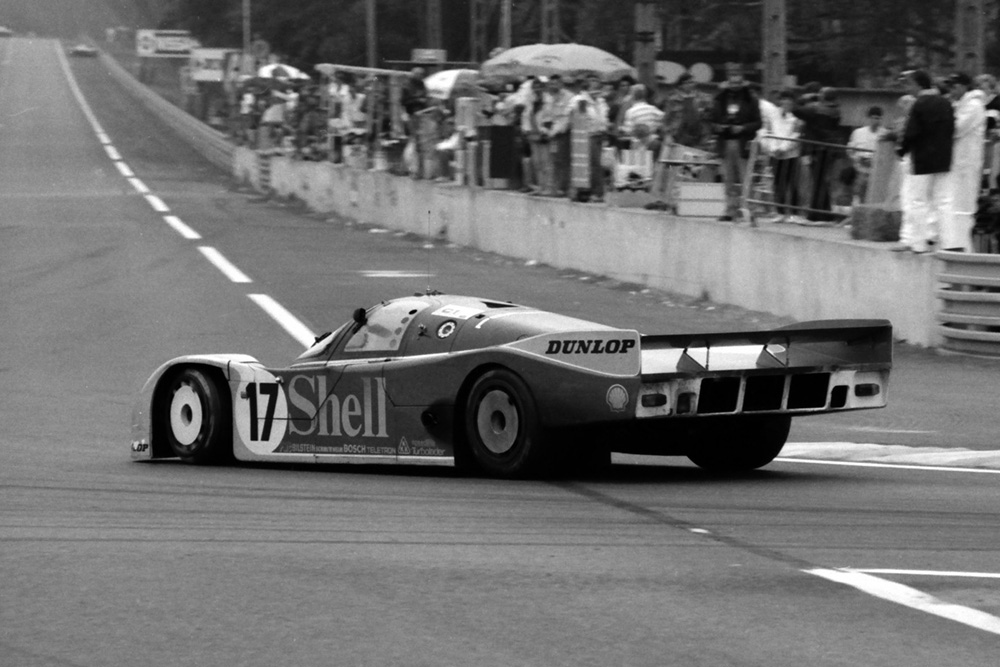
The victor that year was a Jaguar to the delight of the massed British supporters. Derek’s countrymen once again had a car to support, but for many years their loyalty had been to this one person. He had arguably become a figurehead for all those who had made the annual crossing over the English Channel before heading for Le Mans. Typically of the man, he sees this differently.
It has been his belief that the British first of all supported the British cars, and it is only when they have dropped out that they turned to an Englishman who was invariably in a German car. Derek manages to combine a tremendous enthusiasm for the event – even now – with a certain self-depreciation.
Back in 1994, when he had driven the Gulf-sponsored Kremer, the sponsor had coined the slogan ‘Gulf – the Return of the Legend’. ‘Some people thought the “legend” was me,’ quipped Bell, who was by then in his fifties
Years later, Derek, who by then had been given the freedom of the city of Le Mans, reflected on whether he should have put himself forward to drive one of the Bentley Speed 8s. ‘To have had my last year at Le Mans in a Bentley would have been fantastic.’ He would wonder if he should have been more forward. Derek Bell, too shy? Perhaps in this case. The thought of him racing a Bentley is a tantalising one. Had it happened, this article would have had to wait for a few more years to be written…
Pics: Ian Wagstaff & racingsportscars.com