
Porsche was never going to win the Le Mans 24 Hours on its first attempt.
Its sole starter in the 1951 race was a little, Gmünd-built Type 356 driven by importer August Veuillet and his friend Edmund Mouche. What they achieved was impressive enough, lapping with clockwork regularity to win the 751 to 1100cc class while beating the record for the shortest time spent in the pits.
A marker had been set. Over the next few years, the Porsches grew in engine size, never enough to be thought of as overall winners but consistent victors in their category, Veuillet and Mouche winning again in 1952. So it continued with annual class wins. In 1955, Helmut Polensky and Richard von Frankenberg scored Porsche’s first win in the Index of Performance while finishing fourth overall on their Type 550.
A fifth overall the following year showed that the silver cars could operate near the front of the field, even though there was no class win that year. It was back to category-winning ways the following year. The Porsches were now growing in size and it was the two-litre class that fell to the Type 718 RSK of Jean Behra and Hans Herrmann. The ‘big boys’ were now being challenged with the pair taking third overall.
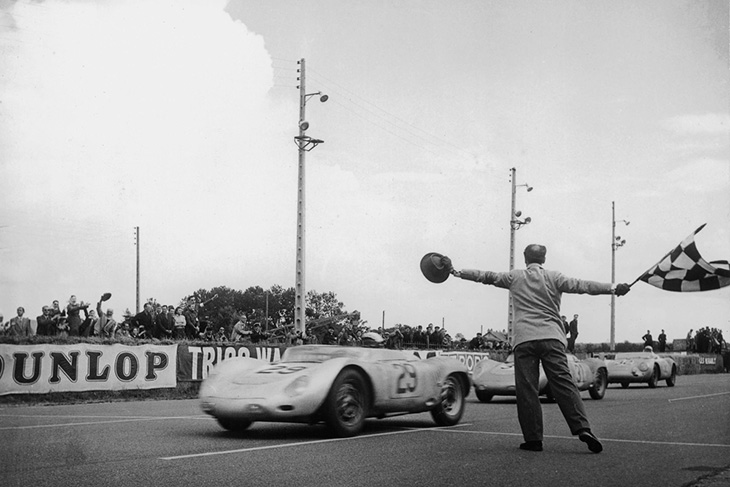
Porsche’s record throughout the 1950s had been impressive until it came to 1959 when none of its six cars finished. Then it was back to class wins again as the cars grew from two litres to, in 1968, three.
That was the first year when Porsche indicated that it really could win Le Mans outright with Dieter Spoerry and ‘Rico’ Steinemann in a Squadra Tartaruga Type 907 finishing second behind one of JW Automotive’s Gulf-sponsored Ford GT40s.
Perhaps it should have happened in 1969. Not only were there both coupe and roadster 908s in the line-up but also a trio of the fearsome 917s. If ever there was a car that was too fast it was the 1969 4.5-litre 917.
The story of how Porsche and Ferrari drove a proverbial stagecoach through the regulations to create their Group 5 monsters has been oft told. Porsche’s technical director; Ferdinand Piëch virtually pawned the family jewels to create 25 monsters that tested the factory drivers to the limit as they threatened to lift off.
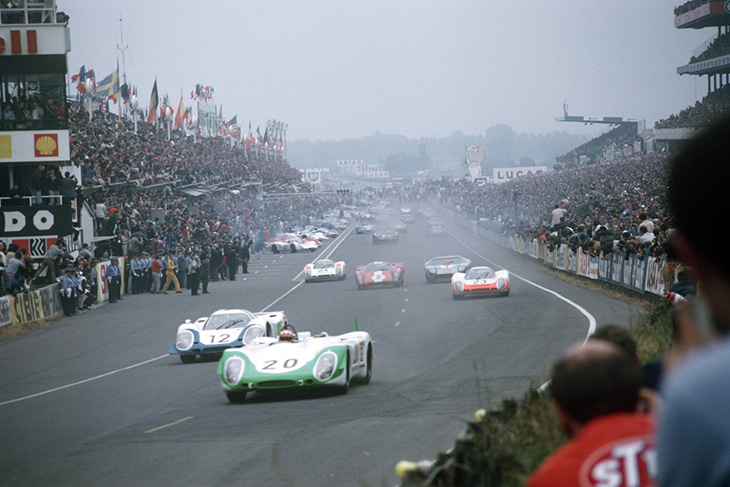
One, driven by Vic Elford and Richard Attwood, led for many laps. Elford would claim “We were so much quicker than anyone else. I loved it!” Attwood was not so sure. The car was six laps in the lead with only three hours to go when the casing of the gearbox started to crack causing oil to leak onto the clutch.
It was retired, much to Richard’s delight. “I couldn’t have been a more happy man at that point. I couldn’t wait to get out of the car. It was such an uncomfortable experience.”
The lead passed to the same GT40 that had won the previous year but Porsche was still in with a shout. As the race drew to is conclusion, Hans Herrmann in the 908 that he was sharing with Gerard Larousse started to challenge Jacky Ickx in the Ford. After the final pit stops, the Belgian had a six-second lead, which Herrmann ground down.
The pair now traded places, sometimes as Hans would recall, trading paintwork. Ickx knew that the Porsche’s brakes were fading and outfoxed his rival at Mulsanne Corner to win by a scant few yards. ‘After the race, I felt bad,’ recalled Herrmann. ‘But I did not dwell on it for long. It does not make sense when you are angry or sad after a race.’
Herrmann and Porsche did not have to wait long for their fortunes to change. A year later, the Neanderthal 917s of 1969 had been tamed and were favourites to win, although they now had the Ferrari 512s to contend with.
It was not easy as the leading 917s, those with five-litre engines and long-tailed bodywork, dropped out, leaving just the smaller-engined, conventional, Porsche Salzburg entered 917K of Herrmann and Attwood.

They pressed on in appallingly wet conditions and, despite being thought the least likely of the Porsches to win that year, scored the marque’s first outright victory at Le Mans…and that with one of its drivers, Atwood, suffering from mumps.
The key to victory was now in Porsche’s hands and a second win for a 917 the following year was almost a foregone conclusion. However, there was another ‘win’ in 1970 that should be not forgotten, that of ‘Larry Wilson’ and ‘Paul-Jacques Dion; in an iconic liveried blue and orange Gulf car.
Alright, so this was a work of fiction, Steve McQueen’s magnificently self-indulgent film, ‘Le Mans’, but it does leave the impression that JW Automotive won the Le Mans 24 hours with a Porsche. The team may have done so with Ford and Mirage, but with a 917…it never happened.
The actual second win did, though, come quickly as the 917s dominated the following year’s Le Mans with Helmut Marko and Gijs van Lennep victorious in a magnesium-chassied Martini Racing 917K.
The latter would recall how, with three hours to go, the brake discs were becoming thin and cracked. It was a matter of stopping to have the discs changed, in which case, one of the Gulf 917s would win, or take it easy on the braking. They chose the latter.
The powers that be were, though, concerned over increasing speeds and eviscerated the front runners at Le Mans by reducing them to three litres. Group Five was dead; Group Six was now the only up-front battleground. Although the 908s were still eligible, it took a while for Porsche to catch up, but in 1976 and 1977 it was back at the front with its three-litre 936 spyder.
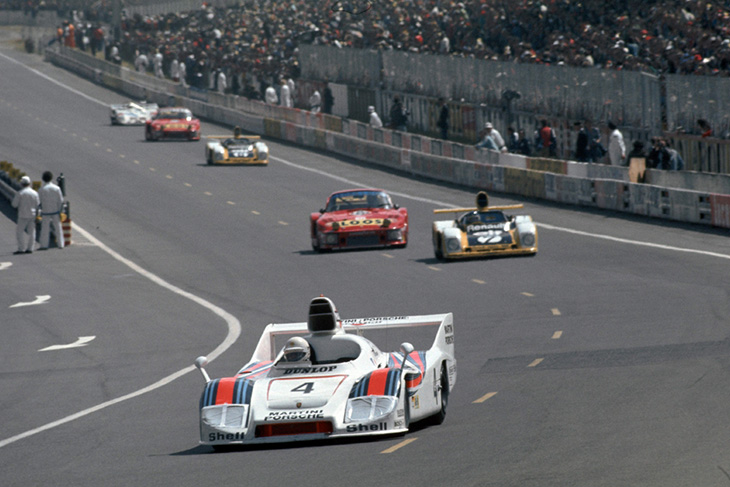
The company was now the dominant force at Le Mans, with a Kremer brother’s 935 K3 taking a sixth victory for the marque in 1978. Unlike the out-and-out 936 sports racers, the looks of this were derived from the 911 road car.
The 936 was not finished yet, though, and won the 24-hour race again in 1981, Jacky Ickx having been one of the drivers in all of its three victories.
Once again the rules were changed but this time it would herald a glorious era for Porsche, the next decade would be that of Group C. What was about to happen was not necessarily obvious at the start of the 1982 Le Mans but, 24 hours later, every step on the podium was taken up by the drivers of the three Rothmans, works-entered 956 coupes.

The following year, the opposition seemed to have almost disappeared, the gird appearing to be dominated by 956s of various hues with a factory car winning again.
And so it continued, although there was no works entry in 1984. That meant the start of a remarkable sequence for Reinhold Joest, winning in consecutive years with exactly the same chassis.
It was a feat he would repeat in the 1990s, again with a Porsche-engined car, but more of that anon. The 956 was replaced by the visually almost identical, but safer, 962 that had been developed to race in America, but this did not stop Porsche from winning, the factory team returning to the top spot on the rostrum for another two years. There were seven consecutive victories at Le Mans in the 1980s before more modern designs from Jaguar and Sauber-Mercedes took over.
The Automobile de l’Ouest tried to bring GT cars to the fore in the 1990s, but twice this was overcome with a Porsche, once in 1994 with Dauer Racing’s car that was little more than a 962 (although it could carry luggage…) and then in 1998 with a factory GT1 98. Both, it has to be said, were travesties of what a GT car should be.
Joest, as mentioned above, also won twice in this era, although his car was not pretending to be anything other than an out-and-out racer. It counts amongst Porsche’s 20 victories thanks to its engine, but the chassis had originally been built by Tom Walkinshaw Racing for Jaguar, making it something of a mongrel.

Porsche no longer sought outright victory at Le Mans during the first decade of the new century. However, it might be said to have returned to its roots when it developed a car to win the lesser LMP2 category, the RS Spyder. (One must also not forget that Porsche has been a contender in the GT classes since they were first introduced.)
True, in America, the Spyders could fight for overall victory, but it was only with the LMP2 category in sight that it returned to the prototype ranks at Le Mans in 2008, twice winning the class.
Porsche’s most recent outright victories came in a sequence of three from 2015 to 2017.
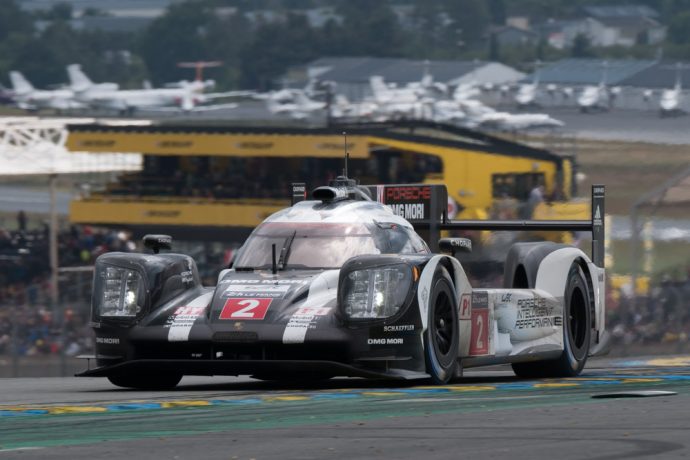
It had returned the year before with the 919, an example of the then technologically advanced dual-hybrid cars that then comprised the LMP1 class. Porsche then withdrew from the Le Mans arena to try its hand at all-electric racing, but you cannot keep the marque away from La Sarthe, and in 2023, it returned with the 963 LMDh.
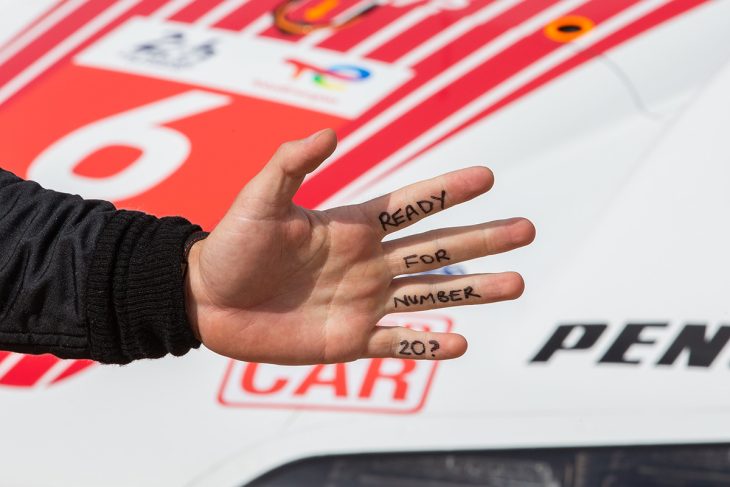
There’s plenty at stake for the Zuffenhausen marque’s three-pronged attack this year, including, of course, the opportunity to deliver a first Le Mans win for Roger Penske after failing to claim win number 20 in the Centenary Le Mans 24 Hours, and missing out last year too.
Admittedly, it’s been a struggle in the opening rounds of the 2025 FIA WEC season, with the Penske team failing to find a way onto the podium ahead of June. But there are reasons to be cheerful. Porsche Penske Motorsport enjoyed title-winning success just last year in the WEC, and has dominated in IMSA GTP this year, winning four of the first five races, including the marquee enduros at Daytona and Sebring.
So will it be a case of third time lucky come Sunday afternoon?
Pre-1998 images courtesy of Porsche