

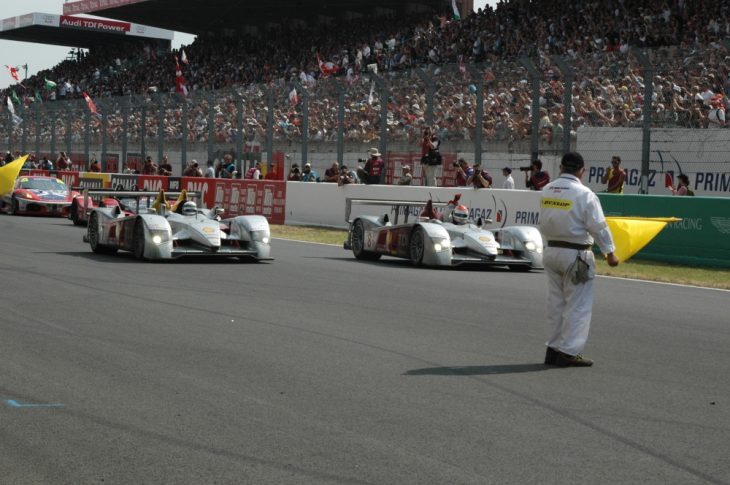
Audi held a press conference the day before the 2005 Le Mans 24 Hours. Former endurance racer and entrant Alain de Cadenet asked a question that many had been posing over previous months: Was Audi going to enter a car for Le Mans powered by Rudolph Diesel’s invention?
Peugeot, a few weeks beforehand, had already announced that such would be its intention. Head of Audi Motorsport Dr Wolfgang Ullrich refused to confirm that there would be a new Le Mans Audi of any kind. It was generally felt that he was stalling.
The previous year, Ian Dawson’s brave, low-budget Taurus Sports Racing team had turned up with a Lola B2K/10 powered by an engine based on the Volkswagen Touareg’s V10 diesel unit. True, it occasionally belched out black smoke and lasted for only three hours before retiring with a clutch problem, but it had managed 16 laps between refuelling stops which compared very favourably to the 11 laps of the winning Audi R8.

It was not the first diesel-powered car to race at Le Mans; that had been the unsuccessful Delage-bodied MAP run by the Deletrez brothers in 1949. Diesels had been banned after that but with the move to ‘greener’ forms of propulsion, they were back on the ACO’s radar and Audi already sold one of the most powerful diesel road cars in the world.
It is said that the initial idea of running an Audi diesel car at Le Mans came from the fertile mind of its head of engine development Ulrich Baretsky. He was, he recalled, ‘struck by a lightning bolt’ knowing that if he did not develop such a machine then someone else would.
The result was the open-cockpit Audi R10 which made its debut at Le Mans exactly two decades ago, a year ahead of the first diesel-powered Peugeot. Audi had already proved to be the serial Le Mans winner of the early 21st century, the only time that it had lost since the turn of the millennium being in 2003 at the hands of a Bentley, but even that had been powered by an Audi engine. The factory team had been missing since the year before that, but its R8s had continued to win in private hands. With the challenge of the new, diesel technology, it was now back.

The R10 won that first year, as it would do so again in 2007 and 2008. As far as La Sarthe was concerned, it remained unbeaten when in factory hands. It would also win the American Le Mans Series in each of these years, as well as its European equivalent in 2008. Audi would totally dominate the diesel era at Le Mans with its turbocharged TDI engines, losing out just the once, to Peugeot in 2009.
The R10 would be replaced by the R15 and then the closed-cockpit R18, but it was the imposing-looking R10, a stark contrast to its predecessor, the arguably more aesthetically pleasing, petrol-fuelled R8, that planted the flag. The progress made in diesel engines, once decried as noisy and smoky, had improved considerably over the previous 15 years, thanks in part to Audi itself but the victory at Le Mans gave them a whole new image.
The 2006 R10 was powered by an all-aluminium, 5.5-litre V12 engine with two Garrett turbochargers blowing at 2.94 bars. (Without turbocharging the car would not have been able to compete with those that were petrol fuelled in terms of power.) Back then, diesel power units were considered to be ‘green’ and Audi underlined this by using Shell synthetic recyclable fuel. Also of note from an outside supplier was the specialised diesel particulate filter manufactured by Dow Automotive.

The power output was said by Audi to be 560bhp at 4500rpm. Famed technical journalist and former Le Mans winner Paul Frère would quote an unofficial source as claiming that the maximum torque was 1250Nm. Such was the power produced that the six speeds of the R8’s Ricardo gearbox was considered too many and Xtrac built a new 5-speed pneumatically-actuated sequential box.
One supplier which did remain the same as for the R8 was the Dallara, which built the chassis. Radical changes were necessary for the new car, with chassis, engine, and gearbox forming an extremely rigid, fully-stressed unit. While the R8 featured a carbon monocoque clothed in separate bodywork, the majority of the carbon-fibre monocoque structure belonging to the R10 was in direct contact with the air flow and required no additional fairings. The R10 also had a significantly longer wheelbase than the R8.
Having said that, the R10 did carry genes from its predecessor. Observed Dr Ullrich ‘The R8 originates from 1999. We’ve gathered a huge amount of know-how since then. All this experience found its way into the new R10.’
The cars would also be run, as had been the R8s, by the team of Reinhold Joest’s multiple Le Mans winners.
The R10, which was unveiled in Paris, was not only notably powerful, it was quiet, underlining the fact that trackside photographers should always look in the direction of the cars coming towards them.
The 2006 Le Mans was not the silver and red R10s’ first race, that was the 12 Hours of Sebring on March 18. Rinaldo Capello, Allan McNish and Tom Kristensen finished four laps ahead of their nearest competitor, admittedly an LMP2 car, to score the first ever win for a diesel-powered car in a major endurance race. If that had not made them favourites for the subsequent 24-hours then practice for the French event certainly did. The two R10s of the above trio and of Frank Biela, Marco Werner and Emanuele Pirro were about two to three seconds a lap quicker than their nearest rivals, the conventional, petrol-engined Pescarolo-Judd C60s.

As if this was not enough to depress Henri Pescarolo and his Gallic team, it appeared as if the R10s would also require fewer fuel stops.
This was confirmed once the race was underway, the Audis coming in every 14 or 15 laps as against the 12 of the Pescarolos. It was reckoned that the former were using around 42.5 litres of diesel per 100 kilometres as against the 53 litres of petrol for their rivals.
It surprised no one at the start when that aggressive Scot, McNish, blasted away into the lead of the race, followed by Biela. From now on, an Audi R10 would lead every lap of the 24 hours. After their first refuelling stops, the two German cars were around a minute ahead of the Pescarolos. The first timing sheets showed McNish’s car eight seconds in the lead.

The only way another team could have won would have been through Audi unreliability, and let us not pretend it was all plain sailing for Joest’s team. Even number eight, Biela/Werner/Pirro’s winning car, which held a comfortable lead for most of the race, had to have its fifth gear changed at around the half-distance mark. The days of replacing the whole gearbox/suspension system, as could be undertaken on the R8s, were now outlawed and so the Audi mechanics had to ‘open the ’box’ and change the internals.
This they managed in an impressive 10 minutes, but by the time they had finished, the leading Pescarolo had moved up to just one lap behind. The morning also saw a defective headlight changed, which again gave the chasing French a chance to catch up almost a lap. At the finish, though, the Audi would have achieved 380 laps, four more than the traditional Pescarolo, with an average speed of 215.4 km/h.
The number seven R10 had been up front until about 7.30 pm when Capello went off temporarily at the Ford corner. It was just the start of various problems for the car; the right-hand bank of injectors changed, a collision with a Ferrari F550 and then a turbo was replaced. As a result, having stormed back up the field, it would finish third. The concerns shown on the faces of Reinhold Joest and Wolfgang Ullrich at around midnight had changed to smiles.
One of the Pescarolos was at least able to salvage second place, albeit four laps behind the winning R10. Kristensen had the consolation of fastest lap.
The drivers seemed to enjoy their new machines. One of them, Emanuele Pirro was much later to observe, ‘The R10 was almost brutal – perhaps not brutal but if did have massive power. I thought at first that it would be difficult to drive on a street circuit, but the driveability of that motor meant that it was better than the R8. If you wanted to do a power slide with an R8, it was not easy. A power slide with an R10 was much easier.’

A year later, Frère would pose the question: was a diesel the ultimate weapon? There were some who wondered if the current ACO regulations favoured such cars and it certainly seemed so at Le Mans. However, on the very different circuits found in North America, it was possible for the LMP2 Porsche Spyders to beat their larger rivals.
The ACO did reduce the diesel cars’ fuel tank capacity to nine litres, theoretically making it necessary to stop as often as those fuelled by petrol. Peugeot also produced its own diesel, the 908 HDi FAP, for 2007 but the R10s continued to win at Le Mans, Biela, Pirro and Werner again finishing first that year after hitherto leader Capello lost a wheel at Indianapolis near the end of the 17th hour.
In 2008, it was the turn of McNish, Kristensen and Capello to come first thanks to Audi’s superior understanding of what it takes to win at Le Mans and the tenacity of its drivers. Their R10 was able to cope with the nighttime rain better than the Peugeots and grabbed the lead in the early hours of the morning to eventually win by less than a lap. The R10s would return for two more years but were now in the hands of private entrant ByKolles Racing with a best place finish of seventh. The factory had replaced the R10 with the smaller, V10-engined R15.

This was slower than the Peugeots and, accordingly, lost out in its first season at Le Mans before outmanoeuvring them the following year, achieving a clean sweep of the podium after all of the French trio had retired.
The last of the diesel Audis, the four-wheel drive hybrid R18 coupe, would be victorious in its first four appearances at Le Mans. Such cars would appear twice more at La Sarthe, but the era of the diesel Le Mans prototype was over, Porsche having returned to the winner’s circle with its petrol hybrid.
Audi had won eight of the nine Le Mans 24-hours during this time, the distinctive R10 having set the proverbial ball rolling with its emphatic performance 20 years ago.
Images courtesy of Ian Wagstaff


