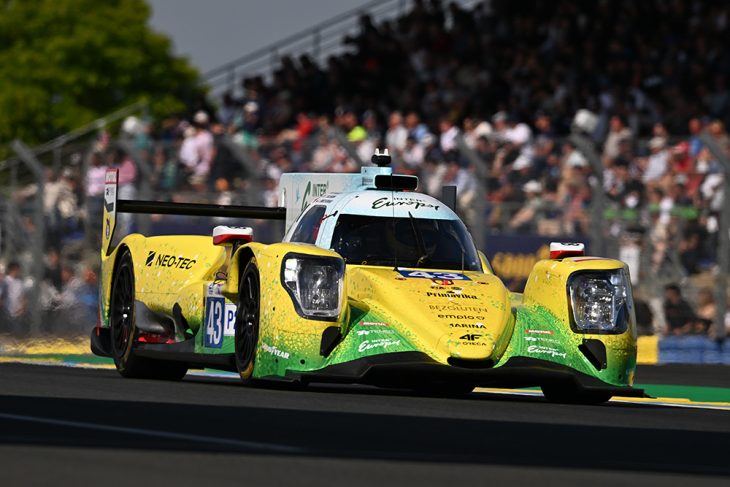

In 2023, behind Ferrari and Toyota’s battle for honours in the centenary edition of the 24 Hours of Le Mans, a stacked LMP2 field saw the start of what may one day be reflected upon as the category’s defining dynasty of the 2020s.
From a 24-car entry filled with drivers and teams destined to progress to the Hypercar ranks, few would have chosen Inter Europol Competition’s #34 ORECA 07 – Gibson, piloted by Jakub Smiechowski, Albert Costa and an injured Fabio Scherer, as the winner of the secondary prototype category, but a near-flawless run some them come out on top in a head-to-head duel with Team WRT.
Three years on, and another victory for the Polish outfit this year would hardly come as a surprise, with them arguably holding the favourites tag after following up 2023 with a runner-up finish in 2024, and another victory in 2025.
12 months ago, Smiechowski, Tom Dillmann and Nick Yelloly triumphed in a race-long duel with Panis Racing, which swung between the pair repeatedly in the closing stages before resolving in Inter Europol’s favour when the TDS Racing-run suffered a mechanical failure.
“It’s one of those wins that will make me happy when I retire,” Dillmann tells DSC. “I now go to Le Mans a bit more relaxed and free, having won it already, but fully focused on another time.
“Last year, I said before the race that we were the favourite. Luckily, it was true, and I still think we are amongst the favourites.”
Dillmann, Smiechowski and Yelloly have all returned to the #43 ORECA together this year, offering them the chance to defend their victory as a unit. This is something which shouldn’t be taken for granted as, outside of the FIA WEC ‘super season’, it’s the first time the defending LMP2 winners have stayed together since 2011.
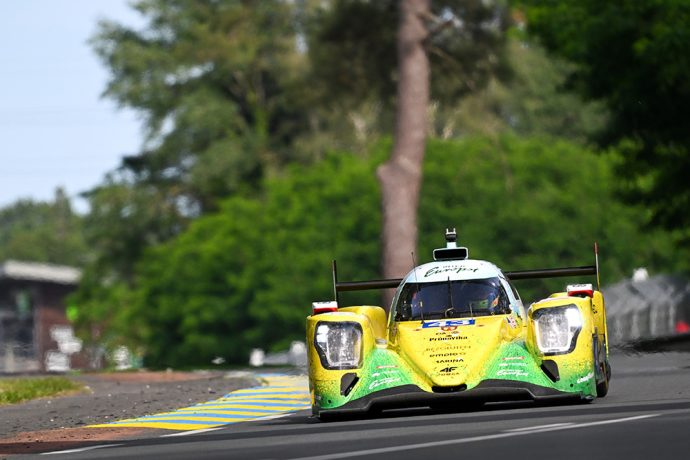
The extent of this advantage is further emphasised with a quick scan down this year’s 19-car LMP2 entry list, with only one other competitor, the #222 United Autosports Pro/Am car, also going unchanged from 2025.
“It’s great that it’s now my third year with the team, and the second year with the same line-up in Europe, which is a huge advantage to be able to keep building up together,” Dillmann says.
“I’m enjoying it a lot, to come to every weekend with a chance to win, because the team is good and I have good teammates.
“Obviously, it worked very well with the three of us, and there was no reason to change really. But other factors can prevent you from continuing together, so we are lucky enough that we are able to continue.
The story of LMP2 in Europe last year was that of the rivalry between Inter Europol and Panis Racing, with the former winning Le Mans, and the latter coming out on top in the European Le Mans Series.
Naturally, Dillmann therefore highlights the TDS Racing-run operation, which will compete under the ‘Forestier Racing by Panis’ banner this year with the line-up of Louis Rousset, Oliver Gray and Esteban Masson, as the most likely team to prevent Inter Europol from making it three Le Mans wins in four years.
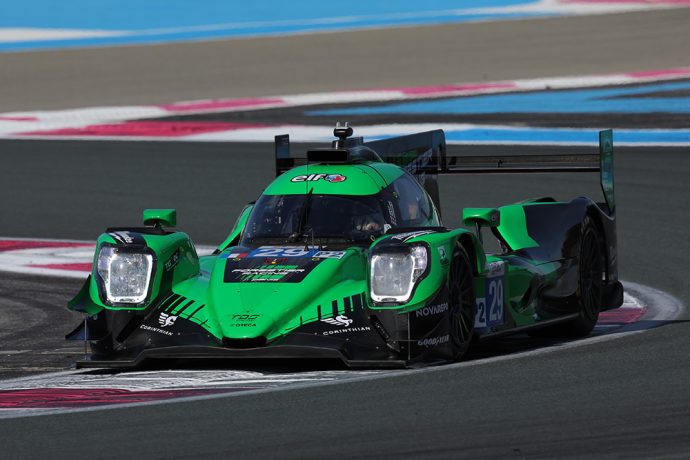
“I think there’s a rivalry, because I think we are the best two teams in LMP2 right now,” the Frenchman says.
“I believe Panis has a stronger line-up than they had last year. We have our strengths, they have their strengths, and quite often the win is between us two, Of course, a lot of teams are working hard and are also very strong, but if you take our last two years, everybody can see that we have been very strong.”
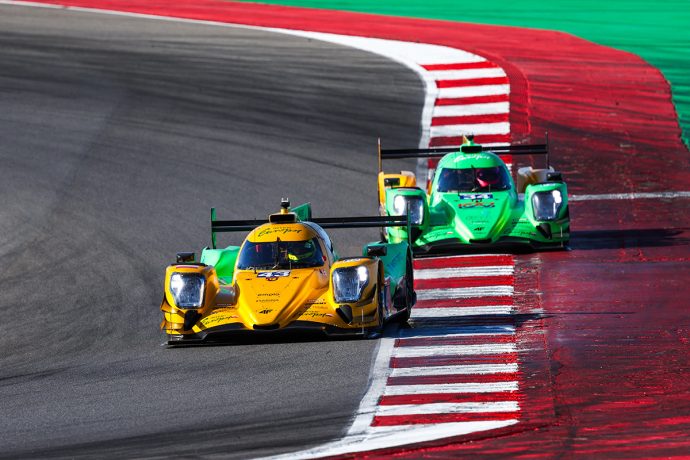
The #43 ORECA is also set to face internal competition this year, with Inter Europol fielding multiple cars in the ‘Pro’ sub-section of LMP2 at Le Mans for the first time.
Reshad De Gerus and 2024 Le Mans winner Bijoy Garg have emerged as the surprise package in the ELMS so far this season, finishing second in both races, and will be joined in the #343 ORECA at Le Mans by Porsche factory driver Nico Müller.
“For sure they are a threat for us,” Dillmann admits. “Because the two cars have good line-ups, and we know the car is good. But it’s also an advantage to work together and be stronger overall as a team. May the best one win.”
And winning, given its past performances, is certainly the goal for Inter Europol at Le Mans 2026, as sporting director Sascha Fassbender highlights:
“I think with the record that we have in Le Mans, with finishing in the last three years two times top of the podium and once second, the aim for this year is quite clear,” he says.
Fassbender has been with Inter Europol since the team made its Le Mans debut back in 2019, and has therefore competed through arguably LMP2’s most-competitive era.
On this front, he credits the ORECA 07, the machine with which Inter Europol has raced in P2 since 2021 having been amongst the final teams to switch over from Ligier JS P217 platform.
“I think that it’s the car that’s made it so interesting,” he states.
“The ORECA 07 is such a nice car to drive that all the drivers that are driving in higher categories and the ORECA 07 say ‘we enjoy this much more than the higher category car’, and this makes it so interesting for high profile drivers to join teams like us, to go into Le Mans.”
The popularity of LMP2 over the past decade has forced everyone in the paddock to raise their game, with Inter Europol evolving to positioning itself as an LMP2 powerhouse capable of making the step into Hypercar should the right opportunity arise.
“The level of the teams that operate the car is now so high,” Fassbender explains. “It’s a high class paddock with highly competitive teams, top drivers and top engineers. I think it’s the highest sports car racing that you can do in Europe.
“When we started in 2019 with the Ligier JS P217, and LMP2, the effort that we did compared to the effort that we’re doing now, it’s I don’t know how many times more than it was in the past.
“We’ve worked very hard to build up our personal standards and to be a benchmark in the paddock. We’ve invested, for example, in hospitality. It looks nice and our guests feel happy.”
The team’s key transition came in the winter of 2022, when Fassbender put in place the foundations from which it has gone on to become a two-time Le Mans winner.
“I changed the structure of the team between 2022 and 2023 and for many people, it was a surprise that we won Le Mans 2023. For me, it wasn’t as I was aware when we went to Le Mans that we would fight for the win,” he explains.

“It was clear we had the drivers, we had the crew. We did the steps and the investment in the engineering and the development of the car.
“I’ve won many 24-hour races in the past, and it’s difficult to describe, but I would say you feel the atmosphere in a workshop before the race, if it will be good or bad. How the workshop looks, if you have a mess because everything is in a rush or everything is well organised, piece by piece by piece.
“If you have this piece by piece by piece, you are well organised, and winning a race starts in the workshop. This special atmosphere, I noticed we had it in ’23, in ’24 we didn’t and we finished second, and last year we had it again.”
The moment to ensure the Polish outfit has an organised workshop ahead of this year’s race has now passed, but whether or not the team has its special atmosphere again, the opposition is well aware that to triumph in LMP2, they’ll have to best Inter Europol Competition first.
Images courtesy of Peter May and David Lord