


Free Practice
The opening 45-minute pratice session began at 14:30 under clearing skies. The circuit was quite dry, following a short but fairly heavy downpour a few hours earlier. The forecast does call for rain most of tomorrow afternoon—making for interesting racing!
Richard Abra worked some Cadabra magic in the opening minutes propelling the Number 1 Aston Martin into Number 1 spot on the times sheets. He was followed, a half-second behind, by Adrian Amstutz in the Stadler Motorsport Porsche 997 GT3 R. Kenneth Heyer was next in the quickest of the several Mercedes. If you are looking for Kenneth, keep a lookout for a tall man wearing the famous feathered Bavarian cap. That’s his proud father Hans, who is rarely seen far from Kenneth’s side and never without the hat. Hans was a very succcessful endurance racer throughout the 1970s and 1980s, and now is coaching his son along on a similar career.

The short length of the practice session meant that nearly all the cars were out on course soon after the start. Only five cars did not record a time, including the SVDP BMW, which had turbo problems. Mark Pilatti also had trouble. His No. 9 Motorsport Services Porcshe came to stop near the pit entrance. This came immediately after he had moved into the top 10 overall. Also stopping on course was one of the legions of Seats. It rejoined, but the Porsche had to be pushed back through the paddock.
Another car to shine was the Number 3 De Lorenzi Mercedes. The team owner, Gian Luca De Lorenzi, vaulted to second overall about halfway through the session. The Aston retained its top spot, improving its speed slightly.

The class leaders include Wolfgang Destree (SP2, No. 12 Porsche), the No. 29 BMW E46 M3 of Tischner Motorsport, best in A5 and a fine 9th overall, the No. 25 Nova Race Ginetta in SP3, Pilatti best in class 997, despite the stop, former overall winner Francesc Gutierrez atop A3T with the No. 39 Seat, and Japanese driver Junichi Umemoto going Beep-Beep in A2 with the Roadrunner Clio. The best in two diesel classes is the No. 61 BMW 320d of MDM Racing, running considerably faster than many petrol cars.
Somewhat dramatically, the session ended with the name “Senna” on top. Actually, Bruno Senna did not set the fast lap in the Aston Martin, but as he was last in the car, his name is frozen on the screen.
Anorak Facts
Here is a bit of trivia about the length of this 24 Hour race. The start is taken along the front straight while the end of the first lap and all subsequent laps is recorded the control tower, located at the start of the front straight. The circuit lap is 4655 meters long. As the start line is 145 meters ahead of the control tower, the first lap is only 4510 meters long. This means that the total race distance = the number of laps completed x 4.655 km. – 0.145 km. Thus, if you are calculating the race speed and other data, this needs to be taken into account.
The formal name of the 24 Hours of Barcelona is the “24 Hores de Barcelona d’Automobilisme Trofeu Fermi Velez.” It is named in honor of the man who was several times Spain’s Sportsman of the Year and is one of the great racing heroes of Catalonia.
The world lost Velez in 2003 when he died at the age of 43. He certainly packed an excellent racing career into that short time. Most of his success came during a ten-year period beginning in 1986. He quickly became one of the most successful sports car drivers of the period. Velez jumped into the deep end of the pool in the first year, driving for John Fitzpatrick’s very strong Porche 956 team. The highlights of the year included a fourth place overall at the Le Mans 24 Hours and then a third at the Nürburgring 1000 Km.

Velez drove for the works Spice team in the Group C2 class of the World Endurance and Sportscar Championship in 1987 and it would be a most memorable year. He was the class victor seven times that year. Together with two second place finishes, it was more than enough to win the C2 driver’s championship, the first world title for a Spanish driver. Victories that year included Le Mans, Monza, Norisring, Spa, and Fuji. However, Fermin was most proud of winning both of the races held on home soil, at Jarama and Jerez.
In 1989 Velez continued driving a Spice prototype, but this time with the Chamberlain Engineering privateer team. Again there were victories, taking the C2 class at four races. However, it was not quite enough for a repeat championship. He did return for a second C2 championship in 1990, driving again for the works Spice team, recording wins at Silverstone, Spa, and Mexico.
Velez came to North America in 1994, joining the Scandia Racing team. They were running the very exciting Ferrari 333SP that was the star of the World Sports Car category. Velez was the overall winniner at five races across a four year period. His prowess at endurance racing was especially noteworthy as he remains one of the few to have won the Sebring 12 Hours more than once, scoring victories in both 1995 and 1997 with the Ferrari. Shorty after that he was diagnosed with cancer and lost the battle against it a few years later. All of us in sports car and endurance racing still miss him and are happy to honor him, having the race named for the wonderful Fermin Velez.
#16, Guttroff Motorsport, Chevrolet Corvette. Sadly this team will not take part in the race. Team owner Tobias Guttroff crashed the car late during the Thursday test session and it cannot be repaired.

#52, Sola Sport, Renault Clio Cup. This team has two drivers who are major players in the automotive world. Jean-Louis Dauger is the organizer of the WTCC series while Carlos Antunes Tavares is the #2 man at Nissan / Renault behind Carlos Ghosn.
#22, Cor Euser Racing, Lotus Evora. Team onwer Cor Euser completed only two installation laps during the test Thursday before the power steering support backet broke. It caused some secondary damage and after a long night of work the team hopes that the car will be ok. The team’s youngest driver, Matt DiLeo of Canada, is a regular competitor in the U.S.-based Indy Lights Series.

#46, Besaplast Racing Team, Mini Cooper S. This team has a long history of endurance racing although this particular car is of relatively new vintage. It was built following an accident with an earlier Mini. After running at Dubai earlier this season, the new chassis will make its Barcelona debut. Among the drivers are Thomas Tekaat, currently leading the German Mini Trophy championship and Henry Littig, the top Gentleman driver in the same series. Sweden’s Fredrik Lestrup is coming off a year of driving in the German GT Masters GT3 series. He will soon test a Holden in the Australian V8 Supercar series and hopes to do a season Down Under in 2014.
Along with the other turbocharged petrol cars, the Minis are concerned about turbo temperatures during pit stops. The RACC rules require all cars to shut down during refuelling and the turbos can easily get hot enough not to be able to re-fire. To avoid this, Besaplast has installed a unique extra water pump that feeds the intercooler. It is switched on by the driver a lap or two before the scheduled stop. Although he still has to cut the engine revs a bit, it is hoped that this will avoid the turbo problems that are chronic to the blown petrol engines. Diesel engines typically run cooler and don’t have these problems. However, it was this concern that caused Audi to ask Besaplast not to enter their TTRS, which otherwise could run with the GT3 cars.
There are several Renault Clio Cup cars in the race but a close look will reveal differences between two of the German entries and the others. The two in question are the #51 Roadrunner Racing entry and the #48 Gloyna Motorsport car. They are both built to VLN (German endurance series) specifications. The differences are mostly in the suspension area as the Nordschleife’s circuits many ups and downs have their own demands on the cars. The teams have elected to keep the basic VLN setup here, although of course the Catalonia track is much flatter.
#41, Monlau Competicion, Seat Leon Supercopa Mk 2. Driver Jose Manuel Alonso Prieto usually just uses his nickname, “Pepus.” But he still gets a laugh from having been known as Senor Alonso at the Hungaroing 12 Hours. He finished on the podium there and all the Hungarian fans simply assumed with the surname Alonso, he must be a certain famous World Champion F1 driver. Jose doesn’t mind the mistake. The Monlau team was one of the few to participate in the first test day, a week ago. They ran the #40 Seat, but tested with the drivers who will now race in #41.
#62, Cor Euser Racing, BMW 120d. There are probably some younger drivers who take a look at Jim Briody and think, “I can outdrive this ‘old man’.”—think twice young ones, this is perhaps the most experienced driver ever at the 24 Hour length. This will be Jim’s 70th 24-hour race. Beginning with the early 1980s he has regularly competed in two or three, sometimes three or four 24-hour races per year. He has recorded 21 first place finishes in class and has been on the podium in more than half his starts—37 in total. It is a remarkable record to which he adds every year. Jim’s style has been always been to stay steady and strike only if and when needed.
There are two past winners of the Barcelona 24 Hours in the field this weekend. Francesc Gutierrez won overall in 1998 and again a decade later in 2008, in addition to three other podium finishes. He is now driving the No. 39 Seat.
Phil Quaife is a defending champion, but will have a tough time repeating the overall win as he is now in the No. 42 A3T class Seat.

Two others have finished on the lower rungs of the overall podium before. Ivo Breukers was third last year and is now in the No. 3 Mercedes-Benz. Jose Manuel Perez-Aicart was second in 2008 and third in 2007. For 2013 he is with the class pole starting No. 40 Seat.
Qualifying
The Barcelona 24 Hours features one single qualifying session of 120 minutes in length. It started a mere 30 minutes after the end of free practice, leaving quite a few teams scampering to complete their adjustments before having to go back out.
Some teams were very calm about it all, case in point the Gloyna Motorsport Clio (No. 48). They simply skipped the free period, relying on the settings done yesterday in testing, and then headed straight into qualiyfing. Others missed practice with problems. The No. 30 MMC BMW M3 [enough “M”s there?] found the seat adjusting itself and took an hour to repair the runners.

Dominik Baumann was the first driver to complete a flying lap during qualifying. His 1:57.910 in the no. 7 Stadler Motorsport Porshe did not remain quickest for very long. Gian Luca De Lorenzi’s second lap was good enough for second and then became the fastest two laps later, at 1:51.669. Baumann improved to 1:53.873, but now Richard Abra was in second spot with the No. 1 Aston Martin.

Others going well at the start were Matteo Cressoni, No. 25 Nova Race Ginetta. His 1:59.116 was good enough for 4th overall and best in SP3. He was fighting for this spot with the quickest 997 class car, the No. 12 Destree Racing entry of Robin Chrzarnowski.
Chances for much of an improvement were dashed with a heavy shower that began at the 10 minute mark. It only lasted about 15 minutes but left the circuit quite slippery. Most teams stopped for grooved tires, or to simply sit out the wet stuff.
Cressoni improved a bit to 1:58.926, just before the rain began, still leading the SP3 class. The 997 lead was taken over by the No. 10 Ruffier Racing Porsche. Second in class was Michel Mitieus in the LD Racing 997. Donald Molenar was one of the last to sneak in a fast one before the rain, parking at 1:57.777 in the No. 34 Top Autoteile BMW, best in A5.
The A3T leader in the early going was Jose Manuel Perez-Aicart in the Monlau Competicion Seat (No. 40), the first car not to crack the two-minute barrier. Down in 25th overall came the best of the diesels, the No. 56 Saxon Motorsport 135d. Their 2:08.069 was clear of a heated battle between the top cars in the smallest petrol class, A2. It was led by Martin Byford in the No. 55 Synchro Motorsport Honda Civic, just clear of Boris Hrubesch (No. 51 Roadrunner Clio) and the No. 50 Black Motorsport Renault.
The smaller diesel class, D1, was in the hands of Daniel Schilliger’s TTC Racing Volkswagen Golf, just ahead of Christian Dijkhof in the Red Camel Seat (No. 59). The last of the class leaders is Thierry Pellerzi, heading up A4 with the No. 36 LD Racing BMW 130i Cup. Behind him was the No. 35 Hofor Racing BMW E36 M3.
At about the one hour mark the track was drying enough that some limited improvement was seen. The quicker laps tended to come from the back. That is, some of the cars that were slow at the start moved up the chart a bit. It began in the A4 class with the Hofor BMW improving with Bernd Küpper behind the wheel, but still remaining second in class.
Rather than taking too many chances under these conditions, most teams are cycling through their driving rosters, making sure all have a turn at the wheel. Apart from the few changes at the far end of the field there were no changes whatsoever in the rest of the grid for the middle portion of the session.

From the standpoint of the marques, there were three different brands occupying the top three spots, Mercedes over Aston over Porsche. The top BMW was in seventh overall, and first in A5. Perhaps the biggest surprise was a Ginetta in eighth overall. The V-6 Ford powered low volume GT was doing well indeed. Just outside of the top ten was the lone Lotus in the race. Another pleasant surprise was the 12th overall Seat, the best start in several years for the locally built car. The only Audi in the race, the Creventic built R8, was a fast 15th overall. The top Volkswagen was 17th overall, the German marque represented by the No. 45 Scirocco of Spanish team, Drivex School.

The No. 18 GC built BMW Silhouette (complete with rear-engine Chevrolet V-8s!) was the next marque represented at 22nd overall. The top Honda cames in at 22nd, the A2 class leading Synchro entry. It was a spot or two ahead of the best Renault. Two other marques had not really featured up to that point. The lone Ferrari, an older F430, had completed vey few laps, as had the two Minis.
Suddenly, with but a bare five minutes to go, and the track now bare of water, about a dozen teams turned up the wick and cranked out their quickest laps of the night. Here were the key ones:
No. 23, Red Camel, Audi R8, Giuseppe Ciro at 1:58.490 jumped to the SP3 leadand 7th overall.
No. 17, Russia’s Lev Fridman at 1:58.989, has put the GC into second in SP2.
No. 9, Mark Pilatti, 1:59.271, good for third in the 997 class with the Motorsport Services entry, improved on the next lap to 1:58.144 for tops in the class.
No. 29, the Tischner BMW improved to 2:02.233 and second in A5, then to 2:01.152.
No. 33, another improvement in the A5 class came from Kevin Clarke in the Intersport Racing M3CSL at 2:04.490

Best of the small all Porsche 996 class is now Jesus Diez-Villaroel with a 2:04.251 in the No. 15 Speedlover entry—later to 2:02.456.
Mark Bus turned a quick lap in the No. 63 BMW, best in D1.
Thomas Tekaat’s 2:05.604 was not only the best in A2, but saved the day for the fans of Minis everywhere—the two cars of the marque having languished until then.
Aaron Harris moved the other Motorsport Services entry up the list, his 2:07.500 placing the No. 43 Seat 33rd overall.
Paul Posthumus recorded a 2:07.958 at the death of the session in the No. 37 Ymor Seat.
The Duel Racing Seat of James Kaye, No. 42, quickened to 2:02.703.
A Renault that went fast at the end with the No. 40 Team Sally entry of Martin Sally Pedersen at 2:10.836.
So does that cover all the improvements? Not at all!
Just when the De Lorenzi team was about ready to celebrate the pole spot, along came one of the great pro drivers here this weekend. Stefan Mücke took the Barwell Motorsport Aston Martin turned in a blistering flying lap, leaving the pole time for the 2013 Barcelona 24 Hours at 1:50.646.
The No. 46 Besaplast Racing Mini spent all of free practice in the pits. At the beginning of the session they discovered a massive build up of water pressure and leakage into the cylinders. They had no choice but to change the motor. This work lasted until deep into the qualifying period. With 10 minutes to go Thomas Tekaat took the car out, with some of the less important connections still not being made under the bonnet and in the cockpit. He had enough time for six laps and on the last one, crossing the line for the last time seconds before the checkered flag. With nearly all the other cars already pulled into the pits, Tekaat set the pole time in A2—now that’s the spirit!
Here are the other fast drivers:
A6 & Overall, Stefan Mücke
SP2; Robin Chrzarnowski
A5; Donald Molenaar
997; Mark Pilatti
SP3; Giuseppe Ciro
A3T; Jose Manuel Perez-Aicart
996; Jesus Diez Villaroel
D1; Mark Bus
A2; Thomas Tekaat
D2; Nick Barrow
A4; Bernd Küpper
Note that at the Steward’s discretion, the A4 and 996 class cars may yet be distributed into the other classes.
Two hours of night practice closed out the day. It was used primarily as an opportunity (and requirement) to cycle through all the drivers. The positions at the top were mostly like that of earlier, with the Aston Martin on top. The No. 7 Stadler Porsche was second, displacing the GDL Racing Mercedes to third. Few teams seemed to be taking the lappery that seriously. There were a few minor offs, which the crews, including the safety car operators, an opportunity to practice their procedures. Four cars did not complete any laps—we will check on those in the morning.
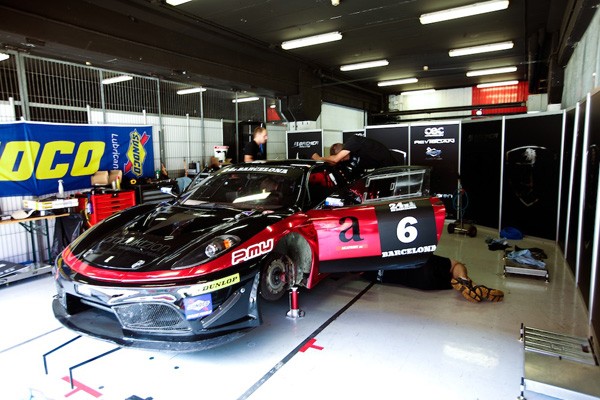
The grid presents a bit of a lottery. There has been little real dry time during which a serious approach was made to fast times. It is clear that the major players are Mercedes, Porsche, and the lone but very well-prepared and driven Aston Martin. There are enough variables among all the A6 teams not to be able to pick clear favorites. About all we can do is to discount the Ferrari, which has not featured at all. Gambling can be fun, place your bets now—make up your own odds—Las Vegas comes to the Mediterranean—stay tuned.
Janos Wimpffen
With thanks to Creventic website for report photographs


