

Paul Truswell looks back at the data from the most recent round of the FIA WEC, and suggests that the next round might be even closer!
One of the things that I like about endurance racing is the fact that you can look at the gaps between cars and examine their lap times, pit stop schedules, and then use that information to work out what might be going to happen in the remainder of the race. Typically, this allows you to predict how the race will pan out, and even predict a winner.
What I liked about the race at the Circuit of the Americas (a title that I still find difficult to use… I’ll get used to it, though), was the fact that it was not possible to predict how the battle for the lead was going to pan out.
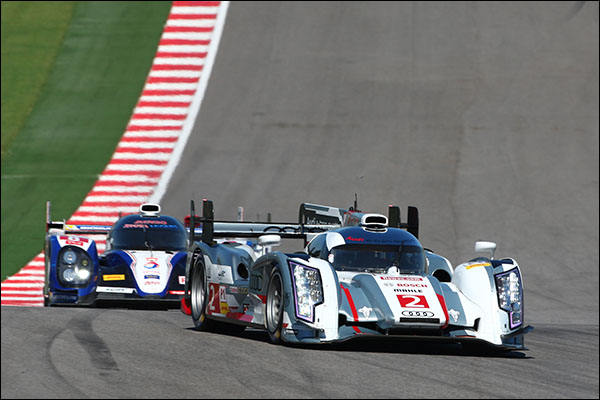
In the second half of the race, it became clear that the no. 2 Audi had the upper hand, but earlier in the race, that was not quite so obvious. And although I wasn’t able to make the trip to Austin, Texas, I was there in spirit, and (thanks to the ever-helpful folk at AlKamel Systems, who provide the official timekeeping data) was able to analyse the race in some detail.
It boiled down, of course, to a race between the no. 2 Audi, driven by Loïc Duval, Allan McNish and Tom Kristensen and the no. 8 Toyota, in the hands of Sebastien Buemi, Stéphane Sarrazin and Anthony Davidson. The story of the 2013 season has been that, generally, Audi has a faster car than Toyota, but that it has to refuel more often. This has enabled Audi to win every race of this year’s World Endurance Championship so far, but with the Toyota being able to double-stint its tyres, the race was finely balanced indeed last weekend in Texas.
In the following two tables are the average lap times achieved by each driver in each car for each stint of the race. For the purposes of this table, the average lap time is the time taken from leaving the pits on the out lap until returning to the pits on the in lap, divided by the number of laps completed in the stint.
First, for the no. 2 Audi e-tron quattro:
|
Stint
|
No. of laps
|
Driver
|
Average lap time
|
|
1
|
25
|
Duval
|
2m 05.831s
|
|
2
|
24
|
McNish
|
1m 50.628s
|
|
3
|
24
|
Kristensen
|
1m 51.747s
|
|
4
|
24
|
Duval
|
1m 50.119s
|
|
5
|
24
|
Duval
|
1m 49.977s
|
|
6
|
24
|
Kristensen
|
1m 50.181s
|
|
7
|
24
|
McNish
|
1m 49.883s
|
|
8
|
18
|
McNish
|
1m 53.118s
|
[sws_divider_small_padding]Second for the no. 8 Toyota TS030:
|
Stint
|
No. of laps
|
Driver
|
Average lap time
|
|
1
|
27
|
Buemi
|
2m 05.499s
|
|
2
|
25
|
Buemi
|
1m 51.242s
|
|
3
|
25
|
Sarrazin
|
1m 51.697s
|
|
4
|
25
|
Sarrazin
|
1m 51.393s
|
|
5
|
26
|
Davidson
|
1m 51.446s
|
|
6
|
25
|
Buemi
|
1m 50.123s
|
|
7
|
19
|
Buemi
|
1m 50.507s
|
|
8
|
15
|
Sarrazin
|
1m 53.306s
|
[sws_divider_small_padding]Obviously, the first stint is slower, as four laps were spent behind the safety car, and since Buemi completed more laps in his stint before coming into the pits, his average lap time is marginally quicker than that of Duval.
In the second stint, McNish was clearly quicker than Buemi (on the second stint for his tyres), but then Sarrazin (on new tyres) actually reduced the gap to Kristensen.
Loïc Duval, in the fourth and fifth stints, was then significantly quicker than either Sarrazin (used tyres) or Davidson (new tyres), even though the Englishman was able to get an extra lap from the Toyota.
By the sixth stint of the race, Kristensen was 50s ahead of Buemi, but again the average lap time of the Toyota was quicker than the Audi, a matter that was quickly resolved once McNish was back in the car, to seal Audi’s victory.
As can be seen, therefore, although there may be good explanations for it, there were phases during the race when the Audi was clearly not quicker than the Toyota.
The real advantage that Toyota had, though, was time in the pits. Here is the time spent in the pit lane (between the pit lane entrance and the pit lane exit), for each car.
Audi no. 2:
|
Stop
|
Details
|
Time in Pit Lane
|
|
1
|
Duval to McNish. Fuel & tyres
|
1m 23.051s
|
|
2
|
McNish to Kristensen. Fuel & tyres
|
1m 21.232s
|
|
3
|
Kristensen to Duval. Fuel & tyres
|
1m 20.265s
|
|
4
|
Duval stays in car. Fuel & tyres
|
1m 19.614s
|
|
5
|
Duval to Kristensen. Fuel & tyres
|
1m 21.664s
|
|
6
|
Kristensen to McNish. Fuel & tyres
|
1m 21.074s
|
|
7
|
McNish stays in car. Fuel only
|
1m 01.711s
|
|
Total
|
9m 08.611s
|
[sws_divider_small_padding]Toyota no. 8:
|
Stop
|
Details
|
Time in Pit Lane
|
|
1
|
Buemi stays in car. Fuel only
|
54.674s
|
|
2
|
Buemi to Sarrazin. Fuel & tyres
|
1m 19.577s
|
|
3
|
Sarrazin stays in car. Fuel only
|
52.636s
|
|
4
|
Sarrazin to Davidson. Fuel & tyres
|
1m 22.240s
|
|
5
|
Davidson to Buemi. Fuel & tyres
|
1m 20.383s
|
|
6
|
Buemi stays in car. Fuel only
|
53.812s
|
|
7
|
Buemi to Sarrazin. Fuel only
|
54.927s
|
|
Total
|
7m 38.249s
|
[sws_divider_small_padding]Notice that the Audi was slower on its only ‘fuel only’ pit stop than Toyota was, and also that the fastest full service (fuel, tyres, driver change) was also done by the Japanese marque.
It is difficult to compare fuel consumption between Audi and Toyota, since the Audi uses diesel and the Toyota petrol, but considering that the Audi has a 58 litre tank and the Toyota 76 litres, one can compare the amount of fuel used in terms of number of tankfuls over the course of the race. In this aspect, the Toyota demonstrates greater efficiency as well, using only 5.84 tankfuls of fuel during the race, compared to the Audi’s 6.40. Interestingly, this suggests that Toyota could have gone two laps longer on every stint, and that would have enabled them to have avoided their final pitstop altogether.

All of this means that Toyota had the wherewithal to have won this race – the lap times were fast enough, the pitstops were quick enough, and the fuel consumption was good enough to beat Audi. I don’t know what will happen in Fuji next month, but I wouldn’t bet against Toyota on home ground.
Paul Truswell


