The Australian GT championship presented by Pirelli gets underway this weekend at Sandown Park with two, one-hour, races.
This year the championship will see six rounds starting at Sandown Park with two sprint races, then onto Phillip Island, Townsville street course, Sydney Motorsports Park, back to Sandown, and ending in November at Highlands Motorsport Park in New Zealand.

The series will see three 101-lap races at Phillip Island, Sydney and Highlands Park. The remaining race weekends will be sprint races.
Each race will have compulsory pitstops with pitstop time being dependant on qualifying position and driver seeding – the better you are, the longer you spend in the pits.
Like last year, Pirelli will be the control tyre supplier. There were rumours that Michelin could re-enter the series, however that has not happened and Pirelli will remain as both title supplier and control supplier for the series.
The series largely follows the Blancpain rules enabling cars to be bought over from Europe in predominantly GT3 and GT4 spec. Porsche Cup cars are also eligible. The series is split into four categories – ‘Championship’ for new spec GT3, ‘Trophy’ for older spec GT3s, ‘Challenge’ for Cup Cars and Ferrari Challenge vehicles and ‘Sports’ for GT4 machines.
The championship class is undoubtedly the strongest and will be contested primarily by twice defending champion Klark Quinn, Tony Quinn, Richard Muscat, Peter Edwards and John Bowe.
It is anticipated that the championship will come down to Klark Quinn, who will be racing the McLaren MP4/12C for the first time in the Australian GT Championship. Gone is the Porsche that he has won the last two championships with, instead preferring the McLaren that proved so fast at the recent Bathurst 12 Hours. The Quinns have put a lot of effort into the McLaren to improve its reliability and pace ahead of the season.

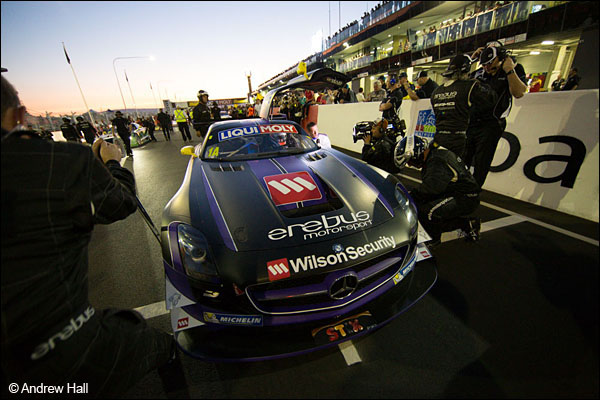
Undoubtedly, Klark’s greatest competition will come from Muscat and Erebus Racing squad with their very well turned out Mercedes SLS GT3. Erebus won the Bathurst 12 hours last year and only competed in a part-championship, winning most of the races they entered. They almost won the championship in 2012 with Peter Hackett, but a last-race spin let Klark take the title. Erebus did not take that championship loss well and will certainly be aiming for the championship in 2014.
Maranello Motorsport are also back with the Ferrari 458 GT3 for Bowe and Edwards. They are, though, the only main team running a gentleman driver and will have to be relying on pitstop time in order to challenge for the title. The team famously won this year’s Bathurst 12 hours in a very tight race with HTP Motorsport Mercedes. While Bowe is very quick and Edwards is coming on nicely, it will be difficult to see them win the championship. The team will also be adding a second car mid-season.

The other championship contender is Tony Quinn. The owner of the series has developed a lot in the past year, taking out race wins for the first time. Whether he will have the consistency to challenge for the overall title remains to be seen, but his Aston Martin is quick and cannot be discounted.
The other challenges in the Championship class include Trofeo Motorsport, who are upgrading their ageing Corvette which will be battling in the midfield. They’ll start the season in a Ferrari until their car becomes competitive.
James Koundouris will be joined by Steve Owen in a Porsche GT3-R. This duo is massively experienced and is returning to the series from the Carrera Cup. Additionally, Justin McMillan is stepping up from the Trophy class and will have Steve Richards beside him in his Lamborghini Gallardo. Like Maranello, it will be difficult to see this car challenging for victories unless the pitstop cycle goes their way.
For the Trophy class, we’ll see tight battles throughout the year, but the driving standards are usually not as consistent and we’ll see more single-round entries through the year.
At Sandown we see the return of Ben Eggleston in his Aston Martin DBRS9. The development series driver will be quick in this class and time will tell whether he will choose to put in a championship run.
Equally, Rod Salmon in his Audi R8 LMS will most likely only spend half the season in the Trophy class. Salmon wants to compete in the outright class, but his main car was heavily damaged during qualifying at Bathurst and as such he is in the Trophy class. As a result he has also lost his very talented co-driver, Liam Talbot, which will no doubt be a blow to the team.
There are a variety of cars that will be able to challenge for the Trophy class championship. With brother James in the right category, Theo Koundouris will be battling in the Trophy class with his 997 Cup S. Michael Hovey will also be competing in a Porsche.
There will be joined by Dean Koutsoumidis in an Audi R8 LMS, which had a strong run at the Bathurst 12 Hours. Equally, Jan Jinadasa started to gain some momentum at the end of last year with class victories. Jinadasa will be in a Lamborghini.
The trophy class will also see a Mosler MT900GT for Dale Paterson and Graham Lusty, and an Ascari KZR-1 for historic runner Keith Kassulke, though it would be fair to say these won’t be in contention for the title.
It will be difficult to pick a winner for the Trophy class with so many gentlemen drivers in differing marques and it will be down to who is most consistent over the season. It may also come down to who selects the fastest non-seeded driver to join them in the distance races. Young guys like Jonathan Venter will be in demand as the season goes on to help their co-drivers with a championship effort.
The Sport category has been dominated by Ginettas in the past. That is unlikely to change this year as the only two entries at the moment are Tony Martin and Mark Griffiths, both with Ginetta G50 GT4s.
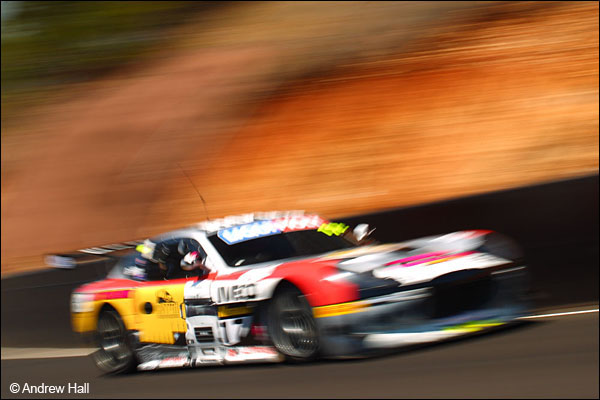
Finally, the Challenge category – a tightly-run championship as Australia boasts a large array of old Cup cars.
George and Ben Foessel will be going up against Brendan Cook and Matt Kingsley. Indiran Padayachee is also competing in the class and all are in 996 or 997 Porsche Cup cars. Again, we will see many one-off drives from other entrants, but these three entries should be around for most of the season and are likely to produce some excellent racing.
In this category, both Ben Foessel and Matt Kingsley are enormously underrated and should both be in contention for that title.
It is expected that additional colours will come and go throughout the year, with the championship taking a new pass with additional endurance races; and oftentimes interest and drivers from other categories, including the V8 Supercars, will provide high-class fields.
This is probably the final year that the championship will be able to be more than anything other than fully-professional. Since Tony Quinn took over the championship, there’s been much expectation that arguably the championship has not been consistently advancing itself as a professional championship for both gentlemen drivers and professionals alike.
There is a lot of expectation for this series and the longer races and the return of Erebus Racing is going a long way in boosting the expectations for the year. There has, however been some discontent with some of the choices of the series, but it now has a strong team base and is gaining strength and credibility amongst teams and drivers in Australian motorsport.
Sam Tickell