Yesterday was a big day for McLaren Automotive, launching the 570S GT4 at Snetterton during the British GT Media Day, as part of the company’s expansion in motorsport activities.
The new car – which won’t be in customer’s hands until September, is set to race throughout 2016 in the British GT Championship with McLaren customer team Ecurie Ecosse, as the company continues to develop and manufacture new chassis for customers.
DSC spoke to McLaren GT managing director Andrew Kirkaldy and McLaren GT’s chief engineer Ian Morgan at length about the new GT4 project:
GT4 as a class continues to be on the rise. This year’s British GT grid features fewer GT3s than GT4s this time around, as more teams continue to utilise its cost-effective and developmental model to go racing.
For McLaren GT and Automotive, turning the new 570 road car into a GT4-spec car seemed like a natural evolution.

“It was always hoped from McLaren GT’s side that a GT4 could be possible from the 570,” Kirkaldy said in conversation with DSC. “Our road car range, like the 650 and P1 are all way too high of a level for GT4, whereas the 570 looked like it was more in the range.
“When we discussed with McLaren Automotive about making it a GT4 car, it seemed like the right thing to do.”
It came at the right time, as being present in GT4 – which now includes the likes of Aston Martin, KTM, Ginetta, Lotus and Porsche – is becoming increasingly important for brands associated with GT racing.
“The thing is it that British GT, two or three years ago, had only a few GT4 cars and now it’s more than half the grid,” he continued. “I think that’s indicative of what’s going to happen. I think if you look at general trends in motor racing over the years, classes come out, they are very cost conscious but get more expensive.
“GT3 is more expensive, GT3’s becoming expensive, while GT4 is a much cheaper route to go racing. The 570 is less than half the price of a GT3 car at the moment.
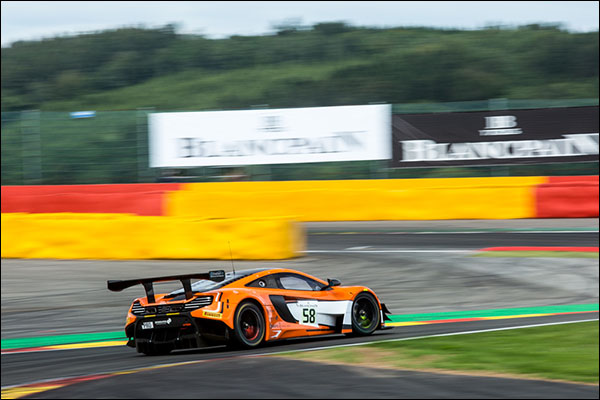
“I think it is important that we want to have the McLaren brand out there and certainly if there’s a vehicle to do it.”
It’s a testament to McLaren Automotive’s continued commitment to expanding its road car range that’s made it possible. As what’s been produced – in an astonishing timeframe of around six months – is a GT4 challenger which looks like it’ll be capable of winning races early on in its life cycle.
The 570S GT4 will be manufactured on the production line at McLaren Automotive with the 570 road car. Because GT4 cars by nature are closer to their road-going version than GT3, and because McLaren hope to produce the car in relatively large numbers, it makes sense.
“There’s two ways to do it,” Morgan explained. “The GT3 route which is what we’ve done with the 650 and MP4-12c at McLaren GT from chassis up, and we can do that because the change of components is so big that it’s the only practical way to do it.

“But with a GT4 car if you did that you’d be limited because there are lots of components straight off the line. To build the cars at the volume we need to, means that it makes sense to do it in the road car environment.
“We hope to be able to build and finish them at a rate of one a day at some stage, and to be building decent size batches.”
The 3.8-litre twin turbo V8 M838TE engine, MonoCell II carbon fibre monocoque, as well as plenty of other small parts are identical to the road car.
“The engine is exactly the same as the road car, but we have to take power out for GT4,” said Kirkaldy. “But you can understand it in BoP world when you look at the level of GT4 cars you’re trying to balance.

“In terms of the monocoque, we’re using MonoCell II, and there’s a lot of advantages in chassis stiffness and I think for a safety perspective it’s a massive plus.
“We’re in the fifth year of McLaren GT, if you count the development year of racing, and we’ve only ever changed one tub. So we know with the 570, that it’s going to be very durable and stiff.”
The key difference with the road and race version therefore comes in the form of the aerodynamics. And the 570S GT4 certainly maximises the category’s capabilities in that aspect.
“The aero on this car is purely done on the rules of GT4, which is that there’s a set 300 mil cord-length rear wing, which is what we have,” explains Kirkaldy. “It has to be within then confines of the car, which is why it’s curved.
“It also has to be a set height from the rear deck of the car. Everything about that rear wing is defined by regulation, it’s the same with the front splitter, which is 80mm protruding from the plan view of the car. The splitter size is defined by GT4 regulations.”

“You don’t know the work other manufacturers put into CFD and aero,” adds Morgan. “But we’ve taken it seriously, we’ve got our own CFD cluster that runs night and day. We believe that when it hits the track it should be right.
“You shouldn’t be building a car and then spending months and months changing components, you can’t afford to do it these days.”
McLaren GT and Automotive clearly feel that in order for the new car to be a success, it has to be versatile too. Not only does it have to have multiple places it can run, but it also has to be easy to drive; attracting pro drivers and track-day enthusiasts alike to spend just over £150,000 on one.
The way McLaren has done that, is by offering two interchangeable versions of the car: 570S GT4 and 570S Sprint.
The GT4 spec car is obviously beholden to regulations, where as the Sprint version will be more powerful, and aimed at track-day goers.
“I think the appeal is that this is a GT4 car and a Sprint car,” said Kirkaldy. “So it’s not just aimed at GT4 racing, I would imagine that we will sell more cars in the Sprint spec than we will in GT4 because people will have a road car and want to take it on a race track.
“We’ve sold a lot of 650 Sprint cars (below), but the value of them is above £200,000, so the level is quite high. This is mid-150s, it would be crazy to say it’s cheap, but for a lot more people that’s achievable, and for a track variant, that’s an acceptable level of spend. 200 plus is quite a lot of money.

“The Sprint car will have more downforce, a bigger rear wing that’s higher. It’ll be more like a GT3-sized rear wing, and will have a bit more power. In GT4, the power level will be defined by BoP so where the GT4 is quite constrained in what it has, the Sprint variant will be a slightly different car.”
Whichever one you buy though, will be convertible to the other specification with ease.
“It’s only a few bolt-on components really, it’s made much easier for us because we are starting from the basis of a very high quality road car product in the first place,” Morgan explained. “The idea was that when I did the original technical spec for the car, that I had a matrix that showed me what a base GT4, base Sprint car is. I then looked at the difference in components with optional bits on it.
“We then try and make it cost-effective, we’re conscious that customers will buy a car to do their own track days and when they decide to race it, it won’t take long to change the car.”
McLaren are also considering one-make series using the car for customers to run in, though nothing is confirmed yet, and it certainly isn’t in the immediate future of the car’s projected four to five-year life cycle.
The Sprint version of the 570S is set to be fully announced in the coming weeks. Meanwhile, McLaren GT will continue to remain firmly focused on the British GT and development programme for the GT4 car.

There will be two chassis running before the car gets fully signed off in the summer, one for Ecurie Ecosse to race, and one for McLaren GT to test.
The development car will rack up over 10,000 kilometres on track before customers can get their hands on one. It’s unlikely to race outside the nine-round British GT programme before September, because McLaren feel that it’s more beneficial to put it through a rigorous process which will take place alongside further testing of the 650S GT3 car.
To put things into perspective, the car will run at Rockingham, Monza, Dunsfold and Silverstone before April 3rd alone. All this running will ensure that the car is ready to be handed to buyers, without a risk of disappointment.
“I think the 570 will be a real success, I’ve already had multiple calls this morning since the launch from people trying to buy them,” Kirkaldy said in summary. “Because we’ve learnt a lot with the 650, and a lot about gentleman drivers and young drivers. We needed to make a car that’s nice and easy to drive, making it a vehicle that someone can just jump into, not too much trouble getting used to.

“We had Rob (Bell) jump into the car just this morning, and he felt immediately at home.”
“We feel that we are starting in a good place with the base car,” concluded Morgan. “I have no doubt we’ll have a competitive car from day one.”
Stephen Kilbey