In the Autobacs Super GT Series, many drivers have come from around the world to race in Japan, and have left a permanent imprint in the series’ history. There’s Ronnie Quintarelli, the Italian with more GT500 Championships than any other driver. There’s the newly-crowned GT300 Champion, João Paulo de Oliveira of Brazil. There’s the last “golden generation” of Benoît Tréluyer, André Lotterer, and Loïc Duval who all became GT500 Champions before combining to win the 24 Hours of Le Mans seven times overall with Audi. And more recently, there’s the super-talented Kiwi Nick Cassidy, the Franco-Argentine phenom Sacha Fenestraz, and the Welsh trailblazer Jann Mardenborough, who’ve all made significant contributions to the series.
In amongst this group of imported drivers, Melbourne, Australia native Jake Parsons is less of a household name in Japan – at least, for the moment. Parsons, who turns 26 in just a couple of weeks, caught up with me a few weeks ago on the eve of the last round of the 2020 Super GT season at Fuji Speedway, where he first explained how racing in Japan has been a goal of his ever since he made his way up the ladder from Australia as a teenager.
“The goal for me to be racing in Japan kind of started in 2014,” says Parsons, who became champion of the AsiaCup Series in Malaysia in 2014, and eventually stepped up to the Formula Masters China Series during the year with AsiaCup organisers Meritus GP. “It was my first time racing outside of Australia, and I got to experience what it was like first-hand racing in Asia.”
“Also, I’d been off to high school to a trip over to Japan, and I saw the Tokyo Auto Salon for the first time, and really got to see like, the racing culture in Japan. And I’d never really heard about it or experienced it before that. So from that point, it kind of opened my eyes to what’s happening out here. Prior to that, the goal was always to go and race in the United States and head towards IndyCar.”
“But I guess, over the course of that year, my goal kind of shifted and I wanted to end up in Japan. So it took a couple of years after that point. Since 2014, and up until 2016, I’d made some contacts in Japan and didn’t really have, like, an ideal sort of team or series to join. So it just made more sense to keep heading towards America. But then in 2017, the opportunity came up to race in Super GT, so it was just like the right time to make the move and yeah, I definitely haven’t regretted it! It’s been my favourite spot to race.”

“It was definitely like a bit of an eye-opener to be racing in Japan. Like in Super GT, I’d just been blown away by the number of fans that are there, and the fact that it’s on TV and everything, it was a bit of an eye-opener.”
Parsons did end up racing in the US as he originally set out to do, competing in what is now the Indy Pro 2000 Series on the IndyCar Road to Indy ladder system. He drove for respected team director Ricardo Juncos, as a teammate to fellow sports car standouts of the future like Will Owen and Garrett Grist, and as a successor to Juncos Racing alumni such as Spencer Pigot, Conor Daly, Gustavo Menezes, and Tatiana Calderón, just to name a few.
And when Parsons made the jump across the Pacific to race in Super GT in 2017, he joined another very respected team: Team Taisan, who were part of Super GT’s history for the first quarter of a century, from the early years of their Porsche 911 GT2s and Ferrari F40s winning races in the formative years GT500, to subsequent championship successes in GT300 between 1996 and 2012. It meant driving for another respected team boss, Yasutsune Chiba, who’d overseen all of Team Taisan’s success from the very beginning of the journey to the day he decided to close the team in 2018, the year after Parsons drove for them.
“I didn’t know too much about the teams in Japan, other than that I had some contact with TOM’s I guess since 2014, but that was about all I knew. So Taisan, I learned, was a very big name -especially like, in the ’90s, it was prime time for them. So I got to go to the team boss’s house and see his [Ferrari] F40 and things and just kind of got blown away by the scale of that as well. So it was a pretty cool initiation into Japan to start with.”
“After doing the first season of Super GT, I was really keen to continue racing in Super GT. But I was also very aware at that point, the number of variables that happen in Super GT, from the different brands of tyres to BoP, so I definitely learned a lot that year.”

“Over the course of the next two seasons, I built up a lot of connections and was able to get the opportunity after meeting Ryo Michigami at the Tokyo Auto Salon in 2019, when they were, I think, announcing drivers for his F3 programme. So that’s where the connection [with Michigami-san] started, and then in 2019 I was able to get some solid results [in Super Taikyu], and build on that into having a seat with them.”
“It was pretty targeted,” says Parsons about the two seasons between Super GT stints, 2018 in the All-Japan Formula 3 National Class driving for Hideki Noda, then driving a Volkswagen Golf TCR in Super Taikyu for Adenau alongside veteran driver Shogo Mitsuyama. “I guess, on the outside, it did look a little bit like going aimlessly from series to series, but there was a plan in place during that time. And it was also very cool to just experience the variety of series going on here – like in F3, travelling with the Super Formula circus, and then Super Taikyu, and then coming back to Super GT. I got to experience racing in all three championships, and it’s been cool to be part of those.”
After two seasons spent racing outside of Super GT, Parsons picked up a drive for 2020 with Honda customer racing team Modulo Drago Corse, partnering Ryo Michigami, the team’s legendary ace driver and president, the first GT500 Champion for Honda in 2000 – someone who has represented Honda at the highest levels of racing for nearly a quarter of a century himself.
“Yeah, I was definitely humbled, and excited about the opportunity,” Parsons says about joining Modulo Drago Corse, Honda, and Michigami. “Honda has been such a favourite brand of mine, since learning about what an NSX was when I was a kid. Not only that, but being able to race with Michigami, who’s like, kind of an NSX legend, having won the championship in the original NSX, and being an icon for Honda. All that, plus being able to race in the new generation NSX, it was a dream for me. I was blown away to have that opportunity. When we got announced at the Tokyo Auto Salon in 2020, it felt like it had all come full circle, because that event is what got me to learn about racing Japan and helped bring me over here to race in the first place.”
When asked about the challenges of returning to Super GT in this strange year of 2020, Parsons elaborated: “There’s been a few obstacles during the season, like we had the first official test and then no driving for like, three or four months because of the COVID situation.”

Parsons even recalls that he could have met the same fate as prospective GT300 drivers like Nicki Thiim and Dennis Lind, who didn’t even make it for any pre-season tests, let alone any races, thanks to COVID-related travel restrictions. “I wasn’t even sure if I’d be racing this year. I almost didn’t even make it over here,” says Parsons. “I got my visa Friday morning, then that night, I jumped on a plane, landed Saturday morning, and went straight to Okayama. Like, I jumped on the first flight basically as soon as the visa arrived. And literally like, two or three days later, like the Tuesday of the following week, the borders were closed. So I was in locked in Japan. And like I just made it over and got to take part this season.”
“There’s still like five or six guys that didn’t come over at all, they basically just got locked out – and that was nearly me as well. I literally just made it by a couple of days. I was calling the immigration office every day for about a month. They were really sick and tired of me too – they’re like, ‘hey, we’re gonna call you when your visa is ready!’ And I was like, ‘okay, but you know, just checking!’ I just had to do everything I could to be here so manage just sneak in at the last minute!”
“And then when things resumed back in Fuji and I set the P1 time in testing, that was a first for the team, actually, to finish P1 in a session of any kind, testing, practice, qualifying, or a race. So that was nice to start off with that. Since then, we’ve had some really nice race pace. I think we’ve made some pretty good improvements in that area, I feel like we’re very strong over the race distance. And we’ve been seeing that on the analytics as well, scoring nicely on the top 10 fastest laps charts, and things like that. So I’d say that the pace has been good, the potential has been there.”

To that end, Parsons has always ranked highly amongst individual GT300 drivers when calculating their ten fastest laps of the race this season. In fact, at the sixth round of the season at Suzuka Circuit, he had the third-highest average out of 55 qualified drivers, the second-fastest of drivers who drove during the closing stint, ahead of Shintaro Kawabata, who drove the closing stint in the race-winning Audi Team Hitotsuyama entry, with similar Success Ballast weight.
“It’s just that there’s been a few times, unfortunately, like the Safety Cars mainly, haven’t haven’t really worked out in our favour,” Parsons explains. “In August, at Suzuka, the Safety Car timing put us a lap down when we had a chance at the podium. Even more frustrating was that one of our sister NSXes at Team UPGarage, who we were kind of fighting with at the time, did get a podium – so it showed us what was on the cards.”
Parsons and Michigami ended 2020 with three top-ten finishes, but there could have been many more. The October round at Fuji saw Parsons score a top-ten finish from 23rd on the grid, only to be hit by another GT500 car with five laps left, leaving them 13th. At the next race at Suzuka, where Parsons was faster than all but two other drivers on the day, his race was compromised by a drive-through and a 60-second stop/go penalty, leaving him 27th and last of all the classified finishers.
Even after our conversation, when the last round at Fuji unfolded, Parsons had it all to do when he got collected by a rival GT300 car on just the second lap of the race, and he and teammate Michigami could only finish 17th to end the year. A best finish of 7th for the season does not truly show what potential the #34 Modulo Kenwood Honda NSX GT3 Evo had at points throughout the season.
“It’s just been a season of strong showings, but also, some opportunities where things were a bit out of our control. So, yeah, it’s a part of racing. And I think we’ve done a good job to keep improving through the season. We focused on improving in qualifying, as our race pace has always been good, but we wanted to improve in that area so that we could be in a spot where we’ve got all the bases covered.”
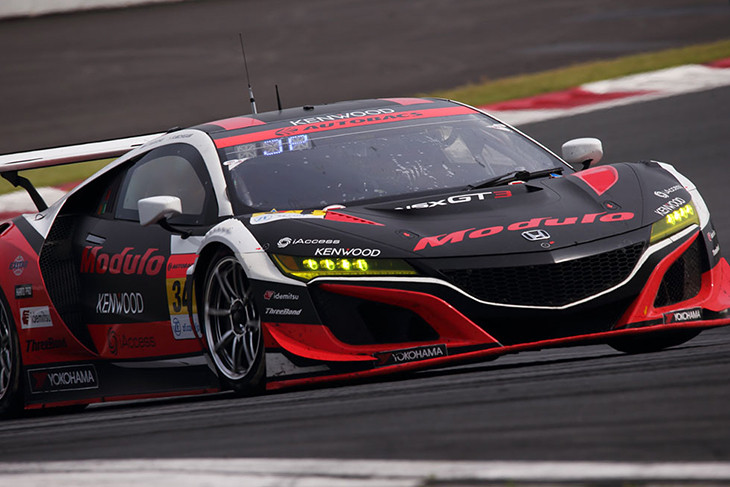
If Parsons had any apprehensions about whether or not the NSX GT3 Evo would live up to his expectations as a childhood NSX fan, those apprehensions were quelled in the first official preseason test at Okayama International Circuit. “It’s been the best GT car I’ve driven for sure,” says Parsons. “The first test really blew me away, at the back straight in Okayama, we were consistently braking as we turn in off the back straight, which was never a possibility in any other cars that I’d driven before. Obviously, it’s been a couple of years since I did Super GT the first time, but the performance felt really nice, and overall, it’s just been a very user-friendly car as a driver. I’m not really fighting with it to be fast, it can be fast and feel quite good.
“Part of me was like kind of relieved, because I thought, ‘oh, I hope this NSX feels as good to drive as it looks and how much I like it,’ and it’s been able to do that. As a fan of the car, it’s been very satisfying. And then as a racing driver, I’ve been very happy with how good the race pace is. The car is really good on tyres and keeps its consistency very well. So that’s really important, too, especially in Super GT when you’re doing longer stints, this car lends itself well to that endurance style of racing.”
One thing that Parsons says has helped him out in his second season is being more familiar with the circuit thanks to his experiences in All-Japan F3 and Super Taikyu in between stints in Super GT. “I’ve been able to understand the circuits a bit better. Being able to continue to acclimatize to the environment and the culture, it’s been quite good,” Parsons says. “I think the fact that I’ve been able to drive different styles of racing cars for three different seasons gave me the chance to take three different approaches to every circuit. So I think I’ve really got a nice kind of gauge on how to get the most out of the circuits. It hasn’t been a case of just rinse and repeat every season, we’ve been taking different approaches, where we’d go, ‘alright, let’s make Autopolis work for me in a TCR, and then the next year, let’s make it work for Super GT.’ I feel like I know the tracks here inside and out as a result of that.”
Being able to learn the tracks was especially helpful during his All-Japan F3 campaign in 2018, where Parsons and his NODA Racing team were, quite literally, the only entrant in the National Class sub-category all season. He may have not had any wheel to wheel competition, through no fault of his own, but Parsons says that campaign was helpful for him to build a consistent approach. “I really got to nail consistency as a driver, because at that point, the way I could really show any performance, I guess was in my lap times – and we were able to set some lap records that season as well. Building that consistency over the race, because it’s such an important factor – that was like a big focus for me. So I think they’ve been very productive years.

“I guess, coming to Japan, you always want to go in a straight line up the ladder. But it’s not always the case, like with racing or with anything. And these opportunities gave me chances to just learn new skills that weren’t necessarily on the radar to start with, but they’re paying off now. So it’s been a pretty cool couple of years.”
With the winter off-season now underway, Parsons is now trying to figure out his plans for 2021. He came in this season to replace young Japanese driver Hiroki Otsu, who got the call up from GT300 after two seasons, to race in GT500 with Honda. The question is, could Jake Parsons make that same step up to the premier class of Super GT in the near future?
“Yeah, I mean, that’s been the goal from the start really.” Parsons says of his future plans. “Super Formula, GT500, that’s been my target really ever since 2014. And we’re moving closer and closer to it.”