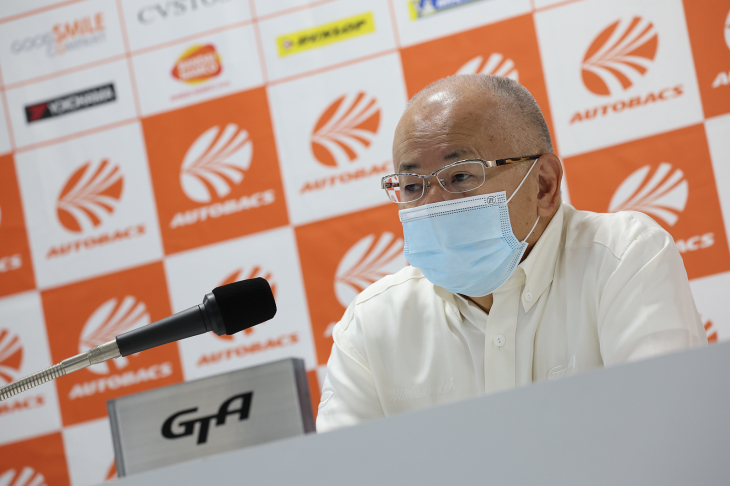
Before the seventh round of the 2021 Autobacs Super GT Series, GT Association (GTA) Chairman Masaaki Bandoh delivered his regular press conference, to discuss a number of topics. The first of which is the current limitations on the number of spectators, and the prospects of them being eased in advance of the upcoming season finale at Fuji Speedway, on 27-28 November.
The GTA sold 1,000 additional tickets to individuals who have been fully vaccinated and provided proof of a negative PCR test upon arrival, at the request of the Japan Sports Agency, who are currently conducting studies to see what effect that the interaction between vaccinated and non-vaccinated people at a sporting event would have on the event itself.
These vaccinated individuals would also receive a certificate that would allow them to leave the stands and potentially interact with non-vaccinated individuals.
On this development, and how it could impact the number of spectators that could come to the last round at Fuji, Chairman Bandoh commented: “We are in discussion with the Japan Sports Agency, but even if we set up some ways for to prove negative, such as a PCR test or COVID-19 vaccination, circuits are outdoor and there is always a possibility to be in close proximity with people who cannot prove negative. Therefore, it is difficult to clearly define the meaning of ‘certificate’.”
“So, at the final round at Fuji, only the people with negative certificate of antigen test and vaccination will be allowed to enter the paddock. For spectators, this will be discussed with the circuit and we need them to do anything they can do under their control, but we will ask them to make sure checking will not get ineffective. JRP (Japan Race Promotion, promoter of Super Formula) made an announcement on ‘SF NEXT50’ the other day, and we will be discussing with JRP on how we can cooperate.”
This then led to discussions of renewable, ‘carbon neutral fuel’ that was discussed in the regular press conference at Autopolis just two weeks prior, and allowed Chairman Bandoh to further elaborate on the development and his views of the potential of this new technology.
“Carbon neutral fuel was also mentioned in the [Super Formula] announcement, and we are checking on the procurement process – including what kind of fuel will be procured and who will supply it. But, obviously, I think Super Formula will be using the same fuel. As far as the procurement goes, the GTA will be responsible, and we will deliver it to the circuit for each race.”
“It is called ‘carbon neutral fuel’, but, basically, the focus is put on the carbon dioxide emitted during the production process. Instead of adding 10 percent of ethanol to the whole of gasoline like in a conventional way, fossil fuel will not be used in the remaining part, outside of the 10 percent of bioethanol. In other words, the part that was gasoline will be made from something else. Crazy things like this are actually being developed in motorsport from this island country of Japan.”
“The price [of the fuel] will be expensive, because this will be recycling of its own kind, and it could be around 1,000 yen per liter.”
“Development is currently going on to bring the specification of carbon neutral fuel close to the JIS [Japanese Industrial Standard]. The reason for that is we want the fuel to be usable not only in the GT500 class, but also in the GT300 class, as well as in open-wheel car races. By having Super GT at the core as driving force, I believe we can develop an industry.”
“‘e-Fuel’ as new gasoline is hard to define, so we refrain from calling it that for now. In the future, we want to develop synthetic fuel made with carbon dioxide itself, and hydrogen created with renewable energy and call that ‘e-Fuel’, but what we are looking for right now is not its ‘definition’ or ‘rationale’.”
“We are receiving support from Toyota, Honda, and Nissan, so we can all together think about something real and feasible. I hope that our industry – the automobile industry, which is the fundamental industry of Japan – creates something firm and right, and, by setting that as the definition, have the fuel eventually produced in Japan. We are putting in all the effort so that the fuel can be developed in the arena of motorsports, and that’s where we are right now. We believe it is important to first trial this extensively in motorsports, and gather as much data as we can.”
“What I can say clearly now is that we have expressed our intent to use this. It is unfortunate that Japan cannot create it yet, but I believe that our work could change the fuel in Japan. To do what we can do, without losing the sound of the engines and smell of gasoline. We will try to eliminate the emissions of carbon dioxide as much as possible in order to accomplish that.”
“We will continue to put our effort in technology development, with the hope that the Japanese motorsports can play a pivotal role in the fundamental industry as well as in sales, promotion, and marketing strategy.”