

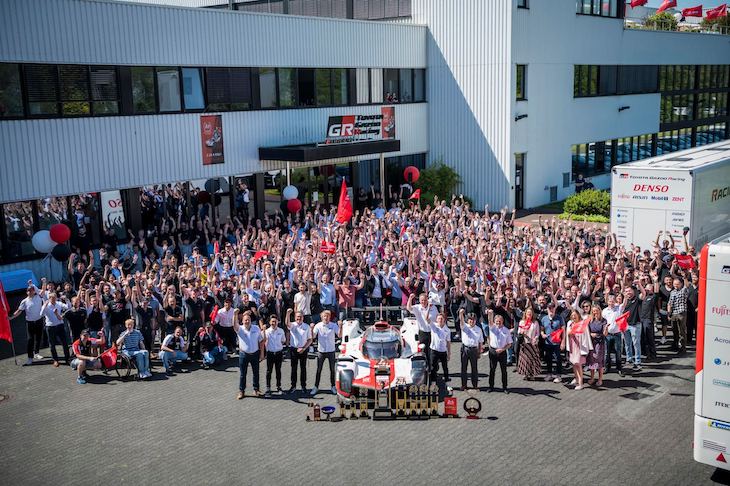
The victorious Toyota Gazoo Racing squad were welcomed back to their Cologne base by the whole staff.
After two 2022 WEC races that featured a Toyota dnf (an accident for the #7 at Sebring, a hybrid system failure for the #8 at Spa), the GR010 Hybrid cars put in a near fault-free run at Le Mans.
With issues for the cars behind the GR010s had a significant advantage going into the night hours, so much so that Sebastien Buemi was vocal on radio communications that the sister car, then in the hands of Mike Conway, was pushing needlessly hard.
The sole issue that hit either car came on Lap 256 for the #7 car, José Maria Lopez pulled the car to the side of the track from the lead with an issue relating to the front motor.
After a system reset he was able to return to the pits, where further resets solved the issue, the #7 back to normal racing speed, albeit nearly a lap behind the new leader
As it was the pair came home one-two, both on 380 laps completed and five laps clear of the third-placed #709 Glickenhaus.
That means Toyota Gazoo Racing has now scored five consecutive overall wins, equalling the records of Audi from 2004-08 and 2010-14 with only Ferrari (6 wins from 1960-65) and Porsche (7 wins from 1981-87) having more consecutive victories. Both will be in the field next year trying to prevent Toyota from adding to their tally!
All bar one of those five have seen Toyota finish one-two, the exception being in 2020 when Rebellion came home second.
The Le Mans result, and additional points therein, see the World Drivers Championship tighten up considerably with just 20 points separating the four full-season crews with three races to go.
Toyota’s #8 crew still trails the Alpine Endurance Team trio, but now by just three points – 81 to 78.
Olivier Pla and Romain Dumas sit third on 68 points with the #7 Toyota crew on 61.
There are 91 points still available!
Toyota leads the manufacturer’s championship with 103 points from Alpine on 81, the French team losing the lead after their Le Mans performance. Glickenhaus are on 69.
David Heinemeier Hansson was tweeting in the early part of the week with a comparison, driver by driver and class by class of pace.
That showed very clearly that the Toyotas had a significant pace advantage over both the Glickenhaus and Alpine attacks – and the pace stayed throughout the race for the GR010s with the fastest lap of the 24 Hours falling to ‘Pechito’ Lopez on lap 371 – a 3:27.749
HYPERCAR drivers ranked by top 20 fastest laps average at #LM24. Glickenhaus was missing ~1.3s of pace on this stat to be competitive with Toyota. pic.twitter.com/Px3Zxh3GmZ
— DHH Racing (@dhhracing) June 13, 2022
The second consecutive 100% finishing record from the Hypercar class contributed to a record number of finishers – 53 from the record number of starters – 62, the maximum number possible since 2019 had not, until this year, been reached after the withdrawal of the #99 Proton Porsche in 2019, a COVID-impacted 59 car entry in 2020, and the withdrawal of the #17 IDC Sport car after a practice accident last year.
With thanks to @WECData on Twitter, Alex Harrison brings further nuggets:
The past seven Le Mans have seen different teams finishing third:
2016 – Audi
2017 – Jackie Chan DC Racing
2018 – Rebellion Racing
2019 – SMP Racing
2020 – Toyota Gazoo Racing
2021 – Alpine Endurance Team
2022 – Scuderia Cameron Glickenhaus!
Alex also points out that the winners finishing time of 24:02:07.996 makes the 2022 Le Mans the longest WEC race so far (75 races have been held since 2012)
Scuderia Cameron Glickenhaus
Glickenhaus finished a fine three-four with their pair of SCG 007 Hypercars with the #709 of Franck Mailleux, Richard Westbrook and Ryan Briscoe taking the podium finish.

That performance marks the first time a non-full season FIA WEC car has reached the podium since the victory by the Porsche of Tandy, Bamber and Hulkenberg in 2015.
It is the first US-flagged podium finish since Champion Audi won overall in 2005 and the first US marque to finish on the podium since Ford’s last overall win in 1969.
The delay for the #708 car after a spin and contact with the barrier, saw the car in the garage for just under 7 minutes for front bodywork, rear suspension, and rear bodywork changes.
The car fought back from 19th to 4th with Olivier Pla putting in the third fastest lap of the race late on, though the cars were not able to match the consistency of pace of the Toyotas ahead.
That garage visit was the first and only time that a Glickenhaus has been delayed in the Le Mans 24 Hours in two x two-car efforts (with the exception of a change of nose section on pit lane after a lap one clash in 2021)!
That in itself is a remarkable statistic.
Alpine Endurance Team
Hobbled somewhat by a late BoP change that saw the #36 car lose some 16 bhp, a decision which surprised many with some observers citing either politics, or the possibility that the team were hiding some ultimate performance in the run-up to the race, the ALpine struggled from the start to stay with the Hypercar pack, making heavy going of getting by a gaggle of fast-starting LMP2s.

The car hit trouble with the electric clutch control unit, losing 13 minutes and then more with an ignition coil issue (losing another 7 minutes).
Still trying to push on there was a late-race brush with the barriers that left the #36 to finish a lowly 23rd place. Not the finish the team wanted for the final appearance at Le Mans by a car initially designed for LMP1.


