


An Australian developed, South Korean GT car to take on Ferrari, Aston Martin, Corvette and Porsche at Le Mans.
Not, on the face of it a programme that anyone would have put a lot of money on succeeding, and it didn’t, but it was the first attempt to put the Hyundai brand onto the world stage in endurance racing.
The Hyundai brand has now progressed with success in the TCR arena, and with the parent company looking hard at the opportunities on offer rather further up the feeding chain!
Spool back more than a decade though and things were very different, aside from rallying, Hyundai was simply not seen as a sporting brand, their GT offerings for the road had been somewhat tame.
Enter the 2009 Genesis Coupe, a larger GT car than the company had marketed to that point with turbo 4 and V6 engines.
Motorsport efforts started to emerge with a rather more relevant platform, a number of tuner conversions for production-based racing plus Formula Drift efforts, including factory-backed programmes.
Rhys Millen had an association with the brand that included record-breaking runs at Pikes Peak, the car powered by a highly tuned version of Hyundai’s ‘Tau’ V8 engine.

And that was a mechanical platform that Aussie outfit Austech saw as having potential for a multi-class-relevant development of the car with versions designed for GTE, GT3 and the then-current Grand-Am GT with the Genesis determined as having potential as a low cost and flexible platform.
The Austech in-house developed V8 was seen too as having racing potential beyond GT racing in LMP2 and the then-current Daytona Prototype formulae too.
Their GT programme was based around the 2012 version of the car.

“When we started this project our objective was to design and produce a range of race cars that would be good customer cars. That is to say, cars that could be purchased by privateer racers, used in multiple categories with minimal changes, that were also cost effective to run and maintain,” said Austech in introducing their project.
That would see the V8 prepped in states of tune from c.450 bhp of Grand-AM GT to c.550bhp for GTE.
The project would be initially proposed and undertaken without any direct Hyundai investment or involvement, though there is little doubt that the intention was to draw their attention to any future potential collaboration.
That approach would though be the project’s downfall, as, in common with the current rules of homologation, the brand’s approval for both GT3 and GTE programmes would be required, and would not appear.
Whatever else the shortcomings of the programme might have been, in engineering, and in finance, its failure to attract the documentary support of Hyundai would be the final blow to their aspirations after some two years of R&D.
Super GT GT300
The Austech effort was followed by another attempt to bring a GT race version of the Genesis Coupe to the track, and remarkably, it targeted yet another different ruleset!
With Super GT set to visit South Korea in 2012 Korean team, Indigo Racing spotted an opportunity to bring a home brand to the show and presented their plans, accompanied by a rough reworking of an old Toyota Supra JGTC car as a concept show car.
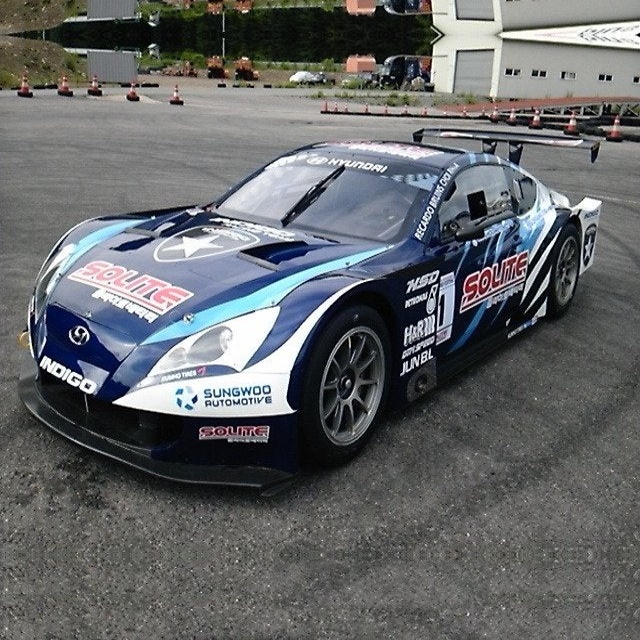
The idea was to build the car on the then new mother chassis concept. But without backing emerging for the project it went no further than a couple of appearances for the show car at PR events.


