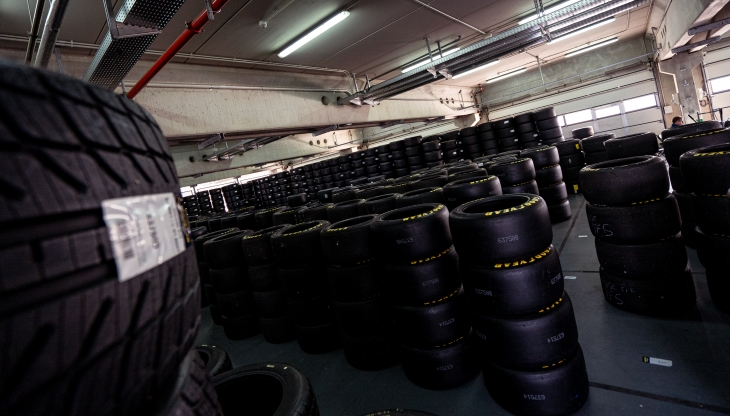
It doesn’t hit home until you see them all in one place. Only when you open the door to Goodyear’s garage at a development test and get a first glimpse of the stacks of tyres that stretch as far as the eye can see, does it become clear just how much expertise, time and resources go into developing a new race tyre.
A double garage filled to the brim with unused rubber was what greeted DSC at Aragon back in May, when it attended the second of Goodyear’s string of major LMGT3 development tests to gain insight into the process.
Tyre testing is not the work of a single weekend for Goodyear, or for that matter, any manufacturer tasked with developing new race tyres. This is a lengthy process. For Goodyear, work has been going on behind the scenes all year and will continue until the winter, when the tyre specs are frozen ahead of the 2024 season.
Goodyear is putting so much weight behind this because being awarded the LMGT3 category tyre deal was of utmost importance. With Michelin supplying Hypercar and the FIA WEC reducing to two categories next year, ensuring it had a presence in the new GT class was vital. With no open door in IMSA (with all categories supplied by Michelin), this secured its future in elite-level sportscar racing.
The challenge of developing and testing new tyres in less than a year is enormous. Creating a tyre that works well for all of the 10 plus GT3 manufacturers that could enter cars in the FIA WEC and ELMS requires a lot of resources.
The tyres also need to meet the criteria outlined by the FIA and ACO (in coordination with Goodyear and Michelin) in its forward-looking ‘tyre road map’, making for a complex operation.
The aim is to produce a tyre that can run from cold (without tyre warmers), displays good performance, is effective for pro and amateur drivers and can double stint on Grand Prix circuits and triple at Le Mans.
Thankfully, Goodyear can draw from decades of experience developing GT and LMP tyres, where the goals have been similar.
“Look at the 24-hour races recently, at the end of the race the teams in LMP2 are close and racing each other, with a single specification that can do five stints. I believe we can hit the same targets in GT and keep the same level of racing,” Goodyear’s endurance programme manager Mike McGregor told DSC during a sit down at Aragon.
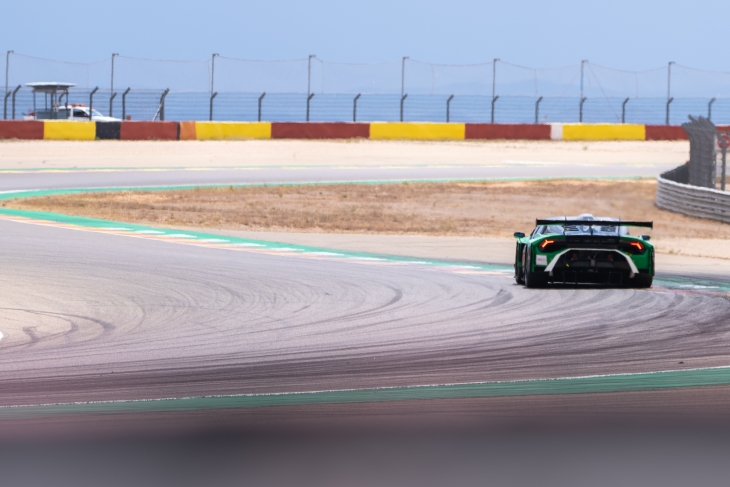
To get ahead of the curve, in anticipation of being granted the contract to supply LMGT3, Goodyear began working on 2024 tyres at the start of this year and had already tested on track before the official tyre contract announcement was made in April.
The first stop was Vallelunga, before the test DSC was on-site for at Aragon in May. Further tests will follow, including one in August at Paul Ricard and a provisional opportunity in October, before a final test open to everyone with the frozen homologated tyres in November at a yet-to-be-determined location.
So how does it all work?
Look at the 24-hour races recently, at the end of the race, the teams in LMP2 are close and racing each other. I believe we can hit the same targets in GT
“We start with a few concepts that we want to evaluate,” Joao Coelho, Goodyear’s manager of motorsport testing & track support explains. “At the first test, you then filter some out. Then you take the ones you see with potential and expand on them at the next test, bringing sets based on that, with additional fine-tuning.
“During the first track test you eliminate the ones that aren’t as promising, the ones that are well received get expanded on so you give yourself different combinations to work with going forward.
“Then at the final test, we will decide what we want to go racing with.”
The overarching process, on paper at least, may sound simple, but the reality is that a military-grade operation is required to ensure that no time or resources are wasted. A huge list of technical and logistical work is completed before anyone even arrives at a circuit and leaves the pitlane with the new tyres fitted.
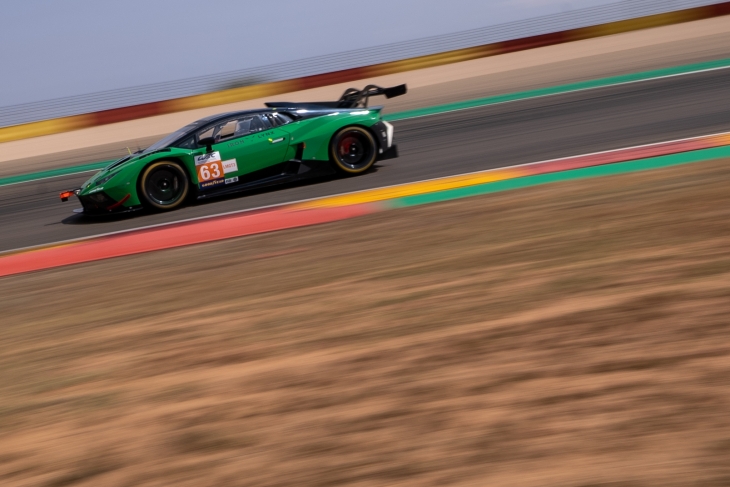
 At Motorland Aragon, the week before Le Mans, Goodyear was joined by representatives from Porsche, Lamborghini, Ferrari and a fourth GT3 manufacturer that wished to remain anonymous. Each manufacturer brought a single car (set up using SRO’s BoP values) and a nominated test driver (to give an idea of the level of talent, Richard Lietz and Daniel Serra, were present for Porsche and Ferrari respectively).
From Goodyear’s side, a band of 40 engineers were on hand to direct the process, led by Mike McGregor and Joao Coelho.
From that group, each OEM was assisted by two dedicated Goodyear track support engineers, one vehicle dynamics engineer, and one R&D engineer, all working independently for their manufacturer.
Consistency is key throughout the process, so Goodyear has tried where possible to ensure the same drivers and engineers are being paired up throughout testing.
Over the four days of track action (where two layouts of the circuit were used), the job list for all in attendance was huge.
You start with a baseline, which in this case has been the current ELMS GTE wet and dry tyres. Why the GTE tyres and not its Nürburgring-raced GT3 products? Goodyear feels the GTE works well with a variety of platforms and weight distributions. The GT3 tyres it uses at the Nürburgring were developed with specific partners and are managed by Box 1 regulations. However, learnings from that programme have been directly relevant in creating the new prospective LMGT3 specs that have been out testing.
In Spain, it was immediately clear why having a strong baseline is so important. With 36 tyre specs to test at Aragon, a good reference point was needed in order for Goodyear to understand the strengths and weaknesses of each new compound and construction it was working with.
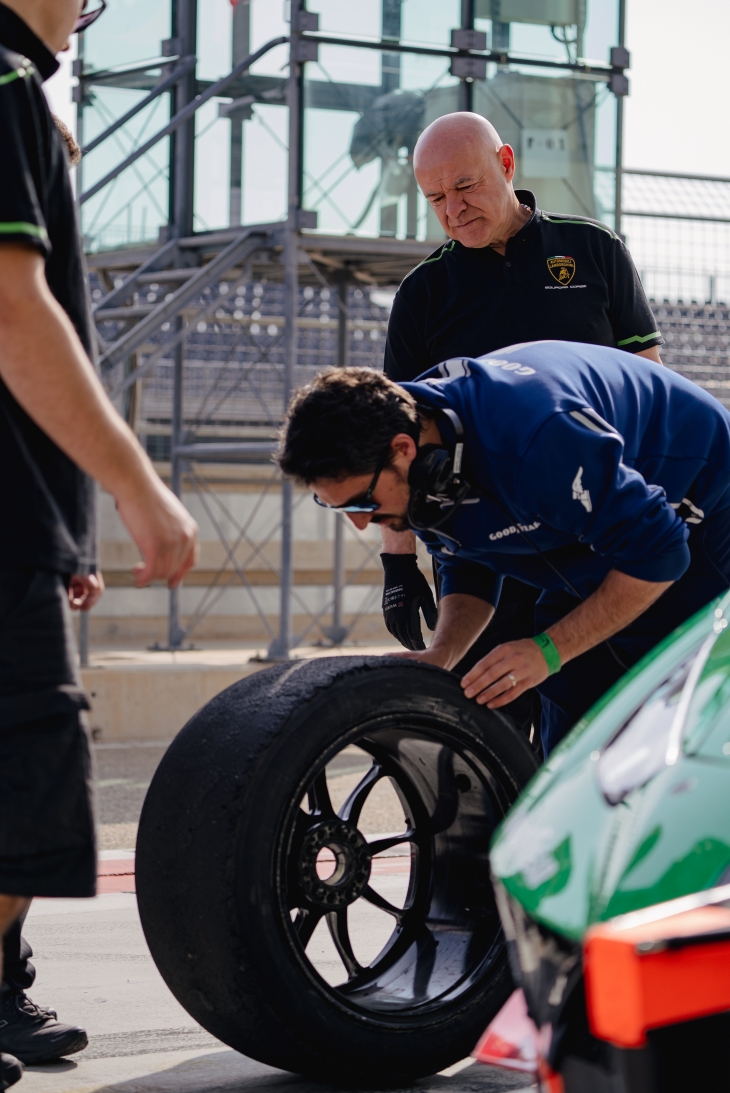
Another essential aspect to get right when tyre testing is the methodology. At a development test, each invited manufacturer is given multiple batches of five to six tyres to sample throughout the day. Goodyear’s engineers know which is which, but the test drivers go in blind. This ensures that the feedback Goodyear receives is as unbiased as possible.
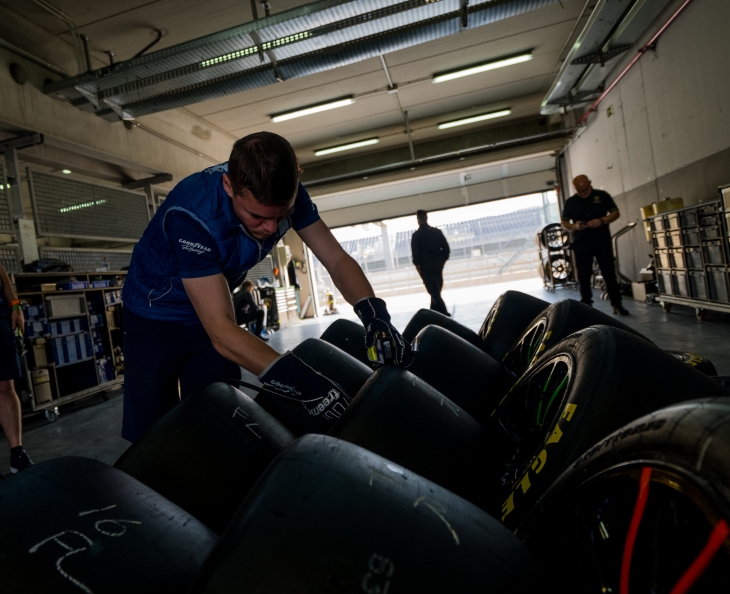
“We won’t tell the drivers in advance what they are testing. We won’t say if it’s a compound or construction group. It’s not to test them or trick them, we just want their honest, unbiased feedback of how they feel driving the car,” explains Joao Coelho.
The first part of the day sees each manufacturer receive a batch of five to six specs. After a run on the baseline tyre, drivers then take each new spec out for short stints, an out-lap, five flying laps and an in-lap.
When they get out the car, the drivers are given a detailed feedback form where they are asked to rate each aspect of the tyre and compare it to the baseline. Additional detailed verbal feedback is also taken down.
“They all expect a baseline to start, but we sometimes throw another baseline at some point during the day,” Coelho adds. “Again, not to trick them, but to get them to evaluate track evolution during the day.
“Temperatures, wind, sunlight, it all changes and has an impact. By doing that we can re-centre where the baseline is.”
The sheer amount of information Goodyear is left to trawl through when the testing finishes is mindbending. It takes weeks to get through it all. Driver feedback is only one element, the data gathered from each car is just as important and even more complex to decipher. Data is shared freely between Goodyear and the manufacturers, to ensure they can gather as much knowledge about each concept as possible.
“We have lap time information, car data information and we will spent weeks after the test putting all the information together,” says Coelho. “From there we can work out which ones we want to carry forward to the next test and which concepts we want to evaluate again.”
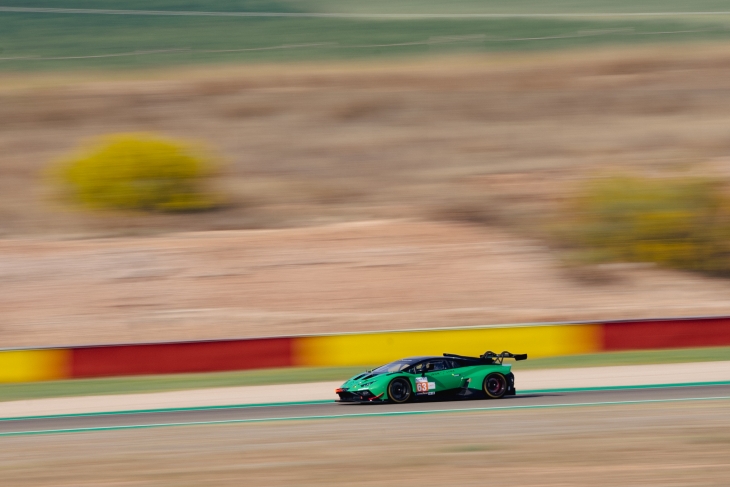
For a driver, tyre testing is not an easy task either. It requires egos to be left at the door, as lap times do not matter.
Instead, the most effective test drivers have the ability to produce consistent lap times and translate everything they’re feeling into cognisant feedback. For some, this comes more naturally, for others it can be extremely tricky to compare minor differences between tyre specs and provide useful first-hand information.
“You have to be honest. It’s just your interpretation of what’s happening with the car,” one test driver at Aragon who wished to remain anonymous, told DSC.
“You’re always having to think about comparing each of the specs to the base tyre. Does it understeer more? Is it better at high speed? What is it like on entry? That gives them what they want. They can then marry that up with the lap times.
“Five or six laps of running usually gives you a good idea of the tyre. When you get used to it, it’s a really good experience, and valuable for a driver too.
“Sometimes you’re testing tyres that are nearly identical, where the lap time difference is only a tenth or two,” the driver continued. “Sometimes you get a few curve balls, where you get tyres that are built for longevity, and the difference can be seconds per lap.
“You just push 100 per cent every lap, if you can do that then you will find the differences. You have to flick a switch and around each lap work out how you’re having to approach each corner to stay at 100 per cent. You’ll realise in your mind, ‘Oh I was flat through that corner before’ or ‘That snapped on exit, that’s new.’
With data alone, you cannot understand the feeling the tyres give you
“That feeling we get as pro drivers is invaluable to tyre engineers. You can look at two lap times that are identical, but only we know how we achieved that. One of the two laps might have been a lot harder to nail.
“With data alone, you cannot understand the feeling the tyres give you, which is imperative when designing a tyre that amateur drivers or even less experienced pros will use.”
Goodyear also has to take into consideration that every driver performs differently and has varying preferences. This is why having a variety of drivers on hand at each test, and not just using one or two, is the most ideal solution.
“It’s important to not go too far down one direction with the tyres, as every driver feels differently and knows what they want,” adds Coelho.
Then comes the second part of each day, where each manufacturer’s staff, their driver and their dedicated Goodyear engineers decide which tyres are good enough to be tested on long runs.
The longer runs then give an even better indication of which tyre specs are most suitable. It’s all about whittling down the number of tyres that should be further tweaked and developed ahead of the final homologation, which in this case, will take place around November time.
But the DNA for tyres that don’t make the cut for the long runs are not necessarily dismissed entirely.
“After the test, we will look over the data and it may be that we create new specs using one tyre’s compound, the mould of another, and the construction of another, to get the best of multiple specs,” Coleho says.
“We may take two tyre specs that work well and blend them together if both of them work well on an individual car. The evolutions could be in construction, like the inside of the tyre walls.”
This is why the hard work really takes place between tests when Goodyear works on a new set of specs using learnings from previous runs. The tweaked and improved specs are conceived, then manufactured rapidly in Germany and undergo a series of checks before being handed over to drivers on the next test. This includes high-speed safety tests and simulator runs using Goodyear’s own facility, which has detailed models of each GT3 car.
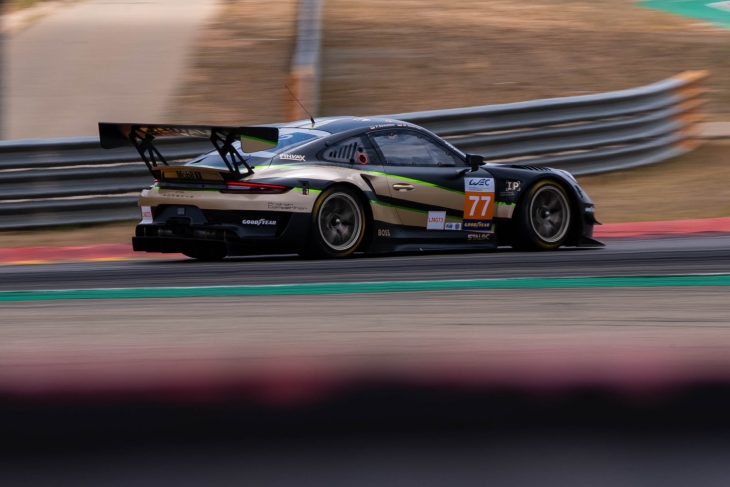
For the 2024 LMGT3 tyres, are still significant milestones to come. For instance, no front-engined GT3 cars have yet tested with Goodyear. However, this is set to change at Paul Ricard over the summer, with Ford believed to be sending a Mustang to test ahead of its planned 2024 WEC programme with Proton.
Corvette has also told DSC that it plans to run its new-for-2024 Z06 GT3.R on Goodyear tyres before the final homologation.
No Bronze or Silver-rated drivers have had a chance to sample Goodyears either. But this may change at Ricard too.
Furthermore, a major aspect that hasn’t yet been decided is the number of homologated compounds that will be used in competition. DSC understands that a decision on whether or not a single dry and wet tyre will be used in the WEC and ELMS, or whether there will be multiple specs for use at different circuits, has yet to be made.
Once frozen, the tyres are locked in for three years, so getting this right in time for Year 1 is critical. None of this is an exact science, the expertise of Goodyear’s staff will go a long way in determining just how well-received its tyres are when the WEC field comes together for the first time in Qatar next March.
Endurance racing is so relevant to what we are doing for road tyres
“This is really important for us,” Mike McGregor told DSC in summary. “You look back to when we came back to endurance racing with Goodyear in 2019 in LMP2. Endurance racing is so relevant to what we are doing for road tyres. Look at GT3 cars and look at what people are taking on track days, it’s very current and relevant to GT3 race cars.
“This programme is not only exciting because we enjoy going racing, but it also gives us knowledge on how to develop a product. If you look at the compound development of what we’ve done within LMP2 and GT in the past, it’s got a track record, it’s directly relevant to the Goodyear road tyres that people are using. For instance, our GT3 RS Porsche compound was specifically developed at the race track, on race cars.
“We are taking this extremely seriously. We want to do this the right way and put everything into this.
“It’s going to be an exciting few years.”