In the last two months Ford has revealed three brand new Mustang race cars, a GT3 and GT4 model and (just last night) the Dark Horse R, which will predominantly be used for its forthcoming single-make series on the IMSA bill. Add that to the Mustang’s current presence in NHRA, Supercars and NASCAR and it’s clear that going forward, Ford’s iconic platform will form a major part of the ‘Blue Oval’s’ wider motorsport strategy.
In conversation with DSC earlier this month, Mark Rushbrook (below, pictured), the global director of Ford Performance Motorsports, was keen to discuss the role of the Mustang in its on-track activities going forward and answer some key questions about the US giant’s medium to long-term outlook.

Behind the scenes, Rushbrook explained, Ford considers most of its involvement in motorsport as a cyclical process. Evidence of this can be found as recently as 2019, when the Ford GT GTE programme was wound down four years after its Le Mans-winning debut campaign, with no immediate plan to build and race a new car to replace it in IMSA or FIA WEC competition.
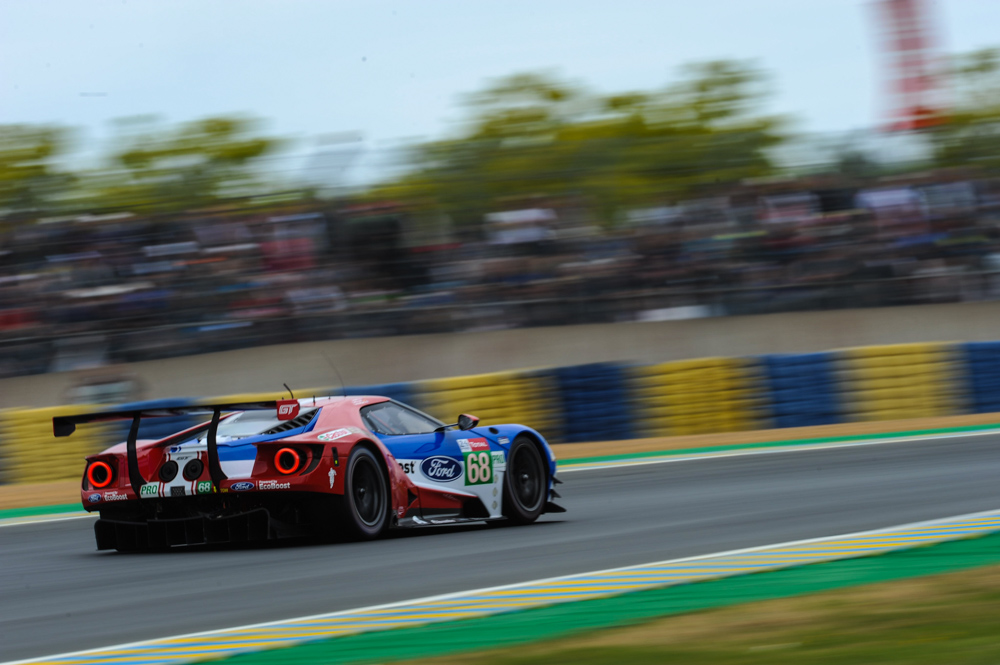
Unlike its long-term commitments to rallying, Australian Supercars and NASCAR, Ford hasn’t felt the need to be wedded to sportscar racing, despite its heritage at events such as the Le Mans 24 Hours. Instead, it has felt that the best way forward has always been to wait for windows of opportunity to arrive before signing off on big-budget programmes.
Right now though, Rushbrook is scaling up the new-look Ford Performance across the board and hopes to deliver success in four defined “cornerstones”. A big part of this is building up its sportscar racing arm and using the Mustang as the foundation.
The fact that Ford has no plans to make cuts in any area in the coming years, even with a hugely expensive 2026 Formula 1 engine programme with Red Bull Racing on the horizon, is particularly encouraging.
The addition of Formula 1 has been a significant add, but it doesn’t come at the expense of anything else
“We always look at all the different opportunities and try and map out at least five years in advance what our plans are,” he said. “We have the Mustang, off-road, Formula 1 and electric demonstrators. They all support each other, it has to make sense for them all to come together.
“I would say that whatever we decided with F1, it still always made sense to have the other three cornerstones. The addition of Formula 1 has been a significant add, but it doesn’t come at the expense of anything else.”
With the GT3 ruleset set to feature in both IMSA and the FIA WEC going forward, as well as the top-end of SRO competition, Ford feels it is the right time to build up a customer racing programme. What it has in the Dark Horse R, GT4 and GT3 Mustangs is a ladder, which can take a track day enthusiast all the way to the pinnacle of GT3 racing and allow teams to compete with Ford at multiple levels.

In the coming years, Rushbrook said he expects customers that go on that journey.
“There will be teams that run multiple cars in multiple classes and drivers that use this to their advantage. There will be teams running the Mustang GT3 and GT4, and there may be some that run the Dark Horse R too. Teams and drivers will climb this ladder.”
Ford is bullish about its prospects because the level of interest in the GT3 and GT4 Mustangs has been higher than anticipated since their reveals. DSC also understands that the number of Dark Horse Rs Ford expects to race in the inaugural season of the Mustang Challenge is particularly punchy too.
There will be teams running the Mustang GT3 and GT4, and there may be some that run the Dark Horse R too
Rushbrook won’t be drawn into specifics at this stage, but he did give DSC some clues as to the level of volume he expects.
“All the cars are sold through our partner Multimatic,” he explained. “We don’t know how many we will sell in total, but at this point, we are only limited by how fast we can build them. We have more orders than we can build initially, but we know we want to be building these cars for the next three to five years. We have a waiting list.
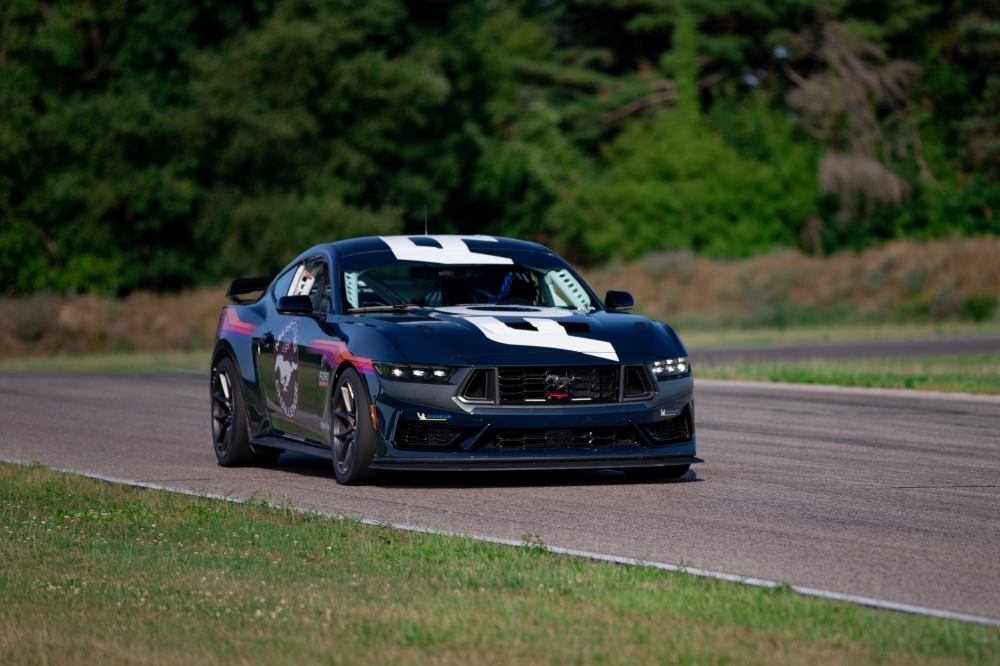
“We have teams wanting to buy three to four Dark Horse Rs for the one-make series already too, and GT4s to go alongside them.
“It’s exciting that our expectations have been exceeded already, but we want to satisfy our customers. It’s important to remember that these cars start in the same assembly plant as every road-going Mustang. They all come out of the Flat Rock assembly plant as a body, some get built into road cars, and others will be built up as race cars.
“Beyond that we are having to ramp up engineering and parts support too. Globally we want to support every customer in this way, and even provide access to our simulators to help them prepare for their racing.”
Was it difficult to find the right price point for the Mustang GT3, the flagship model in this range? It is believed to be priced in the same region as the newest GT3 machinery from Ferrari and Corvette.
“No. The market is there,” Rushbrook replied. “We will sell cars to racers and collectors, though we will prioritise anyone who wants to compete on track.”
On top of this customer programme, Ford also has plans to race as a factory with Multimatic in IMSA’s GTD Pro class. Rushbrook believes this is a valuable marketing-driven component of its plans with the Mustang. It is not a short-term effort specifically being used to demonstrate the car’s capabilities and drum up business.

“IMSA GTD Pro is the only place we can run as a factory full time, and we want to be there long term,” he said.
Looking further afield, adding a fourth rung to this new ladder for a Mustang built to SRO’s growing GT2 platform isn’t currently in the works. Ford is monitoring GT2’s direction of travel, but simply has “too much on its plate” to commit. The long-rumoured Ford LMDh programme is also not on the agenda.
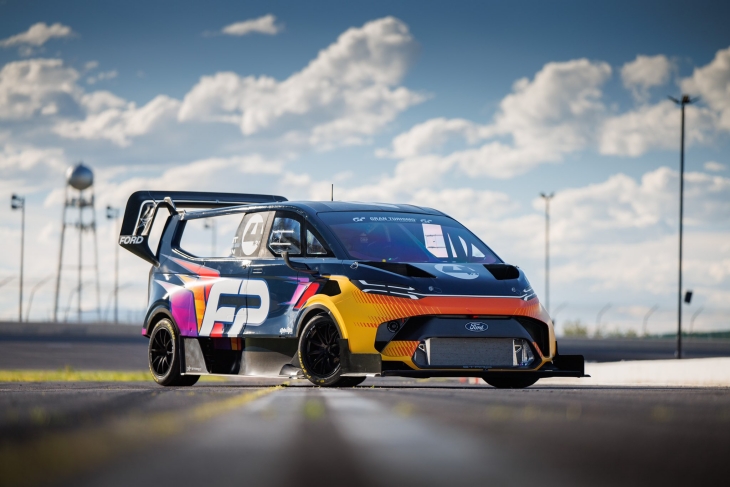
There are no plans to race at a high level with a Ford EV in a championship such as Formula E either. Instead, Ford feels its special projects like the recent Pikes Peak SuperVan 4.2 are “just right” for where it currently is as a company.
Full electric technology is fantastic in terms of performance, but it’s not as engaging as a spectacle, because you don’t have the sound, smell or vibration
“It’s hard because people love motorsports and the natural inclination of series is that we have to switch the technology from ICE to electric,” Rushbrook explained.
“Full electric technology is fantastic in terms of performance, but it’s not as engaging as a spectacle, because you don’t have the sound, smell or vibration. You also can’t suddenly run a fully electric car at the Rolex 24 Hours or at Le Mans right now. If you did you’d spend lots of time charging cars or swapping batteries at pit stops. You don’t want to tell that story about the technology, because it’s a bad story. You can’t force it where it’s not natural.
“With projects like SuperVan 4.2, because we are not entering those into anything, aside from Pikes Peak, we can do what we want and learn whatever we want. So we will keep doing those demonstrators, they work well as a spectacle.
“That’s why Formula 1 came about because of the changes that were being made in the series in terms of increased electrification, with more emphasis on the battery and sustainable fuel.
“To me, the concern is what happens in sportscar racing down the line. For now, Bill Ford has said that as long as we are allowed by regulation to build and sell Mustangs with a naturally aspirated V8, we will, and as long as we can race them by regulation, we will.
“The question is, when will the regulations come along that prevent us from doing that? At that point, what happens to GT3 regulations for example?”
Rushbrook isn’t the only one asking that question. It’s being asked at board level by manufacturers around the world…
Images courtesy of Ford