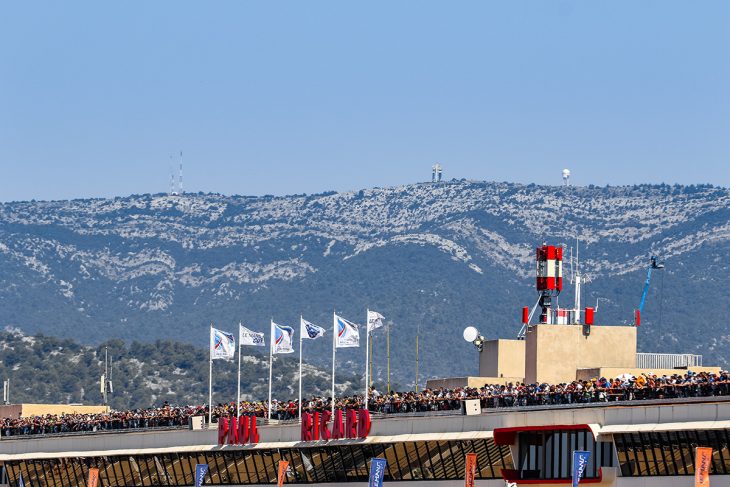
After DSC’s visit to Spa for the 24 and Monza for the WEC’s six-hour race, it was time to focus on the second round of the ELMS season in France, The 4 Hours Of Le Castellet. Once again, the ELMS paddock welcomed over 100 sports prototypes and GT cars when the teams arrived in Le Castellet, with 42 apiece in the ELMS and Le Mans Cup and around 20 additional cars in the Ligier European Series.
There is little doubt at this point that the current ladder system works. Currently, Team Virage and Inter Europol field cars in all three series and there are multiple teams participating in two of them. Look back at recent history and you’ll find plenty of evidence too of teams climbing up to the FIA WEC and using the opportunities that the Asian Le Mans Series can offer during the winter.
Take a stroll through the paddock and it becomes immediately clear that teams are increasingly presenting themselves very professionally; there is barely an untidy-looking car in the entire paddock. For all the reasons above, the changes that are either definitely or potentially coming, need to be managed carefully.
We are now 11 years on from the ELMS melting down in the disastrous 2012 season. So, it’s critically important that any changes made are done with a full understanding of the business cases for this significantly large group in mind.

The coming years look certain to feature major changes for each of the three categories in the ELMS.
The first comes next season when the GTE field transitions to LMGT3. There are concerns around car choice and available numbers of ELMS entries, with significant teams outside the current family expected to try and join. The number is expected to increase from the current GTE levels and Asian Le Mans Series GT3 numbers are expected to be strong too, with some overlap.
If the FIA WEC numbers are as strong as expected and the ACO sticks to its promised LMP2 quota of “at least 15”, then a single-digit number of entries will be available beyond the auto invites from GT World Challenge, ELMS, Asian Le Mans Series and IMSA.

These remaining slots will be filled by teams from additional entries from teams in Hypercar, additional LMGT3 cars and any possible Garage 56 entrant.
In the LMP3 ranks, there are different areas of uncertainty. The 2023 ELMS LMP3 championship winners look set to be the last from the class anywhere, for now at least, to earn an auto-invite to the Le Mans 24 Hours. In addition, numbers in the ELMS look set to be capped at a lower level than is currently the case (circa eight) to accommodate what is expected to be an increase in grid size for LMP2 and LMGT3.
Add into the mix too a looming change of engine for the class to an ORECA-supplied, Toyota-based V6 twin turbo for 2025, and that transition will need to be carefully managed. There was plenty of chatter in the Paul Ricard paddock too of the potential for LMP3’s days being numbered in the ELMS.

Indeed, the perceived outcome shared by many well-established LMP3 teams is that the Michelin Le Mans Cup may, in the short to medium term, transition to an all-LMP3 series. The knock on effect would potentially be GT3 only featuring in the ELMS and LMP3 being made redundant.
If any or all of those changes occur, it is vital to take into consideration both the continued ability of teams to move up the ladder and the benefits drawn from the entry-level on the package having a mixed class format.
There was plenty of chatter in the Paul Ricard paddock of the potential for LMP3’s days to be numbered in the ELMS
The headline LMP2 category has even more transition to look forward to. The current regulations, cars and engines are set to be superseded at the end of the 2025 season.
For LMP2 teams, the ELMS, Asian Le Mans Series and IMSA WeatherTech SportsCar Championship are now their full-season options, with the FIA WEC (aside from Le Mans) no longer available.

In the short term, both the ELMS and IMSA expect to see growth in grid size, whilst the existing packages still provide a good balance between performance and cost. It’s for those very reasons though that the transition to a new formula needs to be very carefully considered.
For the most part, this impacts teams that have no realistic chance of making the leap to Hypercar or GTP. The difference in the level of budget required is of a multi-million Euro scale.
These are the teams, however, that have provided the staircase of talent for drivers, teams and team personnel for the entire ACO rules family for around a decade. There is a fair argument to suggest that without the health of LMP2 since 2017, the current boom in Hypercar simply could not have happened.
The requirement for new chassis and engines in a marketplace that will see fewer opportunities for teams to race at Le Mans in the immediate future is no small step for teams operating often on very small profit margins. The decisions on cost-capping, technology and on the regulations as a whole need therefore to be made carefully and in full consultation with the individuals and businesses directly affected.
Pressure is mounting to address issues of sustainability and environmental awareness across the board
It is well known in the paddock that pressure is mounting to address issues of sustainability and environmental awareness across the board. In particular, there is known to be an aspiration from the rule makers to display “greener” credentials for LMP2. It seems that early discussions about potential mild-hybrid tech have gone away for now, perhaps in part, as a result of experience in the FIA WEC’s top class, where the move to hybrid-powered machinery, particularly in LMDh, has led to costs escalating to a level beyond initial predictions.
If that is the case, then DSC believes that is the correct decision and that initial efforts should rally behind those of sportscar racing’s key suppliers for fuel, lubricants and tyres amongst others to display their green credentials. It’s an area where sportscar racing has led the way but has struggled to get its key messages across. The current boom in popularity for our corner of the sport should help that process.

Looking ahead, the next round at Aragon later this month presents some new challenges. It’s a track that many teams have tested at, but that few (if any) on the bill will have raced at. Quirkily, it’s the first anti-clockwise with a pit lane on driver’s left that the ELMS has visited in a decade. That in itself has meant that some teams have had to invest, for the first time, in the kit to allow their cars to be refuelled on the left-hand side.
Heat is never far from the top mentions of the concerns of teams and drivers. The temperatures trackside at Paul Ricard served as a preview, but Aragon could see another step again. The ELMS at Aragon will run into darkness, but the heat of the day could see conditions for the ELMS, Le Mans Cup and Ligier European Series (the latter two added to the bill after the Imola round’s cancellation) reach blistering levels.
At a recent test for a number of teams at Motorland, the air temperature was at around the 40-degree mark, with the track temperature measured at around 60 degrees.
The weather forecast will be closely monitored, the forecast for the ELMS package meanwhile reads: “Good, but changeable”. That needs a close eye kept on it to ensure that the outcomes are good for the medium and longer terms.